Expert · topic 2
Which exact evidence supports this rule?
Why ask this? An authority homepage is not evidence for a specific conclusion. Record the actual passage and its limits.
Beth uses it for: Citations and source verification
Fictional model answer — use the structure, replace the facts with your own evidence.
- Evidence source type
- Official agency issuance
- Document / issuance title or policy ID
- BIR RMC No. 77-2024 (example of precise source capture)
- Exact source URL, if public
- https://bir-cdn.bir.gov.ph/BIR/pdf/RMC%20No.%2077-2024.pdf
- Section / question / page and short supporting passage
- Q1/A1 identifies invoicing requirements by VAT registration. This is a source-format example, not an approved current Beth tax rule.
- Later amendments or missing checks
- RMC refers to RR 7-2024 as amended by RR 11-2024. Applicability, effective dates and all later changes still require expert verification before release.
Check before continuing: Can a reviewer open the exact document and find the cited support? A link is not a truth check.
Beth 2.0 · expertise collection · 6 October 2026
Give Beth answers it can use.
Start with one founder situation. Explain the work, the decision it changes, the evidence behind it and the limits. This guide teaches the revised collection flow and shows model answers for all 20 topics.
Watch the guided walkthrough
Narrated guide · 11 minutes 46 seconds. The walkthrough uses fictional model answers; it does not present them as approved rules.
The video includes narration and synchronised captions. Use Play with sound to begin, the speaker control to adjust volume, or a chapter button to jump to your role. Model answers for every topic follow below.
Begin with a small, comparable example
1. Create account or sign in
See where to create your account
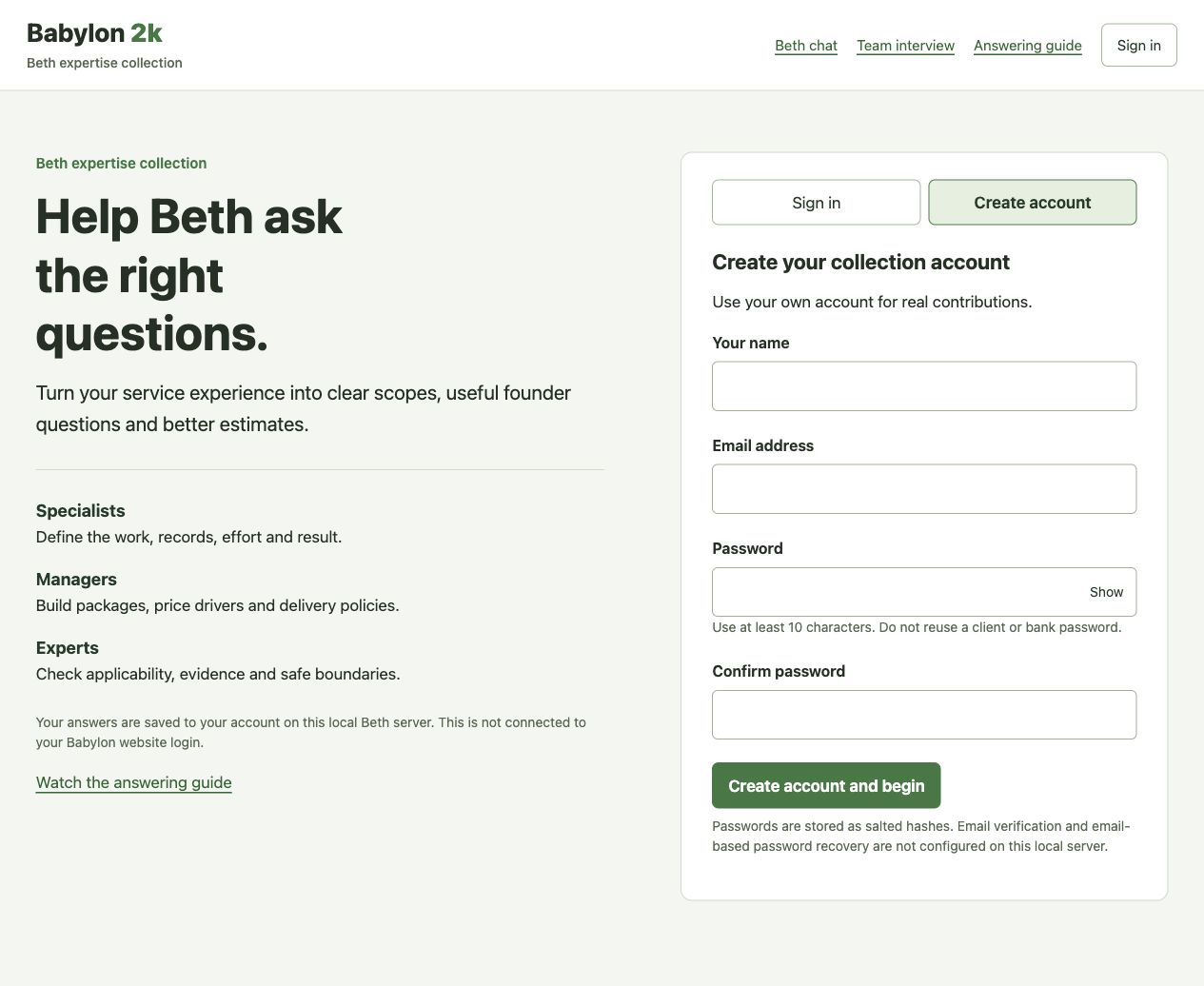
Choose Create account for first use, or Sign in to reopen a saved study.
Use your existing local Beth account, or select Create account and enter your name, email and a password of at least 10 characters. Confirm the password. This account is separate from your Babylon website login. Email verification and email-based password recovery are not configured.
2. Choose one role and one service
Specialist: work and effort. Manager: packages and commercial policy. Expert: evidence and applicability. Create separate studies for other roles or services. A selected role does not grant publication rights.
3. Describe the founder situation
Provide activity, concern, entity, known tax status, covered period and review owner. Use the same anonymised case code across related role studies. Use “Not yet known” when appropriate. Keep client names, tax IDs, bank details and private documents out of the form.
4. Answer what you know; identify what you do not
Choose I can answer, I need to check, or Not applicable. For a gap, name the missing fact, responsible person and next action. Use the model answer’s structure, not its invented facts. “Measured completed jobs” needs comparable job counts and an anonymised evidence reference; an estimate remains an estimate.
Specialist · 8 topics
Define the work before estimating it
What exactly is one unit of this service?
Why ask this? A price needs a bounded unit. Two specialists should count the same work the same way.
Beth uses it for: Service scope and quantity
Fictional model answer — use the structure, replace the facts with your own evidence.
- What is one priced unit?
- One domestic sole proprietor, one month, up to 100 posting events.
- What is included?
- Organise and post 100 sales/expense events; one agreed monthly summary. One posting event is one underlying business transaction, not each debit/credit line.
- What needs a separate job?
- Bank reconciliation, tax returns, prior-month cleanup, payroll, audit and official-notice work are separately scoped.
Check before continuing: Can another colleague count one unit without asking you what “standard” means?
What did a comparable completed job actually take?
Why ask this? Separate observed productive hours from waiting days. An estimate stays an estimate until supported.
Beth uses it for: Effort range and delivery cost
Fictional model answer — use the structure, replace the facts with your own evidence.
- Anonymised job reference
- TRAINING-EXAMPLE-001 (fictional)
- Work units in that job
- 1
- Delivery hours
- 4
- Reviewer hours
- 1
- Coordination hours
- 0.5
- Working days from ready records to completion
- 3
- Comparable jobs behind this answer
- Not confirmed — explain the gap
- What made it quicker or slower?
- Clean spreadsheet with 80 events. Missing invoices would require a separately bounded cleanup; 4 hours is illustrative, not a measured median.
Check before continuing: Do the hours describe the exact unit in topic 1, and is the evidence basis honest?
Which founder answer changes the amount of work?
Why ask this? Beth must collect facts that affect scope rather than ask for information simply because it is available.
Beth uses it for: Founder profiling and price drivers
Fictional model answer — use the structure, replace the facts with your own evidence.
- Ask the founder in plain language
- About how many sales and expense transactions do you have in a usual month? A rough count is fine.
- Which fact does this answer establish?
- Monthly transaction count
- Answer → action
- Up to 100 events → one BK01 unit. Above 100 → BK01 plus BK02 blocks of 100 extra events, rounded upward. Confirm the count during onboarding.
- If the founder says “not sure”, what next?
- Ask whether it is closer to 50, 100 or 300. If still unknown, show a provisional 100-event cap and explain that the confirmed volume can change the estimate.
Check before continuing: If this answer changes nothing in scope, routing or delivery, remove the question.
What can the founder tell us before sending documents?
Why ask this? Readiness checks prevent a low quote from quietly including weeks of reconstruction.
Beth uses it for: Readiness and document checklist
Fictional model answer — use the structure, replace the facts with your own evidence.
- Easy readiness question
- Can you find last month’s sales and expense records, and are they already in one spreadsheet or system?
- Minimum records after scope acceptance
- One month’s sales/expense list and supporting invoices. Statements only for any separately included reconciliation.
- Acceptable substitutes
- Platform CSV exports can support intake; unsupported entries stay flagged rather than invented.
- When work must pause or become a separate phase
- Missing source evidence or an unknown backlog → scoped diagnostic/cleanup before a reliable completion promise.
Check before continuing: Have you separated a quick no-document question from the later secure checklist?
What result proves the job is finished?
Why ask this? Beth should sell an understandable result with acceptance checks, not an accountant’s vague task list.
Beth uses it for: Service deliverable and quality gate
Fictional model answer — use the structure, replace the facts with your own evidence.
- Founder-facing deliverable
- A dated monthly ledger and simple income/expense summary for the agreed period.
- Observable completion checks
- Covered period and event count match scope; unsupported events are listed; reviewer records completion or exceptions.
- Required reviewer role
- Practice lead
- What errors or rework are outside normal effort?
- Correct our posting mistakes within the agreed correction policy. Reconstruct additional missing records only after a scope-change proposal.
Check before continuing: Can the founder and reviewer agree whether the deliverable passes?
Who is qualified and suitable to take this work?
Why ask this? Actual skills and constraints determine matching. A self-description is not credential verification.
Beth uses it for: Specialist eligibility and matching
Fictional model answer — use the structure, replace the facts with your own evidence.
- Services you can deliver
- BK01 · Monthly bookkeeping, BK02 · Extra bookkeeping volume
- Business types / systems you actually handle
- Domestic sole proprietors using spreadsheets; illustrative profile only.
- Cities and remote / on-site coverage
- Remote monthly posting; Cebu visits separately agreed.
- Qualification and verification reference
- No credential is asserted by this example. Roster manager must verify the actual practitioner and any required qualification.
- Work you cannot accept or must refer
- No independent audit or legal opinion; notices and uncertain tax treatment go to the qualified reviewer.
Check before continuing: Would this exclude an unsuitable specialist before they are ranked?
What availability can we responsibly promise?
Why ask this? Online status alone is not acceptance, spare capacity or an appointment.
Beth uses it for: Appointment / handoff policy
Fictional model answer — use the structure, replace the facts with your own evidence.
- Available productive hours each week
- 20
- Working days before a new case can start
- 3
- Callback target, in business hours
- 8
- Backup role and no-reply action
- Manager confirms capacity and a backup practitioner. If live chat is not accepted, retain an assigned callback case; no guaranteed immediate reply.
Check before continuing: Does the promise require an explicit acceptance and a named fallback?
Which conflicts or dependencies prevent acceptance?
Why ask this? Prevent incompatible engagements or a quote that ignores prerequisites.
Beth uses it for: Acceptance / prerequisite gate
Fictional model answer — use the structure, replace the facts with your own evidence.
- What must be completed first?
- Agree covered period and record readiness; resolve old gaps before promising final annual outputs.
- Incompatible work / conflicts
- Preparation and independent audit need an independence assessment; never assume the same preparer can act as independent auditor.
- Who decides the exception?
- Practice lead plus the prospective independent auditor.
- Safe alternative to offer
- Keep preparation separate and obtain a separately accepted independent audit scope where needed.
Check before continuing: Does a blocked case produce a useful next step rather than a silent rejection?
Manager · 6 topics
Build a package the founder actually needs
What founder concern should this package solve?
Why ask this? Work backwards from the business owner’s outcome, then compose the necessary service units.
Beth uses it for: Package selection
Fictional model answer — use the structure, replace the facts with your own evidence.
- Founder concern in their words
- I cannot tell whether last month’s books are complete, and I worry about missing a filing.
- Useful result / successful outcome
- Understandable monthly records and explicitly scoped filing/review support.
- Required service units
- BK01 · Monthly bookkeeping
- Optional services and when to add them
- REC01 when bank reconciliation is needed; separately define its unit and effort. TX01/TX02 only after registration and filing obligations are reviewed; payroll only when employees/pay runs are in scope.
- What this package does not promise
- No unlimited catch-up, tax amounts, penalties, audit sign-off or guaranteed authority response.
Check before continuing: Would a founder recognise the concern before reading the service codes?
How should one unit turn into an indicative professional fee?
Why ask this? Hours, productive role costs and explicit policy create reproducible prices. Scope is priced by software, not guessed by a model.
Beth uses it for: Pricing calculation
Fictional model answer — use the structure, replace the facts with your own evidence.
- Delivery role cost, PHP / productive hour
- 350
- Reviewer cost, PHP / productive hour
- 950
- Coordination cost, PHP / productive hour
- 250
- Overhead allocation, percent
- 15
- Fixed support allocation per package period, PHP
- 600
- Target contribution margin, percent
- 35
- Round upward to this PHP increment
- 500
- Fee period
- Monthly
- Tax treatment, minimum fee and exclusions
- Illustrative PHP professional fee only; government fees, taxes, penalties, travel and paid software separate. Partner minimum and fee VAT treatment still require approval.
Check before continuing: Are role costs, overhead and fixed support each counted once, with an approval owner?
When should a founder move to a different band or added job?
Why ask this? Quantified triggers make quote changes understandable and incremental.
Beth uses it for: Complexity and change pricing
Fictional model answer — use the structure, replace the facts with your own evidence.
- Exact fact and boundary
- More than 100 agreed posting events in the same month; record quality checked separately.
- Additional work unit / quantity rule
- 250 events → one BK01 and two BK02 extra blocks of up to 100; do not charge three full BK01 units.
- Recurring or once-off?
- Recurring each covered period
- How do we confirm the revised scope?
- Show the count, additional units, new fee range and covered month; obtain approval before work outside the accepted scope.
Check before continuing: Is this a real extra unit instead of a vague complexity multiplier?
Where can packages share or credit the same work?
Why ask this? A founder should not pay twice for one service, entity and covered period.
Beth uses it for: Bundle overlap and credits
Fictional model answer — use the structure, replace the facts with your own evidence.
- What makes two lines the same work?
- Same service code, entity, covered period and deliverable.
- Credit / replacement rule
- Replace the monthly base when moving to a broader monthly package; include it once. Credit already completed agreed work only when reusable.
- Evidence needed to apply the credit
- Accepted scope and completion record; a paid invoice alone does not prove the same work was completed.
- Who approves a discount or exception?
- Commercial lead checks partner cost floor and approves the recorded exception.
Check before continuing: Can the calculator reproduce the saving without a discretionary double discount?
How should urgent or changed work be approved?
Why ask this? Urgency must not become an unapproved surcharge or a promise that cannot be delivered.
Beth uses it for: Scope change and escalation
Fictional model answer — use the structure, replace the facts with your own evidence.
- What counts as urgent, and who checks capacity?
- A stated authority deadline or accepted time-critical task; manager and qualified reviewer confirm capacity.
- Required approval before added work
- Written revised units, period, output, exclusions and fee accepted before work starts.
- What client / agency waiting is outside the promise?
- Client missing documents and agency response time are recorded separately from productive effort.
- Case owner and escalation path
- Coordinator assigns qualified notice review; if nobody accepts, callback case stays open with the stated deadline.
Check before continuing: Are scope, amount, deadline and acceptance recorded before execution?
What outcomes will tell us the pricing was wrong?
Why ask this? Do not optimise only for quote acceptance; learn from delivered cost, rework and founder usefulness.
Beth uses it for: Calibration and improvement
Fictional model answer — use the structure, replace the facts with your own evidence.
- Fields to capture after each completed job
- Anonymised job ID, unit/period, confirmed counts, quoted/accepted fees, actual delivery/review/admin hours, rework cause and usefulness rating.
- Who compares estimates with actual outcomes?
- Finance manager and practice lead.
- How often should comparable jobs be reviewed?
- Monthly
- What evidence permits a rule change?
- Review comparable jobs and outliers separately; compare the revised rule with held-out cases before publishing. A job count alone does not prove accuracy.
Check before continuing: Will the data identify which assumption failed, rather than just whether the client bought?
Expert · 6 topics
Make answers checkable and safe
Which founder facts make the rule apply?
Why ask this? Capture a decision table rather than an unqualified rule for every Philippine business.
Beth uses it for: Applicability and advisory routing
Fictional model answer — use the structure, replace the facts with your own evidence.
- Rule category
- Service routing / practice policy
- IF these facts are true
- Founder has incomplete monthly records or cannot quantify the backlog.
- THEN Beth should do / say this
- Explain that reconstruction is separate from a clean-month posting job; offer a bounded diagnostic before confirming effort.
- Exceptions / facts still missing
- Do not infer the filing obligation, tax liability or penalty from record quality. Tax/notice decisions need qualified review.
- Related service units
- BK01 · Monthly bookkeeping, REM01 · Missed filing diagnostic
Check before continuing: Would a change of tax status, year or missing fact change the outcome?
When can this evidence be used, and when must it be checked again?
Why ask this? Store publication, applicability and verification separately so old law cannot masquerade as current advice.
Beth uses it for: Freshness, cache and retirement
Fictional model answer — use the structure, replace the facts with your own evidence.
- Effective-from date, if confirmed
- Not confirmed — explain the gap
- Effective-until date, if superseded
- Not confirmed — explain the gap
- Last check date
- 2026-10-06
- Refresh / withdrawal triggers
- Question-time verification for current legal advice; new/amended issuance retires affected cached answers; blocked authority access triggers verified alternate or review.
- Qualified reviewer and next-review owner
- Named tax expert must accept review; fictional example has no professional sign-off.
- Unresolved dates or source conflicts
- Effective date and amendment completeness not yet confirmed. Search/capture date is not proof of current applicability.
Check before continuing: If dates are uncertain, can Beth still label the gap instead of inventing an effective date?
How should Beth handle an unknown answer or a risky request?
Why ask this? Useful uncertainty handling is better than inventing facts to complete a profile.
Beth uses it for: Unknown route and human escalation
Fictional model answer — use the structure, replace the facts with your own evidence.
- Common founder misunderstanding
- Founder thinks business-name registration proves all tax registrations are complete.
- Next easy clarification question
- Do you also have BIR registration, or are you not sure yet? No document upload needed to answer.
- What Beth must not assume or promise
- Do not infer BIR registration from DTI registration, or promise a penalty waiver.
- Qualified role, urgency and safe next step
- If uncertain, scope registration-status review with a qualified practitioner; notices collect their stated deadline and get prompt review.
Check before continuing: Does “not sure” produce a specific next step rather than an unjustified answer?
What examples should Beth pass before we use the rule?
Why ask this? Reference cases test whether questions, scope and explanations agree; sample completeness is not model accuracy.
Beth uses it for: Evaluation cases and release gate
Fictional model answer — use the structure, replace the facts with your own evidence.
- Simple founder case and expected result
- 80 clean events, one sole proprietor and one month → bounded BK01 scope; related obligations reviewed separately.
- More complex case and expected change
- 250 events → BK01 plus two BK02 blocks; missing records add a separately accepted cleanup phase.
- Uncertain case and expected question
- Only DTI status known → ask BIR status separately; preserve “not sure”.
- Risky / out-of-scope request and safe result
- Guaranteed penalty cancellation requested → no guarantee; offer qualified initial notice review and capture stated deadline.
- What would be an unacceptable answer?
- Inventing source citations, inferring tax status or charging overlapping monthly bookkeeping twice.
Check before continuing: Keep some real comparable cases outside tuning; test them before publishing revisions.
Who may approve, retire or roll back the rule?
Why ask this? Submitted answers are candidates. Publishing needs ownership, evidence review and acceptance tests.
Beth uses it for: Knowledge release and accountability
Fictional model answer — use the structure, replace the facts with your own evidence.
- Accountable rule owner
- Named practice lead, with a qualified tax/legal reviewer for regulated interpretations.
- Review / approval sequence
- Respondent draft → manager checks service/cost logic → expert checks evidence/applicability → authorised publisher signs off.
- Required release evidence
- Source links and dates, agreed service mapping, accepted test cases and change record. This local submission does not provide that approval.
- Retirement / rollback instruction
- Retire superseded rule, invalidate related cache entries, preserve historical applicable versions and rerun affected cases.
Check before continuing: Can a non-programmer trace who approved a rule and why an earlier version was replaced?
What a useful end result can look like
SELLER-MONTH-001 — candidate rules pack
Fictional illustration. No professional approval, measured evidence or live publication.
- Context
- Online clothing seller; one sole proprietor; one month; 80 posting events; tax status still needs review.
- Core scope
- BK01: one month, up to 100 underlying transaction events, posting and monthly summary. Bank reconciliation, filings, cleanup, payroll and audit separately scoped.
- Productive work
- 4 delivery + 1 review + 0.5 coordination = 5.5 hours. 3 elapsed working days kept separate. Zero measured jobs: professional estimate only.
- Illustrative unit fee
- Labour: (4 × ₱350) + (1 × ₱950) + (0.5 × ₱250) = ₱2,475.
Proposed policy: 15% overhead on labour + ₱600 support once per package period = ₱3,446.25.
35% contribution margin: ₱3,446.25 ÷ 0.65 = ₱5,301.92; round upward to ₱500 → ₱5,500 monthly for this stated scope only.
Government fees, taxes, fee VAT treatment, minimum fee and travel require explicit policy. This is not a market norm or approved rate. - Package boundary
- If REC01 or filing support is needed, obtain their units and effort before pricing the combined package. Count shared overhead and support once; do not reuse BK01 hours as evidence for another service.
- Volume branch
- 250 events → BK01 + 2 BK02 extra blocks of up to 100 events. BK02 effort and rates require a separate study. Not sure → ask for a rough band and mark scope provisional.
- Outstanding checks
- Registration/tax status, actual practitioner skills and capacity, supporting measurements, pricing policy, applicable authority and approval owners.
- Test expectations
- 80 clean events → bounded BK01; 250 → two extra blocks; missing records → separate cleanup phase; DTI known only → ask BIR status; penalty guarantee → no guarantee, qualified review.
Check, submit, then give it to the reviewer
Check answers shows captured topics and unresolved items. Coverage does not prove accuracy. Save now checks an explicit save; drafts also save automatically. Record submission preserves a local version. Later edits create a draft while submitted snapshots remain unchanged. Download the structured review pack or print the review. Earlier answers are preserved.
This is working local account storage and collection. It is not a hosted team review portal. The pack is not emailed automatically, and it does not change live answers, train an LLM or publish prices. Give it to the named reviewer yourself.
Reviewer’s next steps
- Group matching case codes, service units and covered periods. Clarify definitions and conflicts.
- Check job evidence, actual role costs, exclusions, independence and capacity. Separate estimates from observed measurements.
- Verify authority passages, effective dates, amendments and business applicability.
- Convert accepted answers into structured service, pricing, matching and evidence rules; preserve the contribution and reviewer references.
- Run simple, complex, unknown, blocked and failure tests; keep some comparable cases out of tuning.
- Approve a version, publish through an authorised production workflow, monitor actual outcomes, and retire outdated rules and cached evidence.
Those production approval and publication steps are requirements, not actions performed by the collection form.
Question-to-use map
| Role / topic | Decision or engine input | What makes the answer useful |
|---|---|---|
| Specialist · What exactly is one unit of this service? | Service scope and quantity | Can another colleague count one unit without asking you what “standard” means? |
| Specialist · What did a comparable completed job actually take? | Effort range and delivery cost | Do the hours describe the exact unit in topic 1, and is the evidence basis honest? |
| Specialist · Which founder answer changes the amount of work? | Founder profiling and price drivers | If this answer changes nothing in scope, routing or delivery, remove the question. |
| Specialist · What can the founder tell us before sending documents? | Readiness and document checklist | Have you separated a quick no-document question from the later secure checklist? |
| Specialist · What result proves the job is finished? | Service deliverable and quality gate | Can the founder and reviewer agree whether the deliverable passes? |
| Specialist · Who is qualified and suitable to take this work? | Specialist eligibility and matching | Would this exclude an unsuitable specialist before they are ranked? |
| Specialist · What availability can we responsibly promise? | Appointment / handoff policy | Does the promise require an explicit acceptance and a named fallback? |
| Specialist · Which conflicts or dependencies prevent acceptance? | Acceptance / prerequisite gate | Does a blocked case produce a useful next step rather than a silent rejection? |
| Manager · What founder concern should this package solve? | Package selection | Would a founder recognise the concern before reading the service codes? |
| Manager · How should one unit turn into an indicative professional fee? | Pricing calculation | Are role costs, overhead and fixed support each counted once, with an approval owner? |
| Manager · When should a founder move to a different band or added job? | Complexity and change pricing | Is this a real extra unit instead of a vague complexity multiplier? |
| Manager · Where can packages share or credit the same work? | Bundle overlap and credits | Can the calculator reproduce the saving without a discretionary double discount? |
| Manager · How should urgent or changed work be approved? | Scope change and escalation | Are scope, amount, deadline and acceptance recorded before execution? |
| Manager · What outcomes will tell us the pricing was wrong? | Calibration and improvement | Will the data identify which assumption failed, rather than just whether the client bought? |
| Expert · Which founder facts make the rule apply? | Applicability and advisory routing | Would a change of tax status, year or missing fact change the outcome? |
| Expert · Which exact evidence supports this rule? | Citations and source verification | Can a reviewer open the exact document and find the cited support? A link is not a truth check. |
| Expert · When can this evidence be used, and when must it be checked again? | Freshness, cache and retirement | If dates are uncertain, can Beth still label the gap instead of inventing an effective date? |
| Expert · How should Beth handle an unknown answer or a risky request? | Unknown route and human escalation | Does “not sure” produce a specific next step rather than an unjustified answer? |
| Expert · What examples should Beth pass before we use the rule? | Evaluation cases and release gate | Keep some real comparable cases outside tuning; test them before publishing revisions. |
| Expert · Who may approve, retire or roll back the rule? | Knowledge release and accountability | Can a non-programmer trace who approved a rule and why an earlier version was replaced? |
Method behind the form
Questions collect information that changes a named decision; answers can be reviewed before submission; interviews ask for concrete examples. See GOV.UK question pages, checking answers and in-depth interviews.
The BIR document in the expert model answer illustrates precise source capture only. It is not a verified current tax recommendation. All example fees and job timings are fictional teaching proposals.