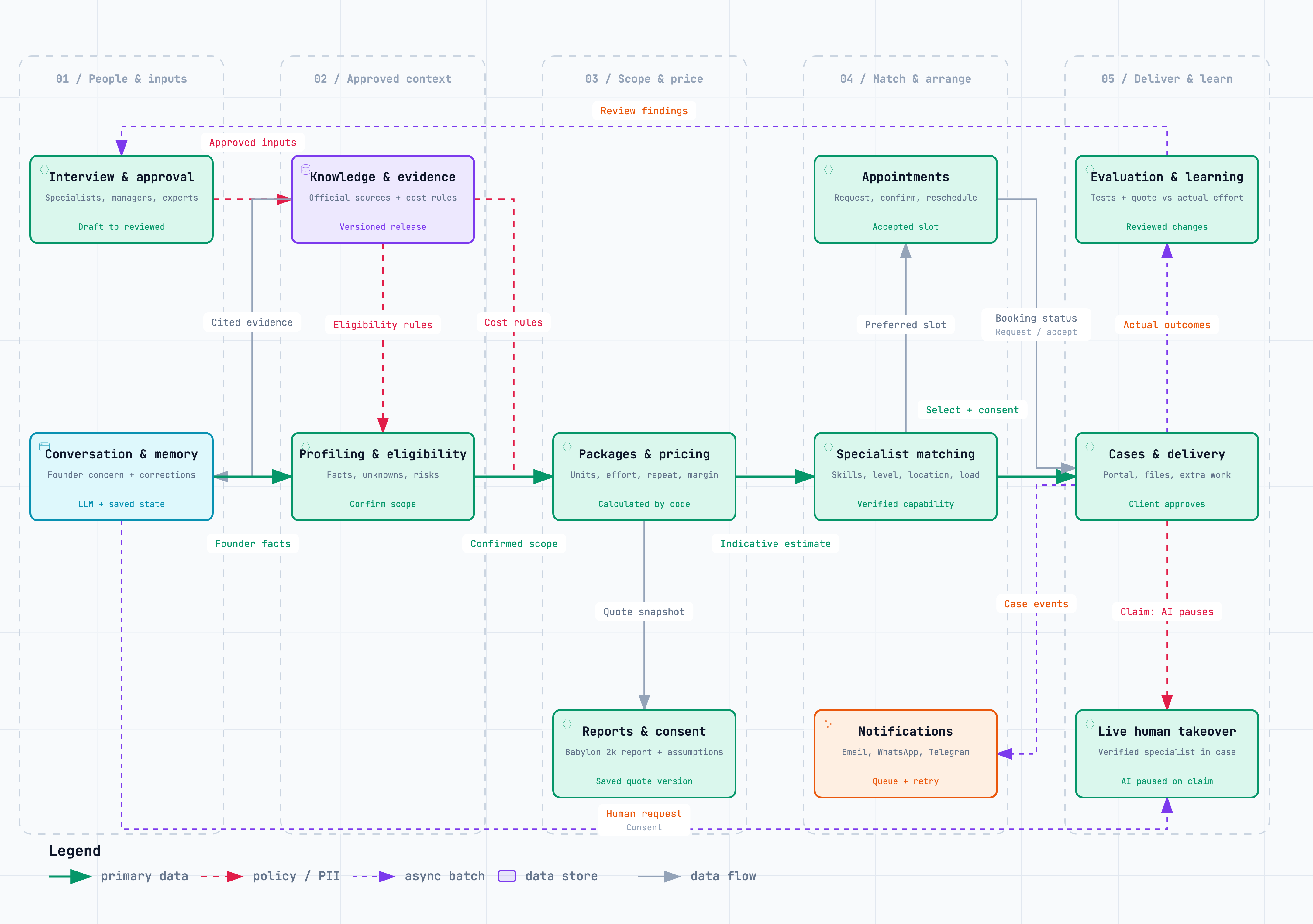
Work needed for production
Who builds and validates it
Whole workstream allocation, not a price for this button. Base effort; project reserve is counted separately.
A shared reference for the people building, validating, managing and using Beth.
Online master updated 9 October 2026 with the RAG architecture and document lifecycle. The earlier team PDF does not include this refinement.
Effort baseline: 6 October 2026 · Architecture update: 9 October 2026 · Subject to discovery validation
Beth’s master scope brings business decisions, expert knowledge and technical delivery together. Start with the part you need.
Choose the role closest to your work. You will see a short reading sequence and the relevant sections, instead of the whole scope at once.
The technical team builds the system. Experts validate its knowledge and service rules. Managers organise delivery. Founders use the service.
The same master reference supports each path. You can still open a specific task link or switch to the complete scope.
For backend, AI/data, frontend, QA and operations engineers.
Your contribution: working integrations, tested behaviour and retrievable acceptance evidence.
For accountants, tax/legal experts, knowledge editors and reviewers.
Your contribution: reviewed service definitions, dependable sources and model answers. Technical integration details are available separately.
For project leads, operations managers and authorised publishers.
Your contribution: named owners, approved operating policies, delivery decisions and acceptance sign-off.
For entrepreneurs, startup founders and SME owners.
Your next step: a clearer business concern, an indicative service plan and an appropriate specialist. The report example is available below.
The full master reference is visible below. Use this view when comparing work across teams.
The online scope is the current master. Earlier standalone diagrams and downloaded documents are supporting snapshots.
This source document holds the work definition. StartInfinity holds the people, checkpoints, execution reports and acceptance evidence. Each task card links to its source using a stable work-package code.
Draft — requires product and reviewer approval. This is a proposed work definition, not a completed delivery or an approved staffing commitment.
Download the complete source blueprintChanges to work definitions are reviewed before the corresponding task cards are revised.
How to read a code: P01 is a parent task; P01.1 is a specific sub-package. P = pilot readiness; D = cloud-release verification; L = broader launch; B = existing prototypes; G = delivery guides. Parent references include both prerequisites and required child outcomes; they are not a standalone scheduling graph.
Each feature links its founder benefit and acceptance criteria to the work packages required to deliver it.
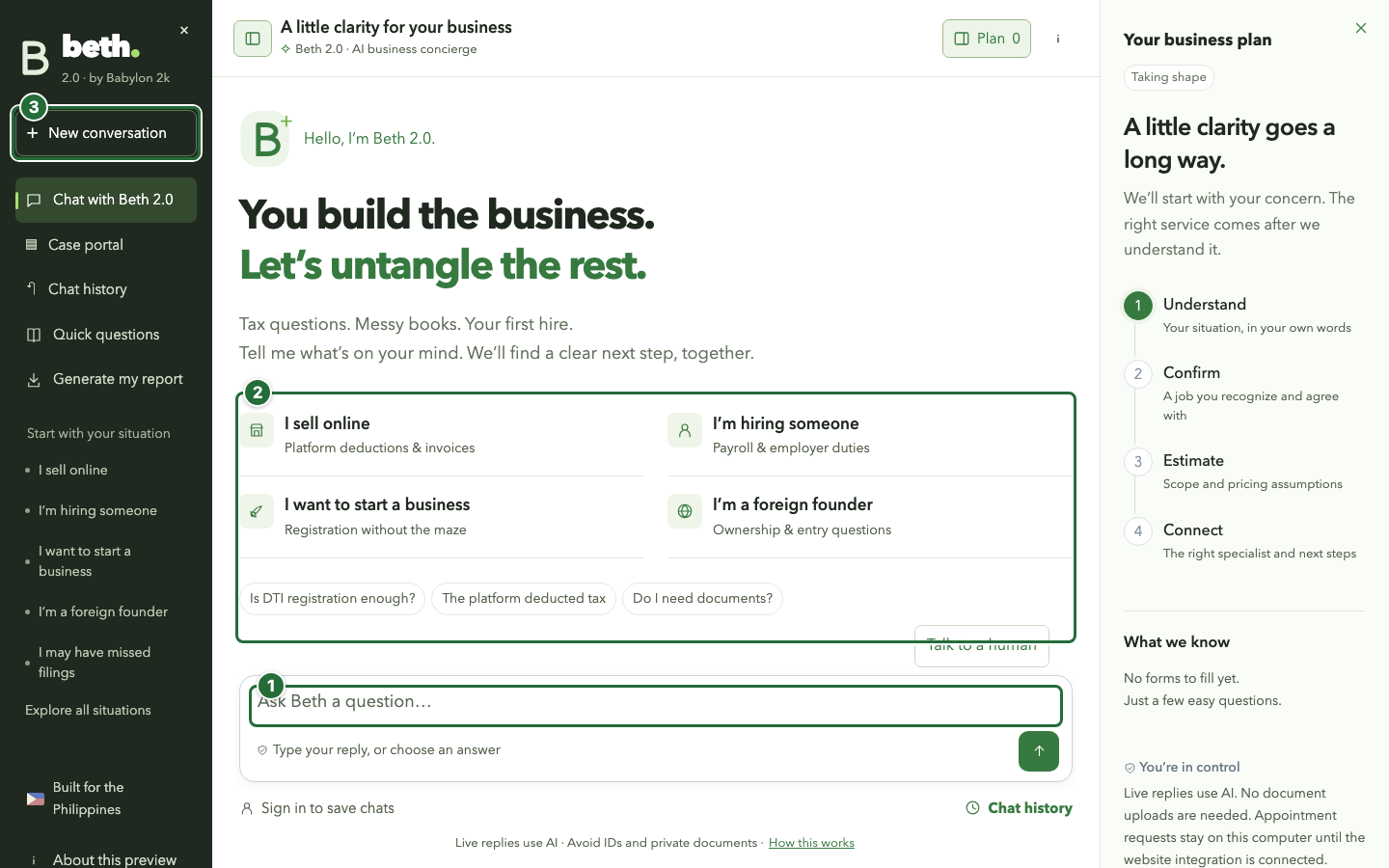
Let a founder describe a problem in their own words and receive a useful next step.
An interrupted reply can resume without losing confirmed facts or repeating an action.
Use a recognisable concern to start relevant questions, without asking for documents immediately.
An online seller and a foreign founder receive the relevant follow-up questions.
Keep unrelated issues separate while retaining each conversation for later.
A new concern does not inherit the previous conversation’s unconfirmed facts.
Associate saved chats, interview answers and cases with the correct account.
A different founder cannot read this account’s conversation or case.
Let a first-time founder register before saving their journey.
A new verified account can save and recall its own work.
Let the founder verify the original reference rather than rely only on Beth’s summary.
A superseded rule is flagged instead of presented as current advice.
Turn a conversation into understandable facts: business type, location, workload and registration status.
Changing monthly entries updates the correct workload band and retains an audit trail.
Get the founder’s agreement that Beth has identified the right problem before preparing an estimate.
No estimate treats an unconfirmed guess as a verified business fact.
Show what the founder may pay, whether the work is one-off or recurring, and how certain the estimate is.
The same facts and price version reproduce the same range; missing facts widen or block the estimate.
Translate service codes into clear line items and their purpose, without charging twice for shared work.
Two services sharing setup work include that setup cost only once.
Give the founder a branded record of the situation, recommendation and estimate.
The report matches the quote version the founder reviewed, even after price rules change.
Allow the founder to retain or share the recommendation without repeating the interview.
Only an authorised user can retrieve the saved report.
Explain why a specialist fits the location, service and complexity of this business.
A nearby profile lacking the required verified skill does not outrank a qualified specialist.
Carry the selected specialist and business brief into booking or case assignment.
The appointment and case retain the selected eligible specialist.
Collect a convenient time and meeting format without suggesting the specialist has accepted it.
A request remains pending until confirmed, and conflicting confirmed slots are prevented.
Persist the request, brief and selected specialist so the founder can follow up.
A retried save creates one appointment request, not two.
Show whether a verified specialist is available and switch conversation ownership when they accept.
A stale presence signal is marked unavailable; Beth cannot talk over an active human specialist.
Let the founder decide whether the specialist receives the conversation summary and contact details.
The handoff cannot expose a summary the founder has not agreed to share.
Keep a task with the chosen specialist even if nobody replies immediately.
An offline specialist still receives an assigned case, with queued delivery tracked separately.
Make staff and founder alerts traceable rather than assume a message was delivered.
One case event produces one notification; a failed delivery is visible and can be retried.
Save time by finding an earlier business issue and its recommendation.
Search returns this founder’s records without exposing another account’s data.
Resume context or remove the chat with a clear explanation of what is retained in an open case.
Deletion removes the intended chat and does not silently delete an active case obligation.
Collect expert decisions, effort drivers and cost inputs that explain a founder question or quotation rule.
An answer with no decision consumer is removed; unapproved answers cannot alter production prices.
Separate completing the survey from proving that Beth quotes and advises accurately.
A complete survey with zero job evidence is not reported as a proven accurate quotation engine.
130 direct references across 34 parent tasks and guides.
Source revision: 2026-10-09.1 · Draft — requires product and reviewer approval
An approved catalogue identifies each included service and package, its evidence, owner and scope; excluded or complex cases have a clear review route.
Required skill / responsible role
Product owner / business analyst
Reviewer role
Product owner and Philippine CPA / practice lead
No prerequisite work packages. The required inputs and readiness criteria are listed below.
These child outcomes complete the parent; they are not prerequisites to beginning every child.
Confirm a named worker, a named reviewer, the source revision, available inputs, a validated effort estimate and an agreed checkpoint before starting.
Effort and checkpoint: Owner to validate at assignment. Existing workstream allocations remain the planning basis; do not count this package again as extra effort.
Parent task owns the stated feature outcome. Child packages are delegated and reviewed separately.
Required child acceptance records plus evidence that the parent’s feature outcome and original checklist pass. Use retrievable redacted links, exact versions and expected/actual results.
Attach the exact artifact/version, expected-versus-actual results and evidence links. The designated reviewer records a dated acceptance decision. Checked boxes alone do not establish completion.
Keep the affected step open, record the exact missing input or decision, identify its accountable owner and agree the next checkpoint.
quote.1 · Indicative range and billing period
quote.2 · What the package includes
start.2 · Choose a starting situation
workshop.2 · Package composition and draft comparison
Pilot scope · Founder journeys · Package definitions
Source revision; completed step numbers; exact deliverable version and evidence links; expected versus actual results; remaining steps; blocker and decision owner; next action and checkpoint; reviewer handoff.
Source revision: 2026-10-09.1 · Draft — requires product and reviewer approval
Three versioned journey briefs have approved outcomes and boundaries.
Required skill / responsible role
Product owner / business analyst
Reviewer role
Domain reviewer
No prerequisite work packages. The required inputs and readiness criteria are listed below.
Confirm a named worker, a named reviewer, the source revision, available inputs, a validated effort estimate and an agreed checkpoint before starting.
Effort and checkpoint: Owner to validate at assignment. Existing workstream allocations remain the planning basis; do not count this package again as extra effort.
A bounded deliverable within P01. Changes to adjacent work require the accountable scope owner’s decision.
Journey briefs, approval record and decision log.
Attach the exact artifact/version, expected-versus-actual results and evidence links. The designated reviewer records a dated acceptance decision. Checked boxes alone do not establish completion.
If a segment or advice boundary is disputed, leave that journey draft and request the named domain decision. Set Stage to Blocked and record the exact failing step, missing decision/input, responsible role and next action in Blocker / decision needed.
start.2 · Choose a starting situation
Pilot scope · Founder journeys · Package definitions
Source revision; completed step numbers; exact deliverable version and evidence links; expected versus actual results; remaining steps; blocker and decision owner; next action and checkpoint; reviewer handoff.
Source revision: 2026-10-09.1 · Draft — requires product and reviewer approval
Each selected code has a reviewed bounded service card; unknown evidence is visibly unresolved.
Required skill / responsible role
Service owner / specialist
Reviewer role
Practice lead / Philippine CPA
Confirm a named worker, a named reviewer, the source revision, available inputs, a validated effort estimate and an agreed checkpoint before starting.
Effort and checkpoint: Owner to validate at assignment. Existing workstream allocations remain the planning basis; do not count this package again as extra effort.
A bounded deliverable within P01. Changes to adjacent work require the accountable scope owner’s decision.
Service-card register, source references and review decisions.
Attach the exact artifact/version, expected-versus-actual results and evidence links. The designated reviewer records a dated acceptance decision. Checked boxes alone do not establish completion.
If evidence or professional approval is missing, retain the service in draft and identify the question needed to approve it. Set Stage to Blocked and record the exact failing step, missing decision/input, responsible role and next action in Blocker / decision needed.
quote.1 · Indicative range and billing period
Pilot scope · Founder journeys · Package definitions
Source revision; completed step numbers; exact deliverable version and evidence links; expected versus actual results; remaining steps; blocker and decision owner; next action and checkpoint; reviewer handoff.
Source revision: 2026-10-09.1 · Draft — requires product and reviewer approval
Four reviewed package definitions have clear boundaries and no duplicate shared work.
Required skill / responsible role
Operations / service-design owner
Reviewer role
Finance owner and domain reviewer
Confirm a named worker, a named reviewer, the source revision, available inputs, a validated effort estimate and an agreed checkpoint before starting.
Effort and checkpoint: Owner to validate at assignment. Existing workstream allocations remain the planning basis; do not count this package again as extra effort.
A bounded deliverable within P01. Changes to adjacent work require the accountable scope owner’s decision.
Package composition matrix, overlap examples and approval record.
Attach the exact artifact/version, expected-versus-actual results and evidence links. The designated reviewer records a dated acceptance decision. Checked boxes alone do not establish completion.
If the component services conflict or lack approval, block package release and list the required service decisions. Set Stage to Blocked and record the exact failing step, missing decision/input, responsible role and next action in Blocker / decision needed.
quote.2 · What the package includes
workshop.2 · Package composition and draft comparison
Pilot scope · Founder journeys · Package definitions
Source revision; completed step numbers; exact deliverable version and evidence links; expected versus actual results; remaining steps; blocker and decision owner; next action and checkpoint; reviewer handoff.
Source revision: 2026-10-09.1 · Draft — requires product and reviewer approval
All 20 topics map to a named decision, structured record, approver and test; no legacy 23-topic map is silently used.
Required skill / responsible role
Business analyst
Reviewer role
Product owner and domain / finance reviewers
These child outcomes complete the parent; they are not prerequisites to beginning every child.
Confirm a named worker, a named reviewer, the source revision, available inputs, a validated effort estimate and an agreed checkpoint before starting.
Effort and checkpoint: Owner to validate at assignment. Existing workstream allocations remain the planning basis; do not count this package again as extra effort.
Parent task owns the stated feature outcome. Child packages are delegated and reviewed separately.
Required child acceptance records plus evidence that the parent’s feature outcome and original checklist pass. Use retrievable redacted links, exact versions and expected/actual results.
Attach the exact artifact/version, expected-versus-actual results and evidence links. The designated reviewer records a dated acceptance decision. Checked boxes alone do not establish completion.
Keep the affected step open, record the exact missing input or decision, identify its accountable owner and agree the next checkpoint.
workshop.1 · Role interviews and service effort cards
Answer-to-decision learning plan · Current 20-topic interview · Model answers
Source revision; completed step numbers; exact deliverable version and evidence links; expected versus actual results; remaining steps; blocker and decision owner; next action and checkpoint; reviewer handoff.
Source revision: 2026-10-09.1 · Draft — requires product and reviewer approval
A versioned crosswalk covers all 20 current topics and explains each retired or changed legacy link.
Required skill / responsible role
Business analyst
Reviewer role
Product owner
Confirm a named worker, a named reviewer, the source revision, available inputs, a validated effort estimate and an agreed checkpoint before starting.
Effort and checkpoint: Owner to validate at assignment. Existing workstream allocations remain the planning basis; do not count this package again as extra effort.
A bounded deliverable within P02. Changes to adjacent work require the accountable scope owner’s decision.
Current-to-legacy crosswalk and accepted mapping review.
Attach the exact artifact/version, expected-versus-actual results and evidence links. The designated reviewer records a dated acceptance decision. Checked boxes alone do not establish completion.
If a topic has no decision consumer, mark the gap and seek a product decision; do not invent a consumer. Set Stage to Blocked and record the exact failing step, missing decision/input, responsible role and next action in Blocker / decision needed.
workshop.1 · Role interviews and service effort cards
Answer-to-decision learning plan · Current 20-topic interview · Model answers
Source revision; completed step numbers; exact deliverable version and evidence links; expected versus actual results; remaining steps; blocker and decision owner; next action and checkpoint; reviewer handoff.
Source revision: 2026-10-09.1 · Draft — requires product and reviewer approval
The approved record contract preserves provenance and rejects invented defaults or executable interview text.
Required skill / responsible role
Data / backend engineer
Reviewer role
Business analyst and domain reviewer
Confirm a named worker, a named reviewer, the source revision, available inputs, a validated effort estimate and an agreed checkpoint before starting.
Effort and checkpoint: Owner to validate at assignment. Existing workstream allocations remain the planning basis; do not count this package again as extra effort.
A bounded deliverable within P02. Changes to adjacent work require the accountable scope owner’s decision.
Candidate schema, validation table and redacted examples.
Attach the exact artifact/version, expected-versus-actual results and evidence links. The designated reviewer records a dated acceptance decision. Checked boxes alone do not establish completion.
If unit, scope or evidence meaning is unresolved, keep the candidate incomplete and route the question to its decision owner. Set Stage to Blocked and record the exact failing step, missing decision/input, responsible role and next action in Blocker / decision needed.
workshop.1 · Role interviews and service effort cards
Answer-to-decision learning plan · Current 20-topic interview · Model answers
Source revision; completed step numbers; exact deliverable version and evidence links; expected versus actual results; remaining steps; blocker and decision owner; next action and checkpoint; reviewer handoff.
Source revision: 2026-10-09.1 · Draft — requires product and reviewer approval
Each topic has one named decision consumer, reviewer role and test, with examples visibly separated from approved rules.
Required skill / responsible role
Business analyst / interview coordinator
Reviewer role
Service, finance and expert reviewers
Confirm a named worker, a named reviewer, the source revision, available inputs, a validated effort estimate and an agreed checkpoint before starting.
Effort and checkpoint: Owner to validate at assignment. Existing workstream allocations remain the planning basis; do not count this package again as extra effort.
A bounded deliverable within P02. Changes to adjacent work require the accountable scope owner’s decision.
Signed consumer matrix and guidance review.
Attach the exact artifact/version, expected-versus-actual results and evidence links. The designated reviewer records a dated acceptance decision. Checked boxes alone do not establish completion.
If a reviewer is not appointed or evidence is unsuitable, report that topic as awaiting review rather than complete. Set Stage to Blocked and record the exact failing step, missing decision/input, responsible role and next action in Blocker / decision needed.
workshop.1 · Role interviews and service effort cards
Answer-to-decision learning plan · Current 20-topic interview · Model answers
Source revision; completed step numbers; exact deliverable version and evidence links; expected versus actual results; remaining steps; blocker and decision owner; next action and checkpoint; reviewer handoff.
Source revision: 2026-10-09.1 · Draft — requires product and reviewer approval
A reviewer can return a submission, contributor corrects it, and a separately approved version retains its audit trail; raw answers cannot change Beth's live output.
Required skill / responsible role
Product owner / workflow analyst
Reviewer role
Accountable service, finance or expert approver
These child outcomes complete the parent; they are not prerequisites to beginning every child.
Confirm a named worker, a named reviewer, the source revision, available inputs, a validated effort estimate and an agreed checkpoint before starting.
Effort and checkpoint: Owner to validate at assignment. Existing workstream allocations remain the planning basis; do not count this package again as extra effort.
Parent task owns the stated feature outcome. Child packages are delegated and reviewed separately.
Required child acceptance records plus evidence that the parent’s feature outcome and original checklist pass. Use retrievable redacted links, exact versions and expected/actual results.
Attach the exact artifact/version, expected-versus-actual results and evidence links. The designated reviewer records a dated acceptance decision. Checked boxes alone do not establish completion.
Keep the affected step open, record the exact missing input or decision, identify its accountable owner and agree the next checkpoint.
workshop.1 · Role interviews and service effort cards
Review and approval design · Collection readiness · Business administration
Source revision; completed step numbers; exact deliverable version and evidence links; expected versus actual results; remaining steps; blocker and decision owner; next action and checkpoint; reviewer handoff.
Source revision: 2026-10-09.1 · Draft — requires product and reviewer approval
An approved matrix identifies every review action, authorised role and required record.
Required skill / responsible role
Product owner / workflow analyst
Reviewer role
Review lead and access owner
Confirm a named worker, a named reviewer, the source revision, available inputs, a validated effort estimate and an agreed checkpoint before starting.
Effort and checkpoint: Owner to validate at assignment. Existing workstream allocations remain the planning basis; do not count this package again as extra effort.
A bounded deliverable within P03. Changes to adjacent work require the accountable scope owner’s decision.
Role/action matrix and state diagram.
Attach the exact artifact/version, expected-versus-actual results and evidence links. The designated reviewer records a dated acceptance decision. Checked boxes alone do not establish completion.
If reviewer authority or data access is disputed, stop that transition and request an access-policy decision. Set Stage to Blocked and record the exact failing step, missing decision/input, responsible role and next action in Blocker / decision needed.
workshop.1 · Role interviews and service effort cards
Review and approval design · Collection readiness · Business administration
Source revision; completed step numbers; exact deliverable version and evidence links; expected versus actual results; remaining steps; blocker and decision owner; next action and checkpoint; reviewer handoff.
Source revision: 2026-10-09.1 · Draft — requires product and reviewer approval
An assigned reviewer can return a pack; a corrected version retains both snapshots and decisions.
Required skill / responsible role
Backend / frontend engineer
Reviewer role
Review lead and QA
Confirm a named worker, a named reviewer, the source revision, available inputs, a validated effort estimate and an agreed checkpoint before starting.
Effort and checkpoint: Owner to validate at assignment. Existing workstream allocations remain the planning basis; do not count this package again as extra effort.
A bounded deliverable within P03. Changes to adjacent work require the accountable scope owner’s decision.
Redacted walkthrough, permission tests and review-history export.
Attach the exact artifact/version, expected-versus-actual results and evidence links. The designated reviewer records a dated acceptance decision. Checked boxes alone do not establish completion.
If cloud identity or review storage is unavailable, mark implementation blocked and retain the approved contract. Set Stage to Blocked and record the exact failing step, missing decision/input, responsible role and next action in Blocker / decision needed.
workshop.1 · Role interviews and service effort cards
Review and approval design · Collection readiness · Business administration
Source revision; completed step numbers; exact deliverable version and evidence links; expected versus actual results; remaining steps; blocker and decision owner; next action and checkpoint; reviewer handoff.
Source revision: 2026-10-09.1 · Draft — requires product and reviewer approval
Only reviewed candidates enter the release bundle; unresolved conflicts remain excluded and traceable.
Required skill / responsible role
Review coordinator
Reviewer role
Qualified service/finance/expert owner
Confirm a named worker, a named reviewer, the source revision, available inputs, a validated effort estimate and an agreed checkpoint before starting.
Effort and checkpoint: Owner to validate at assignment. Existing workstream allocations remain the planning basis; do not count this package again as extra effort.
A bounded deliverable within P03. Changes to adjacent work require the accountable scope owner’s decision.
Conflict register, decisions and candidate-bundle manifest.
Attach the exact artifact/version, expected-versus-actual results and evidence links. The designated reviewer records a dated acceptance decision. Checked boxes alone do not establish completion.
Do not average incompatible answers; block affected candidates until the accountable reviewer resolves or preserves distinct variants. Set Stage to Blocked and record the exact failing step, missing decision/input, responsible role and next action in Blocker / decision needed.
workshop.1 · Role interviews and service effort cards
Review and approval design · Collection readiness · Business administration
Source revision; completed step numbers; exact deliverable version and evidence links; expected versus actual results; remaining steps; blocker and decision owner; next action and checkpoint; reviewer handoff.
Source revision: 2026-10-09.1 · Draft — requires product and reviewer approval
Every material pilot claim resolves to its supporting applicable passage; superseded information cannot appear as current and unavailable evidence triggers the approved fallback.
Required skill / responsible role
Knowledge analyst
Reviewer role
Philippine tax / legal reviewer and knowledge QA
These child outcomes complete the parent; they are not prerequisites to beginning every child.
Confirm a named worker, a named reviewer, the source revision, available inputs, a validated effort estimate and an agreed checkpoint before starting.
Effort and checkpoint: Existing planning allocations predate the 9 October RAG refinement. Validate the PDF/CMS/durable-worker integration and test effort within knowledge, administration, QA and operations before assignment; no additional total has been approved.
Parent task owns the stated feature outcome. Child packages are delegated and reviewed separately.
Required child acceptance records plus evidence that the parent’s feature outcome and original checklist pass. Use retrievable redacted links, exact versions and expected/actual results.
Attach the exact artifact/version, expected-versus-actual results and evidence links. The designated reviewer records a dated acceptance decision. Checked boxes alone do not establish completion.
Keep the affected step open, record the exact missing input or decision, identify its accountable owner and agree the next checkpoint.
sources.1 · Read the cited guidance
sources.2 · Open the original source
RAG and document freshness · Knowledge and evidence · Live sources and cache
Source revision; completed step numbers; exact deliverable version and evidence links; expected versus actual results; remaining steps; blocker and decision owner; next action and checkpoint; reviewer handoff.
Source revision: 2026-10-09.1 · Draft — requires product and reviewer approval
Every approved fact has inspectable support, applicability and a responsible reviewer.
Required skill / responsible role
Knowledge analyst
Reviewer role
Philippine tax/legal reviewer
Confirm a named worker, a named reviewer, the source revision, available inputs, a validated effort estimate and an agreed checkpoint before starting.
Effort and checkpoint: Existing planning allocations predate the 9 October RAG refinement. Validate the PDF/CMS/durable-worker integration and test effort within knowledge, administration, QA and operations before assignment; no additional total has been approved.
A bounded deliverable within P04. Changes to adjacent work require the accountable scope owner’s decision.
Fact/source register, locators and expert approvals. Include the PDF/source schema, role-access test, version history, licence decision and recorded editor walkthrough.
Attach the exact artifact/version, expected-versus-actual results and evidence links. The designated reviewer records a dated acceptance decision. Checked boxes alone do not establish completion.
If source support or applicability cannot be established, retain the fact as a candidate and specify a human-review route. Set Stage to Blocked and record the exact failing step, missing decision/input, responsible role and next action in Blocker / decision needed.
sources.1 · Read the cited guidance
sources.2 · Open the original source
RAG and document freshness · Knowledge and evidence · Live sources and cache
Source revision; completed step numbers; exact deliverable version and evidence links; expected versus actual results; remaining steps; blocker and decision owner; next action and checkpoint; reviewer handoff.
Source revision: 2026-10-09.1 · Draft — requires product and reviewer approval
Answers cite the actual applicable support and do not turn fetched source text into agent instructions.
Required skill / responsible role
AI / data engineer
Reviewer role
Knowledge reviewer and QA
Confirm a named worker, a named reviewer, the source revision, available inputs, a validated effort estimate and an agreed checkpoint before starting.
Effort and checkpoint: Existing planning allocations predate the 9 October RAG refinement. Validate the PDF/CMS/durable-worker integration and test effort within knowledge, administration, QA and operations before assignment; no additional total has been approved.
A bounded deliverable within P04. Changes to adjacent work require the accountable scope owner’s decision.
Redacted answer-to-passage trace and claim-support test results. Include original-PDF versus extracted-table checks, ingestion manifest, active-version transaction proof and held-out retrieval results.
Attach the exact artifact/version, expected-versus-actual results and evidence links. The designated reviewer records a dated acceptance decision. Checked boxes alone do not establish completion.
If a claim lacks support, remove or qualify it and request review; do not fabricate a citation to complete the answer. Set Stage to Blocked and record the exact failing step, missing decision/input, responsible role and next action in Blocker / decision needed.
sources.1 · Read the cited guidance
RAG and document freshness · Knowledge and evidence · Live sources and cache
Source revision; completed step numbers; exact deliverable version and evidence links; expected versus actual results; remaining steps; blocker and decision owner; next action and checkpoint; reviewer handoff.
Source revision: 2026-10-09.1 · Draft — requires product and reviewer approval
Superseded evidence cannot be reused as current; all tested outages lead to a documented verified fallback or review.
Required skill / responsible role
Knowledge / data engineer
Reviewer role
Domain reviewer and QA
Confirm a named worker, a named reviewer, the source revision, available inputs, a validated effort estimate and an agreed checkpoint before starting.
Effort and checkpoint: Existing planning allocations predate the 9 October RAG refinement. Validate the PDF/CMS/durable-worker integration and test effort within knowledge, administration, QA and operations before assignment; no additional total has been approved.
A bounded deliverable within P04. Changes to adjacent work require the accountable scope owner’s decision.
Freshness policy, retirement trace and outage test report. Include durable-workflow recovery trace, reconciliation report, freshness dashboard and retirement/cache invalidation results.
Attach the exact artifact/version, expected-versus-actual results and evidence links. The designated reviewer records a dated acceptance decision. Checked boxes alone do not establish completion.
If freshness or alternate identity is unresolved, quarantine current use and record the source owner's next check. Set Stage to Blocked and record the exact failing step, missing decision/input, responsible role and next action in Blocker / decision needed.
sources.1 · Read the cited guidance
sources.2 · Open the original source
RAG and document freshness · Knowledge and evidence · Live sources and cache
Source revision; completed step numbers; exact deliverable version and evidence links; expected versus actual results; remaining steps; blocker and decision owner; next action and checkpoint; reviewer handoff.
Source revision: 2026-10-09.1 · Draft — requires product and reviewer approval
The same confirmed facts yield consistent scope, volunteered information is not repeatedly asked, unknown values are not invented, and risk cases receive the documented review route.
Required skill / responsible role
Business analyst
Reviewer role
Domain reviewer and founder-experience QA
These child outcomes complete the parent; they are not prerequisites to beginning every child.
Confirm a named worker, a named reviewer, the source revision, available inputs, a validated effort estimate and an agreed checkpoint before starting.
Effort and checkpoint: Owner to validate at assignment. Existing workstream allocations remain the planning basis; do not count this package again as extra effort.
Parent task owns the stated feature outcome. Child packages are delegated and reviewed separately.
Required child acceptance records plus evidence that the parent’s feature outcome and original checklist pass. Use retrievable redacted links, exact versions and expected/actual results.
Attach the exact artifact/version, expected-versus-actual results and evidence links. The designated reviewer records a dated acceptance decision. Checked boxes alone do not establish completion.
Keep the affected step open, record the exact missing input or decision, identify its accountable owner and agree the next checkpoint.
profile.1 · Review the business facts
profile.2 · Confirm the proposed scope
start.1 · Ask Beth a question
start.2 · Choose a starting situation
Source revision; completed step numbers; exact deliverable version and evidence links; expected versus actual results; remaining steps; blocker and decision owner; next action and checkpoint; reviewer handoff.
Source revision: 2026-10-09.1 · Draft — requires product and reviewer approval
No pilot rule relies on an undefined fact or silently converts an unknown into a confirmed value.
Required skill / responsible role
Business analyst
Reviewer role
Domain reviewer
Confirm a named worker, a named reviewer, the source revision, available inputs, a validated effort estimate and an agreed checkpoint before starting.
Effort and checkpoint: Owner to validate at assignment. Existing workstream allocations remain the planning basis; do not count this package again as extra effort.
A bounded deliverable within P05. Changes to adjacent work require the accountable scope owner’s decision.
Fact dictionary, correction examples and reviewer sign-off.
Attach the exact artifact/version, expected-versus-actual results and evidence links. The designated reviewer records a dated acceptance decision. Checked boxes alone do not establish completion.
If fact meaning is ambiguous, leave it unknown and request one clarifying definition before implementing a rule. Set Stage to Blocked and record the exact failing step, missing decision/input, responsible role and next action in Blocker / decision needed.
start.2 · Choose a starting situation
profile.1 · Review the business facts
Source revision; completed step numbers; exact deliverable version and evidence links; expected versus actual results; remaining steps; blocker and decision owner; next action and checkpoint; reviewer handoff.
Source revision: 2026-10-09.1 · Draft — requires product and reviewer approval
Pilot routes preserve uncertainty, avoid repetitive questions and choose the approved review boundary.
Required skill / responsible role
AI / backend engineer
Reviewer role
Product owner and domain reviewer
Confirm a named worker, a named reviewer, the source revision, available inputs, a validated effort estimate and an agreed checkpoint before starting.
Effort and checkpoint: Owner to validate at assignment. Existing workstream allocations remain the planning basis; do not count this package again as extra effort.
A bounded deliverable within P05. Changes to adjacent work require the accountable scope owner’s decision.
Decision table and typical/unknown/urgent routing results.
Attach the exact artifact/version, expected-versus-actual results and evidence links. The designated reviewer records a dated acceptance decision. Checked boxes alone do not establish completion.
If required applicability or urgency rules are unapproved, route to a person instead of guessing the service outcome. Set Stage to Blocked and record the exact failing step, missing decision/input, responsible role and next action in Blocker / decision needed.
start.1 · Ask Beth a question
start.2 · Choose a starting situation
profile.1 · Review the business facts
Source revision; completed step numbers; exact deliverable version and evidence links; expected versus actual results; remaining steps; blocker and decision owner; next action and checkpoint; reviewer handoff.
Source revision: 2026-10-09.1 · Draft — requires product and reviewer approval
Reviewed scenarios produce the right scope, recorded confirmation and traceable correction history.
Required skill / responsible role
QA / conversational UX reviewer
Reviewer role
Product owner and domain reviewer
Confirm a named worker, a named reviewer, the source revision, available inputs, a validated effort estimate and an agreed checkpoint before starting.
Effort and checkpoint: Owner to validate at assignment. Existing workstream allocations remain the planning basis; do not count this package again as extra effort.
A bounded deliverable within P05. Changes to adjacent work require the accountable scope owner’s decision.
Scenario transcripts, confirmation records and reviewer decisions.
Attach the exact artifact/version, expected-versus-actual results and evidence links. The designated reviewer records a dated acceptance decision. Checked boxes alone do not establish completion.
If a critical scope error occurs, report the failing rule and block that route's acceptance until corrected. Set Stage to Blocked and record the exact failing step, missing decision/input, responsible role and next action in Blocker / decision needed.
start.2 · Choose a starting situation
profile.1 · Review the business facts
profile.2 · Confirm the proposed scope
Source revision; completed step numbers; exact deliverable version and evidence links; expected versus actual results; remaining steps; blocker and decision owner; next action and checkpoint; reviewer handoff.
Source revision: 2026-10-09.1 · Draft — requires product and reviewer approval
A saved quote can be reproduced exactly; changing an approved allowance affects only the relevant units; missing critical inputs prevents a firm quote.
Required skill / responsible role
Service-costing analyst
Reviewer role
Finance owner, service owner and pricing QA
These child outcomes complete the parent; they are not prerequisites to beginning every child.
Confirm a named worker, a named reviewer, the source revision, available inputs, a validated effort estimate and an agreed checkpoint before starting.
Effort and checkpoint: Owner to validate at assignment. Existing workstream allocations remain the planning basis; do not count this package again as extra effort.
Parent task owns the stated feature outcome. Child packages are delegated and reviewed separately.
Required child acceptance records plus evidence that the parent’s feature outcome and original checklist pass. Use retrievable redacted links, exact versions and expected/actual results.
Attach the exact artifact/version, expected-versus-actual results and evidence links. The designated reviewer records a dated acceptance decision. Checked boxes alone do not establish completion.
Keep the affected step open, record the exact missing input or decision, identify its accountable owner and agree the next checkpoint.
portal.2 · Approve scope and budget
profile.1 · Review the business facts
profile.2 · Confirm the proposed scope
quote.1 · Indicative range and billing period
quote.2 · What the package includes
report.1 · Babylon 2k report and scope
workshop.2 · Package composition and draft comparison
Source revision; completed step numbers; exact deliverable version and evidence links; expected versus actual results; remaining steps; blocker and decision owner; next action and checkpoint; reviewer handoff.
Source revision: 2026-10-09.1 · Draft — requires product and reviewer approval
A reviewed pricing-input contract identifies units, evidence basis and authority; confidential values remain restricted.
Required skill / responsible role
Service-costing analyst
Reviewer role
Finance owner and practice lead
Confirm a named worker, a named reviewer, the source revision, available inputs, a validated effort estimate and an agreed checkpoint before starting.
Effort and checkpoint: Owner to validate at assignment. Existing workstream allocations remain the planning basis; do not count this package again as extra effort.
A bounded deliverable within P06. Changes to adjacent work require the accountable scope owner’s decision.
Redacted driver register, evidence references and approval manifest.
Attach the exact artifact/version, expected-versus-actual results and evidence links. The designated reviewer records a dated acceptance decision. Checked boxes alone do not establish completion.
If costs or policy approval are missing, retain a draft estimate basis and request the finance decision; do not invent rates. Set Stage to Blocked and record the exact failing step, missing decision/input, responsible role and next action in Blocker / decision needed.
quote.1 · Indicative range and billing period
workshop.2 · Package composition and draft comparison
Source revision; completed step numbers; exact deliverable version and evidence links; expected versus actual results; remaining steps; blocker and decision owner; next action and checkpoint; reviewer handoff.
Source revision: 2026-10-09.1 · Draft — requires product and reviewer approval
Approved rule changes affect the correct quantities, and overlapping work is never charged twice.
Required skill / responsible role
Backend engineer
Reviewer role
Service owner and QA
Confirm a named worker, a named reviewer, the source revision, available inputs, a validated effort estimate and an agreed checkpoint before starting.
Effort and checkpoint: Owner to validate at assignment. Existing workstream allocations remain the planning basis; do not count this package again as extra effort.
A bounded deliverable within P06. Changes to adjacent work require the accountable scope owner’s decision.
Boundary calculations, overlap checks and rule-version change trace.
Attach the exact artifact/version, expected-versus-actual results and evidence links. The designated reviewer records a dated acceptance decision. Checked boxes alone do not establish completion.
If rule interpretation differs from the reviewed unit, stop that service calculation and return the definition for correction. Set Stage to Blocked and record the exact failing step, missing decision/input, responsible role and next action in Blocker / decision needed.
profile.1 · Review the business facts
quote.1 · Indicative range and billing period
quote.2 · What the package includes
workshop.2 · Package composition and draft comparison
Source revision; completed step numbers; exact deliverable version and evidence links; expected versus actual results; remaining steps; blocker and decision owner; next action and checkpoint; reviewer handoff.
Source revision: 2026-10-09.1 · Draft — requires product and reviewer approval
The exact saved estimate is reproducible and its uncertainty/exclusions are visible to the founder.
Required skill / responsible role
QA / backend engineer
Reviewer role
Finance owner and domain reviewer
Confirm a named worker, a named reviewer, the source revision, available inputs, a validated effort estimate and an agreed checkpoint before starting.
Effort and checkpoint: Owner to validate at assignment. Existing workstream allocations remain the planning basis; do not count this package again as extra effort.
A bounded deliverable within P06. Changes to adjacent work require the accountable scope owner’s decision.
Redacted quote snapshots, replay results and missing-input test report.
Attach the exact artifact/version, expected-versus-actual results and evidence links. The designated reviewer records a dated acceptance decision. Checked boxes alone do not establish completion.
If saved inputs or rule versions are incomplete, mark the quote unreplayable and block approval until the record is repaired. Set Stage to Blocked and record the exact failing step, missing decision/input, responsible role and next action in Blocker / decision needed.
profile.2 · Confirm the proposed scope
quote.1 · Indicative range and billing period
quote.2 · What the package includes
report.1 · Babylon 2k report and scope
portal.2 · Approve scope and budget
workshop.2 · Package composition and draft comparison
Source revision; completed step numbers; exact deliverable version and evidence links; expected versus actual results; remaining steps; blocker and decision owner; next action and checkpoint; reviewer handoff.
Source revision: 2026-10-09.1 · Draft — requires product and reviewer approval
Every recommended specialist has verified eligibility for the exact job; an unavailable person is not promised as immediately deployable.
Required skill / responsible role
Specialist operations coordinator
Reviewer role
Practice lead / credential reviewer and operations
These child outcomes complete the parent; they are not prerequisites to beginning every child.
Confirm a named worker, a named reviewer, the source revision, available inputs, a validated effort estimate and an agreed checkpoint before starting.
Effort and checkpoint: Owner to validate at assignment. Existing workstream allocations remain the planning basis; do not count this package again as extra effort.
Parent task owns the stated feature outcome. Child packages are delegated and reviewed separately.
Required child acceptance records plus evidence that the parent’s feature outcome and original checklist pass. Use retrievable redacted links, exact versions and expected/actual results.
Attach the exact artifact/version, expected-versus-actual results and evidence links. The designated reviewer records a dated acceptance decision. Checked boxes alone do not establish completion.
Keep the affected step open, record the exact missing input or decision, identify its accountable owner and agree the next checkpoint.
handoff.1 · Live / Not live indicator
specialists.1 · Compare suitability
specialists.2 · Select this specialist
Source revision; completed step numbers; exact deliverable version and evidence links; expected versus actual results; remaining steps; blocker and decision owner; next action and checkpoint; reviewer handoff.
Source revision: 2026-10-09.1 · Draft — requires product and reviewer approval
Each eligible pilot roster entry has verified job-specific capability and explicit limitations.
Required skill / responsible role
Specialist operations coordinator
Reviewer role
Practice lead / credential reviewer
Confirm a named worker, a named reviewer, the source revision, available inputs, a validated effort estimate and an agreed checkpoint before starting.
Effort and checkpoint: Owner to validate at assignment. Existing workstream allocations remain the planning basis; do not count this package again as extra effort.
A bounded deliverable within P07. Changes to adjacent work require the accountable scope owner’s decision.
Redacted roster, private verification references and review decisions.
Attach the exact artifact/version, expected-versus-actual results and evidence links. The designated reviewer records a dated acceptance decision. Checked boxes alone do not establish completion.
If capability or a required qualification is unverified, exclude the practitioner from that service's eligible results. Set Stage to Blocked and record the exact failing step, missing decision/input, responsible role and next action in Blocker / decision needed.
specialists.1 · Compare suitability
Source revision; completed step numbers; exact deliverable version and evidence links; expected versus actual results; remaining steps; blocker and decision owner; next action and checkpoint; reviewer handoff.
Source revision: 2026-10-09.1 · Draft — requires product and reviewer approval
Availability promises require verified status and explicit acceptance, with documented fallback.
Required skill / responsible role
Specialist operations owner
Reviewer role
Practice lead / operations manager
Confirm a named worker, a named reviewer, the source revision, available inputs, a validated effort estimate and an agreed checkpoint before starting.
Effort and checkpoint: Owner to validate at assignment. Existing workstream allocations remain the planning basis; do not count this package again as extra effort.
A bounded deliverable within P07. Changes to adjacent work require the accountable scope owner’s decision.
Capacity register, status-expiry examples and signed handoff policy.
Attach the exact artifact/version, expected-versus-actual results and evidence links. The designated reviewer records a dated acceptance decision. Checked boxes alone do not establish completion.
If a specialist has not confirmed capacity, display unavailable or pending and route the case to its operations owner. Set Stage to Blocked and record the exact failing step, missing decision/input, responsible role and next action in Blocker / decision needed.
specialists.1 · Compare suitability
handoff.1 · Live / Not live indicator
Source revision; completed step numbers; exact deliverable version and evidence links; expected versus actual results; remaining steps; blocker and decision owner; next action and checkpoint; reviewer handoff.
Source revision: 2026-10-09.1 · Draft — requires product and reviewer approval
No ineligible practitioner is recommended and every selected specialist remains traceable across the handoff.
Required skill / responsible role
Backend engineer / QA
Reviewer role
Specialist operations reviewer
Confirm a named worker, a named reviewer, the source revision, available inputs, a validated effort estimate and an agreed checkpoint before starting.
Effort and checkpoint: Owner to validate at assignment. Existing workstream allocations remain the planning basis; do not count this package again as extra effort.
A bounded deliverable within P07. Changes to adjacent work require the accountable scope owner’s decision.
Matching fixtures, reasons and selection/reassignment trace.
Attach the exact artifact/version, expected-versus-actual results and evidence links. The designated reviewer records a dated acceptance decision. Checked boxes alone do not establish completion.
If filtering or identity linkage fails, suppress that match and report the roster or mapping correction required. Set Stage to Blocked and record the exact failing step, missing decision/input, responsible role and next action in Blocker / decision needed.
specialists.1 · Compare suitability
specialists.2 · Select this specialist
Source revision; completed step numbers; exact deliverable version and evidence links; expected versus actual results; remaining steps; blocker and decision owner; next action and checkpoint; reviewer handoff.
Source revision: 2026-10-09.1 · Draft — requires product and reviewer approval
A founder sees only their cases, a specialist sees only assigned cases, repeated acceptance cannot duplicate a job, and unapproved extra work never starts.
Required skill / responsible role
Backend engineer
Reviewer role
Case operations and permission / workflow QA
These child outcomes complete the parent; they are not prerequisites to beginning every child.
Confirm a named worker, a named reviewer, the source revision, available inputs, a validated effort estimate and an agreed checkpoint before starting.
Effort and checkpoint: Owner to validate at assignment. Existing workstream allocations remain the planning basis; do not count this package again as extra effort.
Parent task owns the stated feature outcome. Child packages are delegated and reviewed separately.
Required child acceptance records plus evidence that the parent’s feature outcome and original checklist pass. Use retrievable redacted links, exact versions and expected/actual results.
Attach the exact artifact/version, expected-versus-actual results and evidence links. The designated reviewer records a dated acceptance decision. Checked boxes alone do not establish completion.
Keep the affected step open, record the exact missing input or decision, identify its accountable owner and agree the next checkpoint.
handoff.3 · Create a case and request a human
portal.1 · Case status and owner
portal.2 · Approve scope and budget
report.1 · Babylon 2k report and scope
specialists.2 · Select this specialist
Source revision; completed step numbers; exact deliverable version and evidence links; expected versus actual results; remaining steps; blocker and decision owner; next action and checkpoint; reviewer handoff.
Source revision: 2026-10-09.1 · Draft — requires product and reviewer approval
Repeated acceptance creates one case with the agreed scope and a visible responsible role/next action.
Required skill / responsible role
Backend engineer
Reviewer role
Case operations and QA
Confirm a named worker, a named reviewer, the source revision, available inputs, a validated effort estimate and an agreed checkpoint before starting.
Effort and checkpoint: Owner to validate at assignment. Existing workstream allocations remain the planning basis; do not count this package again as extra effort.
A bounded deliverable within P08. Changes to adjacent work require the accountable scope owner’s decision.
Redacted case record, state-transition checks and retry result.
Attach the exact artifact/version, expected-versus-actual results and evidence links. The designated reviewer records a dated acceptance decision. Checked boxes alone do not establish completion.
If scope or specialist identity is unresolved, keep acceptance pending and ask the authorised owner to resolve it. Set Stage to Blocked and record the exact failing step, missing decision/input, responsible role and next action in Blocker / decision needed.
report.1 · Babylon 2k report and scope
specialists.2 · Select this specialist
handoff.3 · Create a case and request a human
portal.1 · Case status and owner
Source revision; completed step numbers; exact deliverable version and evidence links; expected versus actual results; remaining steps; blocker and decision owner; next action and checkpoint; reviewer handoff.
Source revision: 2026-10-09.1 · Draft — requires product and reviewer approval
A case has a usable readiness checklist; missing evidence and unapproved extra work remain visibly blocked.
Required skill / responsible role
Case operations analyst
Reviewer role
Practice lead and authorised client representative
Confirm a named worker, a named reviewer, the source revision, available inputs, a validated effort estimate and an agreed checkpoint before starting.
Effort and checkpoint: Owner to validate at assignment. Existing workstream allocations remain the planning basis; do not count this package again as extra effort.
A bounded deliverable within P08. Changes to adjacent work require the accountable scope owner’s decision.
Document-preparation checklist, redacted change proposal and approval history.
Attach the exact artifact/version, expected-versus-actual results and evidence links. The designated reviewer records a dated acceptance decision. Checked boxes alone do not establish completion.
If required records or approval are absent, pause only the affected milestone and record who must supply or approve the next input. Set Stage to Blocked and record the exact failing step, missing decision/input, responsible role and next action in Blocker / decision needed.
portal.1 · Case status and owner
portal.2 · Approve scope and budget
Source revision; completed step numbers; exact deliverable version and evidence links; expected versus actual results; remaining steps; blocker and decision owner; next action and checkpoint; reviewer handoff.
Source revision: 2026-10-09.1 · Draft — requires product and reviewer approval
A case retains correct scope/owner/messages, rejects unapproved work, and closes only against reviewed delivery evidence.
Required skill / responsible role
Booking / case operations engineer
Reviewer role
Operations manager and QA
Confirm a named worker, a named reviewer, the source revision, available inputs, a validated effort estimate and an agreed checkpoint before starting.
Effort and checkpoint: Owner to validate at assignment. Existing workstream allocations remain the planning basis; do not count this package again as extra effort.
A bounded deliverable within P08. Changes to adjacent work require the accountable scope owner’s decision.
Approved state table, redacted message history, retry/denial results and reviewed delivery sample
Attach the exact artifact/version, expected-versus-actual results and evidence links. The designated reviewer records a dated acceptance decision. Checked boxes alone do not establish completion.
If a milestone or approval is missing, leave the affected work/case pending and record the required owner decision. Set Stage to Blocked and record the exact failing step, missing decision/input, responsible role and next action in Blocker / decision needed.
specialists.2 · Select this specialist
portal.1 · Case status and owner
Source revision; completed step numbers; exact deliverable version and evidence links; expected versus actual results; remaining steps; blocker and decision owner; next action and checkpoint; reviewer handoff.
Source revision: 2026-10-09.1 · Draft — requires product and reviewer approval
A real founder reaches the correct shared inbox; only one specialist owns a conversation; AI stays paused during takeover and failed delivery does not lose the case.
Required skill / responsible role
Integration engineer
Reviewer role
Support operations, security and integration QA
These child outcomes complete the parent; they are not prerequisites to beginning every child.
Confirm a named worker, a named reviewer, the source revision, available inputs, a validated effort estimate and an agreed checkpoint before starting.
Effort and checkpoint: Owner to validate at assignment. Existing workstream allocations remain the planning basis; do not count this package again as extra effort.
Parent task owns the stated feature outcome. Child packages are delegated and reviewed separately.
Required child acceptance records plus evidence that the parent’s feature outcome and original checklist pass. Use retrievable redacted links, exact versions and expected/actual results.
Attach the exact artifact/version, expected-versus-actual results and evidence links. The designated reviewer records a dated acceptance decision. Checked boxes alone do not establish completion.
Keep the affected step open, record the exact missing input or decision, identify its accountable owner and agree the next checkpoint.
handoff.1 · Live / Not live indicator
handoff.2 · Consent to share the brief
handoff.3 · Create a case and request a human
portal.3 · Notification delivery status
Source revision; completed step numbers; exact deliverable version and evidence links; expected versus actual results; remaining steps; blocker and decision owner; next action and checkpoint; reviewer handoff.
Source revision: 2026-10-09.1 · Draft — requires product and reviewer approval
A founder's website and Telegram messages resolve to the correct authorised case without duplicate tickets.
Required skill / responsible role
Integration engineer
Reviewer role
Support operations and access reviewer
Confirm a named worker, a named reviewer, the source revision, available inputs, a validated effort estimate and an agreed checkpoint before starting.
Effort and checkpoint: Owner to validate at assignment. Existing workstream allocations remain the planning basis; do not count this package again as extra effort.
A bounded deliverable within P09. Changes to adjacent work require the accountable scope owner’s decision.
Channel setup manifest, redacted ticket trace and routing/deduplication tests.
Attach the exact artifact/version, expected-versus-actual results and evidence links. The designated reviewer records a dated acceptance decision. Checked boxes alone do not establish completion.
If provider access or identity linkage is unavailable, retain manual supervised handoff and report the exact account/connector requirement. Set Stage to Blocked and record the exact failing step, missing decision/input, responsible role and next action in Blocker / decision needed.
handoff.1 · Live / Not live indicator
handoff.2 · Consent to share the brief
handoff.3 · Create a case and request a human
Source revision; completed step numbers; exact deliverable version and evidence links; expected versus actual results; remaining steps; blocker and decision owner; next action and checkpoint; reviewer handoff.
Source revision: 2026-10-09.1 · Draft — requires product and reviewer approval
One person owns the conversation and Beth cannot speak over active human takeover.
Required skill / responsible role
Realtime / backend engineer
Reviewer role
Support operations and QA
Confirm a named worker, a named reviewer, the source revision, available inputs, a validated effort estimate and an agreed checkpoint before starting.
Effort and checkpoint: Owner to validate at assignment. Existing workstream allocations remain the planning basis; do not count this package again as extra effort.
A bounded deliverable within P09. Changes to adjacent work require the accountable scope owner’s decision.
Concurrent-accept, late-reply, expiry and resume test results.
Attach the exact artifact/version, expected-versus-actual results and evidence links. The designated reviewer records a dated acceptance decision. Checked boxes alone do not establish completion.
If ownership is uncertain, pause automated posting and assign operations to reconcile the ticket rather than choose a speaker silently. Set Stage to Blocked and record the exact failing step, missing decision/input, responsible role and next action in Blocker / decision needed.
handoff.1 · Live / Not live indicator
Source revision; completed step numbers; exact deliverable version and evidence links; expected versus actual results; remaining steps; blocker and decision owner; next action and checkpoint; reviewer handoff.
Source revision: 2026-10-09.1 · Draft — requires product and reviewer approval
No reply retains an owned follow-up task; retries cannot duplicate the handoff or expose an unconsented brief.
Required skill / responsible role
Support integration engineer
Reviewer role
Support operations reviewer
Confirm a named worker, a named reviewer, the source revision, available inputs, a validated effort estimate and an agreed checkpoint before starting.
Effort and checkpoint: Owner to validate at assignment. Existing workstream allocations remain the planning basis; do not count this package again as extra effort.
A bounded deliverable within P09. Changes to adjacent work require the accountable scope owner’s decision.
No-reply walkthrough, redacted channel receipts and reassignment/withdrawal tests.
Attach the exact artifact/version, expected-versus-actual results and evidence links. The designated reviewer records a dated acceptance decision. Checked boxes alone do not establish completion.
If delivery remains unacknowledged, keep it failed/pending with an operations owner; never report sent as received. Set Stage to Blocked and record the exact failing step, missing decision/input, responsible role and next action in Blocker / decision needed.
handoff.1 · Live / Not live indicator
handoff.2 · Consent to share the brief
handoff.3 · Create a case and request a human
portal.3 · Notification delivery status
Source revision; completed step numbers; exact deliverable version and evidence links; expected versus actual results; remaining steps; blocker and decision owner; next action and checkpoint; reviewer handoff.
Source revision: 2026-10-09.1 · Draft — requires product and reviewer approval
A trained manager corrects a routine rule, previews its impact, obtains approval, publishes and reverses it without changing code or database records.
Required skill / responsible role
Product / UX analyst
Reviewer role
Authorised publisher and business / release QA
P03.1 P01.3 P16 P03.3 P04.1 P06.2 P04.3
These child outcomes complete the parent; they are not prerequisites to beginning every child.
Confirm a named worker, a named reviewer, the source revision, available inputs, a validated effort estimate and an agreed checkpoint before starting.
Effort and checkpoint: Owner to validate at assignment. Existing workstream allocations remain the planning basis; do not count this package again as extra effort.
Parent task owns the stated feature outcome. Child packages are delegated and reviewed separately.
Required child acceptance records plus evidence that the parent’s feature outcome and original checklist pass. Use retrievable redacted links, exact versions and expected/actual results.
Attach the exact artifact/version, expected-versus-actual results and evidence links. The designated reviewer records a dated acceptance decision. Checked boxes alone do not establish completion.
Keep the affected step open, record the exact missing input or decision, identify its accountable owner and agree the next checkpoint.
workshop.1 · Role interviews and service effort cards
workshop.2 · Package composition and draft comparison
workshop.3 · Readiness and evidence check
Team workshop screen · Business administration
Source revision; completed step numbers; exact deliverable version and evidence links; expected versus actual results; remaining steps; blocker and decision owner; next action and checkpoint; reviewer handoff.
Source revision: 2026-10-09.1 · Draft — requires product and reviewer approval
Approved editor contracts cover routine business changes without direct code/database edits.
Required skill / responsible role
Product / UX analyst
Reviewer role
Business operations and access owner
Confirm a named worker, a named reviewer, the source revision, available inputs, a validated effort estimate and an agreed checkpoint before starting.
Effort and checkpoint: Owner to validate at assignment. Existing workstream allocations remain the planning basis; do not count this package again as extra effort.
A bounded deliverable within P10. Changes to adjacent work require the accountable scope owner’s decision.
Editor field/action matrix and manager usability notes.
Attach the exact artifact/version, expected-versus-actual results and evidence links. The designated reviewer records a dated acceptance decision. Checked boxes alone do not establish completion.
If a change needs policy authority or unsafe direct access, exclude that action and request a role/workflow decision. Set Stage to Blocked and record the exact failing step, missing decision/input, responsible role and next action in Blocker / decision needed.
workshop.1 · Role interviews and service effort cards
Team workshop screen · Business administration
Source revision; completed step numbers; exact deliverable version and evidence links; expected versus actual results; remaining steps; blocker and decision owner; next action and checkpoint; reviewer handoff.
Source revision: 2026-10-09.1 · Draft — requires product and reviewer approval
A manager can inspect a candidate's effect and evidence without changing live Beth; every preview ties to an immutable version.
Required skill / responsible role
Backend / frontend engineer
Reviewer role
Authorised publisher and QA
Confirm a named worker, a named reviewer, the source revision, available inputs, a validated effort estimate and an agreed checkpoint before starting.
Effort and checkpoint: Owner to validate at assignment. Existing workstream allocations remain the planning basis; do not count this package again as extra effort.
A bounded deliverable within P10. Changes to adjacent work require the accountable scope owner’s decision.
Release manifest, change comparison and failed-gate walkthrough.
Attach the exact artifact/version, expected-versus-actual results and evidence links. The designated reviewer records a dated acceptance decision. Checked boxes alone do not establish completion.
If an approval or test fails, retain the previous current version and identify the candidate record needing correction. Set Stage to Blocked and record the exact failing step, missing decision/input, responsible role and next action in Blocker / decision needed.
workshop.1 · Role interviews and service effort cards
workshop.2 · Package composition and draft comparison
workshop.3 · Readiness and evidence check
Team workshop screen · Business administration
Source revision; completed step numbers; exact deliverable version and evidence links; expected versus actual results; remaining steps; blocker and decision owner; next action and checkpoint; reviewer handoff.
Source revision: 2026-10-09.1 · Draft — requires product and reviewer approval
The manager can publish and reverse a tested change without developer intervention, with a complete audit trail.
Required skill / responsible role
Backend engineer / release coordinator
Reviewer role
Authorised publisher and QA
Confirm a named worker, a named reviewer, the source revision, available inputs, a validated effort estimate and an agreed checkpoint before starting.
Effort and checkpoint: Owner to validate at assignment. Existing workstream allocations remain the planning basis; do not count this package again as extra effort.
A bounded deliverable within P10. Changes to adjacent work require the accountable scope owner’s decision.
Publish/rollback exercise record, version audit and cache-retirement checks.
Attach the exact artifact/version, expected-versus-actual results and evidence links. The designated reviewer records a dated acceptance decision. Checked boxes alone do not establish completion.
If a release or rollback cannot be proven consistent, keep or restore the verified previous release and escalate to its operating owner. Set Stage to Blocked and record the exact failing step, missing decision/input, responsible role and next action in Blocker / decision needed.
workshop.1 · Role interviews and service effort cards
workshop.2 · Package composition and draft comparison
workshop.3 · Readiness and evidence check
Team workshop screen · Business administration
Source revision; completed step numbers; exact deliverable version and evidence links; expected versus actual results; remaining steps; blocker and decision owner; next action and checkpoint; reviewer handoff.
Source revision: 2026-10-09.1 · Draft — requires product and reviewer approval
The approved pilot suite has no critical failures; held-out results and limitations are recorded, and measured outcomes lead to reviewed changes rather than automatic price edits.
Required skill / responsible role
Evaluation analyst
Reviewer role
Independent Philippine domain reviewers and evaluation lead
P01.1 P01.2 P02.3 P10.2 P04.2 P05.3 P06.3 P07.3 P15.2 P08.3 P15.3 D07.3
These child outcomes complete the parent; they are not prerequisites to beginning every child.
Confirm a named worker, a named reviewer, the source revision, available inputs, a validated effort estimate and an agreed checkpoint before starting.
Effort and checkpoint: Owner to validate at assignment. Existing workstream allocations remain the planning basis; do not count this package again as extra effort.
Parent task owns the stated feature outcome. Child packages are delegated and reviewed separately.
Required child acceptance records plus evidence that the parent’s feature outcome and original checklist pass. Use retrievable redacted links, exact versions and expected/actual results.
Attach the exact artifact/version, expected-versus-actual results and evidence links. The designated reviewer records a dated acceptance decision. Checked boxes alone do not establish completion.
Keep the affected step open, record the exact missing input or decision, identify its accountable owner and agree the next checkpoint.
start.1 · Ask Beth a question
workshop.3 · Readiness and evidence check
Evaluation and improvement · Acceptance requirements
Source revision; completed step numbers; exact deliverable version and evidence links; expected versus actual results; remaining steps; blocker and decision owner; next action and checkpoint; reviewer handoff.
Source revision: 2026-10-09.1 · Draft — requires product and reviewer approval
The reviewed suite and frozen split have expected outcomes and no development/holdout leakage.
Required skill / responsible role
Evaluation analyst
Reviewer role
Independent Philippine domain reviewers
Confirm a named worker, a named reviewer, the source revision, available inputs, a validated effort estimate and an agreed checkpoint before starting.
Effort and checkpoint: Owner to validate at assignment. Existing workstream allocations remain the planning basis; do not count this package again as extra effort.
A bounded deliverable within P11. Changes to adjacent work require the accountable scope owner’s decision.
Redacted scenario manifest, split/version record and reviewer acceptance.
Attach the exact artifact/version, expected-versus-actual results and evidence links. The designated reviewer records a dated acceptance decision. Checked boxes alone do not establish completion.
If reference outcomes are disputed or holdout leaks, stop evaluation and have independent reviewers correct/refreeze the affected cases. Set Stage to Blocked and record the exact failing step, missing decision/input, responsible role and next action in Blocker / decision needed.
workshop.3 · Readiness and evidence check
Evaluation and improvement · Acceptance requirements
Source revision; completed step numbers; exact deliverable version and evidence links; expected versus actual results; remaining steps; blocker and decision owner; next action and checkpoint; reviewer handoff.
Source revision: 2026-10-09.1 · Draft — requires product and reviewer approval
A reproducible paired evaluation has reviewed results and no critical suite failure before release acceptance.
Required skill / responsible role
QA / AI evaluation engineer
Reviewer role
Independent domain reviewers
P11.1 P10.2 P04.2 P05.3 P06.3 P07.3 P15.2
Confirm a named worker, a named reviewer, the source revision, available inputs, a validated effort estimate and an agreed checkpoint before starting.
Effort and checkpoint: Owner to validate at assignment. Existing workstream allocations remain the planning basis; do not count this package again as extra effort.
A bounded deliverable within P11. Changes to adjacent work require the accountable scope owner’s decision.
Run manifest, redacted outputs, blinded scoring and critical-failure log.
Attach the exact artifact/version, expected-versus-actual results and evidence links. The designated reviewer records a dated acceptance decision. Checked boxes alone do not establish completion.
If a critical error occurs, block that candidate and assign the failed rule/source/action for correction and affected-case rerun. Set Stage to Blocked and record the exact failing step, missing decision/input, responsible role and next action in Blocker / decision needed.
start.1 · Ask Beth a question
workshop.3 · Readiness and evidence check
Evaluation and improvement · Acceptance requirements
Source revision; completed step numbers; exact deliverable version and evidence links; expected versus actual results; remaining steps; blocker and decision owner; next action and checkpoint; reviewer handoff.
Source revision: 2026-10-09.1 · Draft — requires product and reviewer approval
Pilot acceptance and improvement proposals rely on reviewed outcomes, not filled surveys or conversion alone.
Required skill / responsible role
Operations / analytics coordinator
Reviewer role
Finance owner, QA and practice lead
Confirm a named worker, a named reviewer, the source revision, available inputs, a validated effort estimate and an agreed checkpoint before starting.
Effort and checkpoint: Owner to validate at assignment. Existing workstream allocations remain the planning basis; do not count this package again as extra effort.
A bounded deliverable within P11. Changes to adjacent work require the accountable scope owner’s decision.
Anonymised outcome register, calibration review and pilot go/hold decision.
Attach the exact artifact/version, expected-versus-actual results and evidence links. The designated reviewer records a dated acceptance decision. Checked boxes alone do not establish completion.
If actual job evidence or launch readiness is absent, label results provisional and keep expansion approval on hold. Set Stage to Blocked and record the exact failing step, missing decision/input, responsible role and next action in Blocker / decision needed.
workshop.3 · Readiness and evidence check
Evaluation and improvement · Acceptance requirements
Source revision; completed step numbers; exact deliverable version and evidence links; expected versus actual results; remaining steps; blocker and decision owner; next action and checkpoint; reviewer handoff.
Source revision: 2026-10-09.1 · Draft — requires product and reviewer approval
Each expansion has an approved owner, prerequisite, measurable acceptance and decision to proceed; future integrations do not become blockers for today's cloud demo deployment.
Required skill / responsible role
Product owner / business analyst
Reviewer role
Business decision maker, product owner and technical lead
These child outcomes complete the parent; they are not prerequisites to beginning every child.
Confirm a named worker, a named reviewer, the source revision, available inputs, a validated effort estimate and an agreed checkpoint before starting.
Effort and checkpoint: Owner to validate at assignment. Existing workstream allocations remain the planning basis; do not count this package again as extra effort.
Parent task owns the stated feature outcome. Child packages are delegated and reviewed separately.
Required child acceptance records plus evidence that the parent’s feature outcome and original checklist pass. Use retrievable redacted links, exact versions and expected/actual results.
Attach the exact artifact/version, expected-versus-actual results and evidence links. The designated reviewer records a dated acceptance decision. Checked boxes alone do not establish completion.
Keep the affected step open, record the exact missing input or decision, identify its accountable owner and agree the next checkpoint.
portal.1 · Case status and owner
specialists.1 · Compare suitability
Broader launch scope · Delivery sequence
Source revision; completed step numbers; exact deliverable version and evidence links; expected versus actual results; remaining steps; blocker and decision owner; next action and checkpoint; reviewer handoff.
Source revision: 2026-10-09.1 · Draft — requires product and reviewer approval
A prioritised expansion brief has explicit scope, acceptance and approvals; it authorises planning only.
Required skill / responsible role
Product owner / business analyst
Reviewer role
Practice lead and launch owner
Confirm a named worker, a named reviewer, the source revision, available inputs, a validated effort estimate and an agreed checkpoint before starting.
Effort and checkpoint: Owner to validate at assignment. Existing workstream allocations remain the planning basis; do not count this package again as extra effort.
A bounded deliverable within P12. Changes to adjacent work require the accountable scope owner’s decision.
Expansion decision log and scoped acceptance briefs.
Attach the exact artifact/version, expected-versus-actual results and evidence links. The designated reviewer records a dated acceptance decision. Checked boxes alone do not establish completion.
Without pilot acceptance or reviewer capacity, retain each expansion as proposed and do not commit a launch date. Set Stage to Blocked and record the exact failing step, missing decision/input, responsible role and next action in Blocker / decision needed.
specialists.1 · Compare suitability
Broader launch scope · Delivery sequence
Source revision; completed step numbers; exact deliverable version and evidence links; expected versus actual results; remaining steps; blocker and decision owner; next action and checkpoint; reviewer handoff.
Source revision: 2026-10-09.1 · Draft — requires product and reviewer approval
Each option has a reviewed feasibility brief and explicit proceed/defer approval before implementation.
Required skill / responsible role
Integration analyst
Reviewer role
Technical lead and operations owner
Confirm a named worker, a named reviewer, the source revision, available inputs, a validated effort estimate and an agreed checkpoint before starting.
Effort and checkpoint: Owner to validate at assignment. Existing workstream allocations remain the planning basis; do not count this package again as extra effort.
A bounded deliverable within P12. Changes to adjacent work require the accountable scope owner’s decision.
Provider/action inventory, compatibility questions and decision record.
Attach the exact artifact/version, expected-versus-actual results and evidence links. The designated reviewer records a dated acceptance decision. Checked boxes alone do not establish completion.
If provider action or permission cannot be proven, record the gap and seek a scope decision rather than promise the integration. Set Stage to Blocked and record the exact failing step, missing decision/input, responsible role and next action in Blocker / decision needed.
portal.1 · Case status and owner
Broader launch scope · Delivery sequence
Source revision; completed step numbers; exact deliverable version and evidence links; expected versus actual results; remaining steps; blocker and decision owner; next action and checkpoint; reviewer handoff.
Source revision: 2026-10-09.1 · Draft — requires product and reviewer approval
The broader-launch plan states validated need, bounded workflow, tests and decision owners without installing new infrastructure.
Required skill / responsible role
Technical / operations analyst
Reviewer role
Technical lead, QA and product owner
Confirm a named worker, a named reviewer, the source revision, available inputs, a validated effort estimate and an agreed checkpoint before starting.
Effort and checkpoint: Owner to validate at assignment. Existing workstream allocations remain the planning basis; do not count this package again as extra effort.
A bounded deliverable within P12. Changes to adjacent work require the accountable scope owner’s decision.
Workflow brief, recovery scenarios, capacity assumptions and scope approval.
Attach the exact artifact/version, expected-versus-actual results and evidence links. The designated reviewer records a dated acceptance decision. Checked boxes alone do not establish completion.
If autonomous recovery is not an approved need, keep supervised follow-up and request a separate architecture/scope decision. Set Stage to Blocked and record the exact failing step, missing decision/input, responsible role and next action in Blocker / decision needed.
Broader launch scope · Delivery sequence
Source revision; completed step numbers; exact deliverable version and evidence links; expected versus actual results; remaining steps; blocker and decision owner; next action and checkpoint; reviewer handoff.
Source revision: 2026-10-09.1 · Draft — requires product and reviewer approval
A founder’s report reproduces the saved scope, quote, assumptions and evidence version; sharing is consented and authorised; chat deletion follows an approved policy without silently deleting an active case.
Required skill / responsible role
Frontend/backend engineer and privacy owner
Reviewer role
Product owner and privacy / records reviewer
These child outcomes complete the parent; they are not prerequisites to beginning every child.
Confirm a named worker, a named reviewer, the source revision, available inputs, a validated effort estimate and an agreed checkpoint before starting.
Effort and checkpoint: Owner to validate at assignment. Existing workstream allocations remain the planning basis; do not count this package again as extra effort.
Production pilot work from the feature sweep dated 8 Oct 2026. This does not require the active cloud demonstration to adopt the proposed production stack. Approve unresolved policies/technology choices before implementation.
A founder’s report reproduces the saved scope, quote, assumptions and evidence version; sharing is consented and authorised; chat deletion follows an approved policy without silently deleting an active case. — attach child acceptance records and the feature-level test result.
Attach the exact artifact/version, expected-versus-actual results and evidence links. The designated reviewer records a dated acceptance decision. Checked boxes alone do not establish completion.
Keep the affected step open, record the exact missing input or decision, identify its accountable owner and agree the next checkpoint.
handoff.2 · Consent to share the brief
history.1 · Search previous conversations
history.2 · Recall or delete
report.1 · Babylon 2k report and scope
report.2 · Download, print or save
start.3 · Start a new conversation
Report screen · History screen
Source revision; completed step numbers; exact deliverable version and evidence links; expected versus actual results; remaining steps; blocker and decision owner; next action and checkpoint; reviewer handoff.
Source revision: 2026-10-09.1 · Draft — requires product and reviewer approval
Approved field/access and retention matrices cover each operation; unknown policy decisions block affected implementation.
Required skill / responsible role
Frontend/backend engineer and privacy owner
Reviewer role
Product owner and privacy reviewer
Confirm a named worker, a named reviewer, the source revision, available inputs, a validated effort estimate and an agreed checkpoint before starting.
Effort and checkpoint: Owner to validate at assignment. Existing workstream allocations remain the planning basis; do not count this package again as extra effort.
A bounded deliverable within P13. Changes to adjacent work require the accountable scope owner’s decision.
Approved field matrix, consent wording, data-lifecycle decisions and reviewer record
Attach the exact artifact/version, expected-versus-actual results and evidence links. The designated reviewer records a dated acceptance decision. Checked boxes alone do not establish completion.
If an input, approval, provider or expected result is missing, record the exact gap and decision/action owner; keep the relevant step open. Set Stage to Blocked and record the exact failing step, missing decision/input, responsible role and next action in Blocker / decision needed.
report.1 · Babylon 2k report and scope
handoff.2 · Consent to share the brief
Report screen · History screen
Source revision; completed step numbers; exact deliverable version and evidence links; expected versus actual results; remaining steps; blocker and decision owner; next action and checkpoint; reviewer handoff.
Source revision: 2026-10-09.1 · Draft — requires product and reviewer approval
Downloaded and on-screen reports exactly reproduce the saved amounts/assumptions and never disclose restricted internal costs.
Required skill / responsible role
Frontend/backend engineer and privacy owner
Reviewer role
Product owner and privacy reviewer
Confirm a named worker, a named reviewer, the source revision, available inputs, a validated effort estimate and an agreed checkpoint before starting.
Effort and checkpoint: Owner to validate at assignment. Existing workstream allocations remain the planning basis; do not count this package again as extra effort.
A bounded deliverable within P13. Changes to adjacent work require the accountable scope owner’s decision.
Saved input snapshot, report samples, exact-total comparison and authorisation test results
Attach the exact artifact/version, expected-versus-actual results and evidence links. The designated reviewer records a dated acceptance decision. Checked boxes alone do not establish completion.
If an input, approval, provider or expected result is missing, record the exact gap and decision/action owner; keep the relevant step open. Set Stage to Blocked and record the exact failing step, missing decision/input, responsible role and next action in Blocker / decision needed.
report.1 · Babylon 2k report and scope
report.2 · Download, print or save
Report screen · History screen
Source revision; completed step numbers; exact deliverable version and evidence links; expected versus actual results; remaining steps; blocker and decision owner; next action and checkpoint; reviewer handoff.
Source revision: 2026-10-09.1 · Draft — requires product and reviewer approval
An authorised sharing/history/deletion scenario and an unauthorised scenario match the approved policy; retained cases remain traceable.
Required skill / responsible role
Frontend/backend engineer and privacy owner
Reviewer role
Product owner and privacy reviewer
Confirm a named worker, a named reviewer, the source revision, available inputs, a validated effort estimate and an agreed checkpoint before starting.
Effort and checkpoint: Owner to validate at assignment. Existing workstream allocations remain the planning basis; do not count this package again as extra effort.
A bounded deliverable within P13. Changes to adjacent work require the accountable scope owner’s decision.
Consent/audit records, before/after history results and denied-access evidence
Attach the exact artifact/version, expected-versus-actual results and evidence links. The designated reviewer records a dated acceptance decision. Checked boxes alone do not establish completion.
If an input, approval, provider or expected result is missing, record the exact gap and decision/action owner; keep the relevant step open. Set Stage to Blocked and record the exact failing step, missing decision/input, responsible role and next action in Blocker / decision needed.
start.3 · Start a new conversation
report.2 · Download, print or save
handoff.2 · Consent to share the brief
history.1 · Search previous conversations
history.2 · Recall or delete
Report screen · History screen
Source revision; completed step numbers; exact deliverable version and evidence links; expected versus actual results; remaining steps; blocker and decision owner; next action and checkpoint; reviewer handoff.
Source revision: 2026-10-09.1 · Draft — requires product and reviewer approval
Approved conversation/model/tool policies preserve confirmed facts, isolate sessions, enforce business rules, cap spend and escalate safely; any proposed production engines pass a scoped proof before adoption.
Required skill / responsible role
AI/backend engineer and platform owner
Reviewer role
AI evaluation and security reviewers
These child outcomes complete the parent; they are not prerequisites to beginning every child.
Confirm a named worker, a named reviewer, the source revision, available inputs, a validated effort estimate and an agreed checkpoint before starting.
Effort and checkpoint: Owner to validate at assignment. Existing workstream allocations remain the planning basis; do not count this package again as extra effort.
Production pilot work from the feature sweep dated 8 Oct 2026. This does not require the active cloud demonstration to adopt the proposed production stack. Approve unresolved policies/technology choices before implementation.
Approved conversation/model/tool policies preserve confirmed facts, isolate sessions, enforce business rules, cap spend and escalate safely; any proposed production engines pass a scoped proof before adoption. — attach child acceptance records and the feature-level test result.
Attach the exact artifact/version, expected-versus-actual results and evidence links. The designated reviewer records a dated acceptance decision. Checked boxes alone do not establish completion.
Keep the affected step open, record the exact missing input or decision, identify its accountable owner and agree the next checkpoint.
history.1 · Search previous conversations
sources.1 · Read the cited guidance
start.1 · Ask Beth a question
start.3 · Start a new conversation
Conversation screen · Model and source mechanism · MCP connections
Source revision; completed step numbers; exact deliverable version and evidence links; expected versus actual results; remaining steps; blocker and decision owner; next action and checkpoint; reviewer handoff.
Source revision: 2026-10-09.1 · Draft — requires product and reviewer approval
A versioned policy states the allowed model/tool path for every pilot task and distinguishes current deployment from future runtime work.
Required skill / responsible role
AI/backend engineer and platform owner
Reviewer role
AI evaluation and security reviewers
Confirm a named worker, a named reviewer, the source revision, available inputs, a validated effort estimate and an agreed checkpoint before starting.
Effort and checkpoint: Owner to validate at assignment. Existing workstream allocations remain the planning basis; do not count this package again as extra effort.
A bounded deliverable within P14. Changes to adjacent work require the accountable scope owner’s decision.
Approved runtime decision, state diagram/table, model policy and tool-permission matrix
Attach the exact artifact/version, expected-versus-actual results and evidence links. The designated reviewer records a dated acceptance decision. Checked boxes alone do not establish completion.
If an input, approval, provider or expected result is missing, record the exact gap and decision/action owner; keep the relevant step open. Set Stage to Blocked and record the exact failing step, missing decision/input, responsible role and next action in Blocker / decision needed.
start.1 · Ask Beth a question
start.3 · Start a new conversation
sources.1 · Read the cited guidance
Conversation screen · Model and source mechanism · MCP connections
Source revision; completed step numbers; exact deliverable version and evidence links; expected versus actual results; remaining steps; blocker and decision owner; next action and checkpoint; reviewer handoff.
Source revision: 2026-10-09.1 · Draft — requires product and reviewer approval
The scenario preserves latest facts and single action receipts; failure/budget cases take the approved fallback or human path.
Required skill / responsible role
AI/backend engineer and platform owner
Reviewer role
AI evaluation and security reviewers
Confirm a named worker, a named reviewer, the source revision, available inputs, a validated effort estimate and an agreed checkpoint before starting.
Effort and checkpoint: Owner to validate at assignment. Existing workstream allocations remain the planning basis; do not count this package again as extra effort.
A bounded deliverable within P14. Changes to adjacent work require the accountable scope owner’s decision.
State/streaming fixtures, expected/actual logs, redacted traces and policy-version review
Attach the exact artifact/version, expected-versus-actual results and evidence links. The designated reviewer records a dated acceptance decision. Checked boxes alone do not establish completion.
If an input, approval, provider or expected result is missing, record the exact gap and decision/action owner; keep the relevant step open. Set Stage to Blocked and record the exact failing step, missing decision/input, responsible role and next action in Blocker / decision needed.
start.1 · Ask Beth a question
start.3 · Start a new conversation
sources.1 · Read the cited guidance
history.1 · Search previous conversations
Conversation screen · Model and source mechanism · MCP connections
Source revision; completed step numbers; exact deliverable version and evidence links; expected versus actual results; remaining steps; blocker and decision owner; next action and checkpoint; reviewer handoff.
Source revision: 2026-10-09.1 · Draft — requires product and reviewer approval
The bounded approved actions work with least necessary scope, isolation and replay safety; failed compatibility yields an explicit replacement/manual decision.
Required skill / responsible role
AI/backend engineer and platform owner
Reviewer role
AI evaluation and security reviewers
Confirm a named worker, a named reviewer, the source revision, available inputs, a validated effort estimate and an agreed checkpoint before starting.
Effort and checkpoint: Owner to validate at assignment. Existing workstream allocations remain the planning basis; do not count this package again as extra effort.
A bounded deliverable within P14. Changes to adjacent work require the accountable scope owner’s decision.
Scoped compatibility matrix, real-provider receipts, denied-action/retry tests and adoption decision
Attach the exact artifact/version, expected-versus-actual results and evidence links. The designated reviewer records a dated acceptance decision. Checked boxes alone do not establish completion.
If an input, approval, provider or expected result is missing, record the exact gap and decision/action owner; keep the relevant step open. Set Stage to Blocked and record the exact failing step, missing decision/input, responsible role and next action in Blocker / decision needed.
sources.1 · Read the cited guidance
Conversation screen · Model and source mechanism · MCP connections
Source revision; completed step numbers; exact deliverable version and evidence links; expected versus actual results; remaining steps; blocker and decision owner; next action and checkpoint; reviewer handoff.
Source revision: 2026-10-09.1 · Draft — requires product and reviewer approval
Real alerts have visible delivery results, operators can detect and diagnose service failures without leaking private data, and the approved pilot traffic envelope has measured capacity and failure evidence.
Required skill / responsible role
Integration/platform engineer and operations lead
Reviewer role
Service operations, platform and performance QA
These child outcomes complete the parent; they are not prerequisites to beginning every child.
Confirm a named worker, a named reviewer, the source revision, available inputs, a validated effort estimate and an agreed checkpoint before starting.
Effort and checkpoint: Owner to validate at assignment. Existing workstream allocations remain the planning basis; do not count this package again as extra effort.
Production pilot work from the feature sweep dated 8 Oct 2026. This does not require the active cloud demonstration to adopt the proposed production stack. Approve unresolved policies/technology choices before implementation.
Real alerts have visible delivery results, operators can detect and diagnose service failures without leaking private data, and the approved pilot traffic envelope has measured capacity and failure evidence. — attach child acceptance records and the feature-level test result.
Attach the exact artifact/version, expected-versus-actual results and evidence links. The designated reviewer records a dated acceptance decision. Checked boxes alone do not establish completion.
Keep the affected step open, record the exact missing input or decision, identify its accountable owner and agree the next checkpoint.
booking.2 · Save appointment request
portal.3 · Notification delivery status
workshop.3 · Readiness and evidence check
Alerts workstream · QA and observability · Operating capacity
Source revision; completed step numbers; exact deliverable version and evidence links; expected versus actual results; remaining steps; blocker and decision owner; next action and checkpoint; reviewer handoff.
Source revision: 2026-10-09.1 · Draft — requires product and reviewer approval
One approved real email flow succeeds; duplicate retries do not create another case/alert and failures remain actionable to staff.
Required skill / responsible role
Integration/platform engineer and operations lead
Reviewer role
QA and service operations
Confirm a named worker, a named reviewer, the source revision, available inputs, a validated effort estimate and an agreed checkpoint before starting.
Effort and checkpoint: Owner to validate at assignment. Existing workstream allocations remain the planning basis; do not count this package again as extra effort.
A bounded deliverable within P15. Changes to adjacent work require the accountable scope owner’s decision.
Event/template matrix, redacted provider receipt and duplicate/failure test log
Attach the exact artifact/version, expected-versus-actual results and evidence links. The designated reviewer records a dated acceptance decision. Checked boxes alone do not establish completion.
If an input, approval, provider or expected result is missing, record the exact gap and decision/action owner; keep the relevant step open. Set Stage to Blocked and record the exact failing step, missing decision/input, responsible role and next action in Blocker / decision needed.
booking.2 · Save appointment request
portal.3 · Notification delivery status
workshop.3 · Readiness and evidence check
Alerts workstream · QA and observability · Operating capacity
Source revision; completed step numbers; exact deliverable version and evidence links; expected versus actual results; remaining steps; blocker and decision owner; next action and checkpoint; reviewer handoff.
Source revision: 2026-10-09.1 · Draft — requires product and reviewer approval
An operator can detect, locate and triage a deliberate failure using the guide and approved traces without accessing unnecessary private data.
Required skill / responsible role
Integration/platform engineer and operations lead
Reviewer role
QA and service operations
Confirm a named worker, a named reviewer, the source revision, available inputs, a validated effort estimate and an agreed checkpoint before starting.
Effort and checkpoint: Owner to validate at assignment. Existing workstream allocations remain the planning basis; do not count this package again as extra effort.
A bounded deliverable within P15. Changes to adjacent work require the accountable scope owner’s decision.
Redaction checks, correlated trace sample, tested alert and incident runbook
Attach the exact artifact/version, expected-versus-actual results and evidence links. The designated reviewer records a dated acceptance decision. Checked boxes alone do not establish completion.
If an input, approval, provider or expected result is missing, record the exact gap and decision/action owner; keep the relevant step open. Set Stage to Blocked and record the exact failing step, missing decision/input, responsible role and next action in Blocker / decision needed.
workshop.3 · Readiness and evidence check
Alerts workstream · QA and observability · Operating capacity
Source revision; completed step numbers; exact deliverable version and evidence links; expected versus actual results; remaining steps; blocker and decision owner; next action and checkpoint; reviewer handoff.
Source revision: 2026-10-09.1 · Draft — requires product and reviewer approval
Measured results support an approved capacity envelope or explicitly limit launch; no untested sizing assumption is reported as capacity.
Required skill / responsible role
Integration/platform engineer and operations lead
Reviewer role
QA and service operations
Confirm a named worker, a named reviewer, the source revision, available inputs, a validated effort estimate and an agreed checkpoint before starting.
Effort and checkpoint: Owner to validate at assignment. Existing workstream allocations remain the planning basis; do not count this package again as extra effort.
A bounded deliverable within P15. Changes to adjacent work require the accountable scope owner’s decision.
Approved workload/threshold plan, result graphs/logs and launch-limit decision
Attach the exact artifact/version, expected-versus-actual results and evidence links. The designated reviewer records a dated acceptance decision. Checked boxes alone do not establish completion.
If an input, approval, provider or expected result is missing, record the exact gap and decision/action owner; keep the relevant step open. Set Stage to Blocked and record the exact failing step, missing decision/input, responsible role and next action in Blocker / decision needed.
workshop.3 · Readiness and evidence check
Alerts workstream · QA and observability · Operating capacity
Source revision; completed step numbers; exact deliverable version and evidence links; expected versus actual results; remaining steps; blocker and decision owner; next action and checkpoint; reviewer handoff.
Source revision: 2026-10-09.1 · Draft — requires product and reviewer approval
Founder, specialist, manager and expert roles have explicit business membership and access rules; private files can be collected and retrieved only by authorised parties under approved retention rules.
Required skill / responsible role
Backend/platform engineer and privacy operations owner
Reviewer role
Security / privacy reviewer and business membership owner
These child outcomes complete the parent; they are not prerequisites to beginning every child.
Confirm a named worker, a named reviewer, the source revision, available inputs, a validated effort estimate and an agreed checkpoint before starting.
Effort and checkpoint: Owner to validate at assignment. Existing workstream allocations remain the planning basis; do not count this package again as extra effort.
Production pilot work from the feature sweep dated 8 Oct 2026. This does not require the active cloud demonstration to adopt the proposed production stack. Approve unresolved policies/technology choices before implementation.
Founder, specialist, manager and expert roles have explicit business membership and access rules; private files can be collected and retrieved only by authorised parties under approved retention rules. — attach child acceptance records and the feature-level test result.
Attach the exact artifact/version, expected-versus-actual results and evidence links. The designated reviewer records a dated acceptance decision. Checked boxes alone do not establish completion.
Keep the affected step open, record the exact missing input or decision, identify its accountable owner and agree the next checkpoint.
access.1 · Sign in
access.2 · Create an account
handoff.1 · Live / Not live indicator
history.1 · Search previous conversations
history.2 · Recall or delete
portal.1 · Case status and owner
portal.2 · Approve scope and budget
Sign-in screen · Role permissions
Source revision; completed step numbers; exact deliverable version and evidence links; expected versus actual results; remaining steps; blocker and decision owner; next action and checkpoint; reviewer handoff.
Source revision: 2026-10-09.1 · Draft — requires product and reviewer approval
Every pilot operation has an approved role/membership rule and recovery/revocation path; edition gaps have a decision rather than an assumed permission.
Required skill / responsible role
Backend/platform engineer and privacy operations owner
Reviewer role
Security/QA and business owner
Confirm a named worker, a named reviewer, the source revision, available inputs, a validated effort estimate and an agreed checkpoint before starting.
Effort and checkpoint: Owner to validate at assignment. Existing workstream allocations remain the planning basis; do not count this package again as extra effort.
A bounded deliverable within P16. Changes to adjacent work require the accountable scope owner’s decision.
Approved access matrix, membership fixtures and recovery/edition decisions
Attach the exact artifact/version, expected-versus-actual results and evidence links. The designated reviewer records a dated acceptance decision. Checked boxes alone do not establish completion.
If an input, approval, provider or expected result is missing, record the exact gap and decision/action owner; keep the relevant step open. Set Stage to Blocked and record the exact failing step, missing decision/input, responsible role and next action in Blocker / decision needed.
access.1 · Sign in
access.2 · Create an account
handoff.1 · Live / Not live indicator
portal.1 · Case status and owner
portal.2 · Approve scope and budget
history.1 · Search previous conversations
Sign-in screen · Role permissions
Source revision; completed step numbers; exact deliverable version and evidence links; expected versus actual results; remaining steps; blocker and decision owner; next action and checkpoint; reviewer handoff.
Source revision: 2026-10-09.1 · Draft — requires product and reviewer approval
Founders receive source-approved preparation requirements and authorised upload/retrieval; direct-link and cross-business attempts cannot bypass permissions.
Required skill / responsible role
Backend/platform engineer and privacy operations owner
Reviewer role
Security/QA and business owner
Confirm a named worker, a named reviewer, the source revision, available inputs, a validated effort estimate and an agreed checkpoint before starting.
Effort and checkpoint: Owner to validate at assignment. Existing workstream allocations remain the planning basis; do not count this package again as extra effort.
A bounded deliverable within P16. Changes to adjacent work require the accountable scope owner’s decision.
Document requirement mapping, upload fixtures, access-denial logs and private-storage proof
Attach the exact artifact/version, expected-versus-actual results and evidence links. The designated reviewer records a dated acceptance decision. Checked boxes alone do not establish completion.
If an input, approval, provider or expected result is missing, record the exact gap and decision/action owner; keep the relevant step open. Set Stage to Blocked and record the exact failing step, missing decision/input, responsible role and next action in Blocker / decision needed.
handoff.1 · Live / Not live indicator
portal.1 · Case status and owner
portal.2 · Approve scope and budget
Sign-in screen · Role permissions
Source revision; completed step numbers; exact deliverable version and evidence links; expected versus actual results; remaining steps; blocker and decision owner; next action and checkpoint; reviewer handoff.
Source revision: 2026-10-09.1 · Draft — requires product and reviewer approval
Revocation and data-lifecycle tests match approved policy, including retained-case exceptions and provider boundaries.
Required skill / responsible role
Backend/platform engineer and privacy operations owner
Reviewer role
Security/QA and business owner
Confirm a named worker, a named reviewer, the source revision, available inputs, a validated effort estimate and an agreed checkpoint before starting.
Effort and checkpoint: Owner to validate at assignment. Existing workstream allocations remain the planning basis; do not count this package again as extra effort.
A bounded deliverable within P16. Changes to adjacent work require the accountable scope owner’s decision.
Revocation/lifecycle test matrix, redacted trace checks and privacy owner acceptance
Attach the exact artifact/version, expected-versus-actual results and evidence links. The designated reviewer records a dated acceptance decision. Checked boxes alone do not establish completion.
If an input, approval, provider or expected result is missing, record the exact gap and decision/action owner; keep the relevant step open. Set Stage to Blocked and record the exact failing step, missing decision/input, responsible role and next action in Blocker / decision needed.
handoff.1 · Live / Not live indicator
portal.1 · Case status and owner
portal.2 · Approve scope and budget
history.2 · Recall or delete
Sign-in screen · Role permissions
Source revision; completed step numbers; exact deliverable version and evidence links; expected versus actual results; remaining steps; blocker and decision owner; next action and checkpoint; reviewer handoff.
Source revision: 2026-10-09.1 · Draft — requires product and reviewer approval
A founder can request, receive staff confirmation, reschedule and cancel a consultation in the Philippine time zone; duplicates and conflicting confirmed specialist slots are prevented; calendar downloads never imply an unaccepted meeting.
Required skill / responsible role
Booking integration engineer and booking operations
Reviewer role
Booking operations manager and QA
These child outcomes complete the parent; they are not prerequisites to beginning every child.
Confirm a named worker, a named reviewer, the source revision, available inputs, a validated effort estimate and an agreed checkpoint before starting.
Effort and checkpoint: Owner to validate at assignment. Existing workstream allocations remain the planning basis; do not count this package again as extra effort.
Production pilot work from the feature sweep dated 8 Oct 2026. This does not require the active cloud demonstration to adopt the proposed production stack. Approve unresolved policies/technology choices before implementation.
A founder can request, receive staff confirmation, reschedule and cancel a consultation in the Philippine time zone; duplicates and conflicting confirmed specialist slots are prevented; calendar downloads never imply an unaccepted meeting. — attach child acceptance records and the feature-level test result.
Attach the exact artifact/version, expected-versus-actual results and evidence links. The designated reviewer records a dated acceptance decision. Checked boxes alone do not establish completion.
Keep the affected step open, record the exact missing input or decision, identify its accountable owner and agree the next checkpoint.
booking.1 · Preferred date and time
booking.2 · Save appointment request
Source revision; completed step numbers; exact deliverable version and evidence links; expected versus actual results; remaining steps; blocker and decision owner; next action and checkpoint; reviewer handoff.
Source revision: 2026-10-09.1 · Draft — requires product and reviewer approval
An approved state/validation matrix and fixtures distinguish a saved request from specialist acceptance.
Required skill / responsible role
Booking integration engineer and booking operations
Reviewer role
QA and operations manager
Confirm a named worker, a named reviewer, the source revision, available inputs, a validated effort estimate and an agreed checkpoint before starting.
Effort and checkpoint: Owner to validate at assignment. Existing workstream allocations remain the planning basis; do not count this package again as extra effort.
A bounded deliverable within P17. Changes to adjacent work require the accountable scope owner’s decision.
Approved state matrix; valid and boundary fixture results with exact expected/actual states
Attach the exact artifact/version, expected-versus-actual results and evidence links. The designated reviewer records a dated acceptance decision. Checked boxes alone do not establish completion.
If an input, approval, provider or expected result is missing, record the exact gap and decision/action owner; keep the relevant step open. Set Stage to Blocked and record the exact failing step, missing decision/input, responsible role and next action in Blocker / decision needed.
booking.1 · Preferred date and time
booking.2 · Save appointment request
Source revision; completed step numbers; exact deliverable version and evidence links; expected versus actual results; remaining steps; blocker and decision owner; next action and checkpoint; reviewer handoff.
Source revision: 2026-10-09.1 · Draft — requires product and reviewer approval
Each allowed transition has one durable result; conflicting bookings and unauthorised or repeated actions cannot change the wrong record.
Required skill / responsible role
Booking integration engineer and booking operations
Reviewer role
QA and operations manager
Confirm a named worker, a named reviewer, the source revision, available inputs, a validated effort estimate and an agreed checkpoint before starting.
Effort and checkpoint: Owner to validate at assignment. Existing workstream allocations remain the planning basis; do not count this package again as extra effort.
A bounded deliverable within P17. Changes to adjacent work require the accountable scope owner’s decision.
Transition matrix execution log, duplicate/conflict proof and role-access test results
Attach the exact artifact/version, expected-versus-actual results and evidence links. The designated reviewer records a dated acceptance decision. Checked boxes alone do not establish completion.
If an input, approval, provider or expected result is missing, record the exact gap and decision/action owner; keep the relevant step open. Set Stage to Blocked and record the exact failing step, missing decision/input, responsible role and next action in Blocker / decision needed.
booking.1 · Preferred date and time
booking.2 · Save appointment request
Source revision; completed step numbers; exact deliverable version and evidence links; expected versus actual results; remaining steps; blocker and decision owner; next action and checkpoint; reviewer handoff.
Source revision: 2026-10-09.1 · Draft — requires product and reviewer approval
Calendar files reproduce the saved appointment state, reminders have real delivery evidence, and no download implies an unaccepted booking.
Required skill / responsible role
Booking integration engineer and booking operations
Reviewer role
QA and operations manager
Confirm a named worker, a named reviewer, the source revision, available inputs, a validated effort estimate and an agreed checkpoint before starting.
Effort and checkpoint: Owner to validate at assignment. Existing workstream allocations remain the planning basis; do not count this package again as extra effort.
A bounded deliverable within P17. Changes to adjacent work require the accountable scope owner’s decision.
Sanitised calendar examples, saved-state comparison, reminder receipts and reviewed journey log
Attach the exact artifact/version, expected-versus-actual results and evidence links. The designated reviewer records a dated acceptance decision. Checked boxes alone do not establish completion.
If an input, approval, provider or expected result is missing, record the exact gap and decision/action owner; keep the relevant step open. Set Stage to Blocked and record the exact failing step, missing decision/input, responsible role and next action in Blocker / decision needed.
booking.2 · Save appointment request
Source revision; completed step numbers; exact deliverable version and evidence links; expected versus actual results; remaining steps; blocker and decision owner; next action and checkpoint; reviewer handoff.
Source revision: 2026-10-09.1 · Draft — requires product and reviewer approval
All agreed paths work at beth2.top, persist records in cloud storage and do not rely on the Mac being online.
Required skill / responsible role
Deployment engineer in the original chat
Reviewer role
Technical release reviewer and product QA
D02.1 D02.2 D02.3 D03.1 D03.2 D03.3 D04.2 D04.3 D06.1 D06.2 D06.3 D07.1
These child outcomes complete the parent; they are not prerequisites to beginning every child.
Confirm a named worker, a named reviewer, the source revision, available inputs, a validated effort estimate and an agreed checkpoint before starting.
Effort and checkpoint: Owner to validate at assignment. Existing workstream allocations remain the planning basis; do not count this package again as extra effort.
Parent task owns the stated feature outcome. Child packages are delegated and reviewed separately.
Required child acceptance records plus evidence that the parent’s feature outcome and original checklist pass. Use retrievable redacted links, exact versions and expected/actual results.
Attach the exact artifact/version, expected-versus-actual results and evidence links. The designated reviewer records a dated acceptance decision. Checked boxes alone do not establish completion.
Keep the affected step open, record the exact missing input or decision, identify its accountable owner and agree the next checkpoint.
Deployment and recovery · Beth cloud
Source revision; completed step numbers; exact deliverable version and evidence links; expected versus actual results; remaining steps; blocker and decision owner; next action and checkpoint; reviewer handoff.
Source revision: 2026-10-09.1 · Draft — requires product and reviewer approval
A hosted preview serves all four entrances and its API reaches the cloud database.
Required skill / responsible role
Deployment engineer in the original chat
Reviewer role
Technical reviewer
No prerequisite work packages. The required inputs and readiness criteria are listed below.
Confirm a named worker, a named reviewer, the source revision, available inputs, a validated effort estimate and an agreed checkpoint before starting.
Effort and checkpoint: Owner to validate at assignment. Existing workstream allocations remain the planning basis; do not count this package again as extra effort.
A bounded deliverable within D01. Changes to adjacent work require the accountable scope owner’s decision.
Build/migration result and release revision.; Preview URL with route checks and redacted storage-status response.
Attach the exact artifact/version, expected-versus-actual results and evidence links. The designated reviewer records a dated acceptance decision. Checked boxes alone do not establish completion.
If build, routing or database setup fails, record the failing step and owner; do not connect the live domain. Set Stage to Blocked and record the exact failing step, missing decision/input, responsible role and next action in Blocker / decision needed.
Deployment and recovery · Beth cloud
Source revision; completed step numbers; exact deliverable version and evidence links; expected versus actual results; remaining steps; blocker and decision owner; next action and checkpoint; reviewer handoff.
Source revision: 2026-10-09.1 · Draft — requires product and reviewer approval
All promised guide assets work in preview and their access matches the approved inventory.
Required skill / responsible role
Deployment engineer and documentation editor
Reviewer role
Product reviewer
Confirm a named worker, a named reviewer, the source revision, available inputs, a validated effort estimate and an agreed checkpoint before starting.
Effort and checkpoint: Owner to validate at assignment. Existing workstream allocations remain the planning basis; do not count this package again as extra effort.
A bounded deliverable within D01. Changes to adjacent work require the accountable scope owner’s decision.
Asset inventory and upload receipts without publishing credentials.; Link/media checks including seeking and gated-download results.
Attach the exact artifact/version, expected-versus-actual results and evidence links. The designated reviewer records a dated acceptance decision. Checked boxes alone do not establish completion.
Missing required assets or incorrect exposure blocks this package; optional omissions need a visible limitation and reviewer agreement. Set Stage to Blocked and record the exact failing step, missing decision/input, responsible role and next action in Blocker / decision needed.
Deployment and recovery · Beth cloud
Source revision; completed step numbers; exact deliverable version and evidence links; expected versus actual results; remaining steps; blocker and decision owner; next action and checkpoint; reviewer handoff.
Source revision: 2026-10-09.1 · Draft — requires product and reviewer approval
The agreed cloud demo is live on beth2.top and its required journeys work without the Mac.
Required skill / responsible role
Deployment engineer in the original chat
Reviewer role
Release reviewer
D01.1 D01.2 D02.1 D02.2 D02.3 D03.1 D03.2 D03.3 D04.2 D04.3 D06.1 D06.2 D06.3 D07.1
Confirm a named worker, a named reviewer, the source revision, available inputs, a validated effort estimate and an agreed checkpoint before starting.
Effort and checkpoint: Owner to validate at assignment. Existing workstream allocations remain the planning basis; do not count this package again as extra effort.
A bounded deliverable within D01. Changes to adjacent work require the accountable scope owner’s decision.
Preview acceptance sign-off and release revision.; Live hostname checks and redacted domain configuration change.; Rollback instructions tied to the published revision.
Attach the exact artifact/version, expected-versus-actual results and evidence links. The designated reviewer records a dated acceptance decision. Checked boxes alone do not establish completion.
Do not connect live traffic if required preview checks fail; recover the prior route/release if live checks fail. Set Stage to Blocked and record the exact failing step, missing decision/input, responsible role and next action in Blocker / decision needed.
Deployment and recovery · Beth cloud
Source revision; completed step numbers; exact deliverable version and evidence links; expected versus actual results; remaining steps; blocker and decision owner; next action and checkpoint; reviewer handoff.
Source revision: 2026-10-09.1 · Draft — requires product and reviewer approval
Cross-account access is rejected; commercial costing requires separate access; credentials never appear in user responses or browser assets.
Required skill / responsible role
QA engineer
Reviewer role
Security and access-control reviewer
These child outcomes complete the parent; they are not prerequisites to beginning every child.
Confirm a named worker, a named reviewer, the source revision, available inputs, a validated effort estimate and an agreed checkpoint before starting.
Effort and checkpoint: Owner to validate at assignment. Existing workstream allocations remain the planning basis; do not count this package again as extra effort.
Parent task owns the stated feature outcome. Child packages are delegated and reviewed separately.
Required child acceptance records plus evidence that the parent’s feature outcome and original checklist pass. Use retrievable redacted links, exact versions and expected/actual results.
Attach the exact artifact/version, expected-versus-actual results and evidence links. The designated reviewer records a dated acceptance decision. Checked boxes alone do not establish completion.
Keep the affected step open, record the exact missing input or decision, identify its accountable owner and agree the next checkpoint.
access.1 · Sign in
access.2 · Create an account
report.2 · Download, print or save
Source revision; completed step numbers; exact deliverable version and evidence links; expected versus actual results; remaining steps; blocker and decision owner; next action and checkpoint; reviewer handoff.
Source revision: 2026-10-09.1 · Draft — requires product and reviewer approval
Every tested private read, mutation and record download is tied to the current account; logout revokes access.
Required skill / responsible role
QA engineer
Reviewer role
Security-minded technical reviewer
Confirm a named worker, a named reviewer, the source revision, available inputs, a validated effort estimate and an agreed checkpoint before starting.
Effort and checkpoint: Owner to validate at assignment. Existing workstream allocations remain the planning basis; do not count this package again as extra effort.
A bounded deliverable within D02. Changes to adjacent work require the accountable scope owner’s decision.
Account-isolation test matrix with statuses and no personal credentials.; Redacted denial and logout results.
Attach the exact artifact/version, expected-versus-actual results and evidence links. The designated reviewer records a dated acceptance decision. Checked boxes alone do not establish completion.
Any cross-account exposure or unauthorized mutation blocks release until corrected and rechecked. Set Stage to Blocked and record the exact failing step, missing decision/input, responsible role and next action in Blocker / decision needed.
access.1 · Sign in
access.2 · Create an account
Source revision; completed step numbers; exact deliverable version and evidence links; expected versus actual results; remaining steps; blocker and decision owner; next action and checkpoint; reviewer handoff.
Source revision: 2026-10-09.1 · Draft — requires product and reviewer approval
Private commercial assets and account exports remain protected across direct URLs; only the publishing credential authorizes guide uploads.
Required skill / responsible role
QA engineer
Reviewer role
Access-control reviewer
Confirm a named worker, a named reviewer, the source revision, available inputs, a validated effort estimate and an agreed checkpoint before starting.
Effort and checkpoint: Owner to validate at assignment. Existing workstream allocations remain the planning basis; do not count this package again as extra effort.
A bounded deliverable within D02. Changes to adjacent work require the accountable scope owner’s decision.
Public/private asset map with no commercial amounts.; Direct-route, export/calendar and upload-denial test results.
Attach the exact artifact/version, expected-versus-actual results and evidence links. The designated reviewer records a dated acceptance decision. Checked boxes alone do not establish completion.
Unintended private exposure or unauthorized publishing blocks release; do not attach leaked content to the shared task. Set Stage to Blocked and record the exact failing step, missing decision/input, responsible role and next action in Blocker / decision needed.
report.2 · Download, print or save
Source revision; completed step numbers; exact deliverable version and evidence links; expected versus actual results; remaining steps; blocker and decision owner; next action and checkpoint; reviewer handoff.
Source revision: 2026-10-09.1 · Draft — requires product and reviewer approval
Authentication and credential errors fail safely; configured limits work; secrets remain server-side and rotation steps are documented.
Required skill / responsible role
Backend engineer or QA engineer
Reviewer role
Security-minded technical reviewer
Confirm a named worker, a named reviewer, the source revision, available inputs, a validated effort estimate and an agreed checkpoint before starting.
Effort and checkpoint: Owner to validate at assignment. Existing workstream allocations remain the planning basis; do not count this package again as extra effort.
A bounded deliverable within D02. Changes to adjacent work require the accountable scope owner’s decision.
Abuse/error test results with expected statuses.; Cookie/header checks and redacted secret-exposure review.; Rotation procedure containing credential names, never values.
Attach the exact artifact/version, expected-versus-actual results and evidence links. The designated reviewer records a dated acceptance decision. Checked boxes alone do not establish completion.
Credential exposure, broken expiry, ineffective hosted login limits or accepted foreign-origin writes blocks release. Set Stage to Blocked and record the exact failing step, missing decision/input, responsible role and next action in Blocker / decision needed.
Source revision; completed step numbers; exact deliverable version and evidence links; expected versus actual results; remaining steps; blocker and decision owner; next action and checkpoint; reviewer handoff.
Source revision: 2026-10-09.1 · Draft — requires product and reviewer approval
Hosted storage passes persistence, idempotency, conflict and immutable-snapshot checks with recorded results.
Required skill / responsible role
QA engineer
Reviewer role
Data reliability and product QA reviewer
These child outcomes complete the parent; they are not prerequisites to beginning every child.
Confirm a named worker, a named reviewer, the source revision, available inputs, a validated effort estimate and an agreed checkpoint before starting.
Effort and checkpoint: Owner to validate at assignment. Existing workstream allocations remain the planning basis; do not count this package again as extra effort.
Parent task owns the stated feature outcome. Child packages are delegated and reviewed separately.
Required child acceptance records plus evidence that the parent’s feature outcome and original checklist pass. Use retrievable redacted links, exact versions and expected/actual results.
Attach the exact artifact/version, expected-versus-actual results and evidence links. The designated reviewer records a dated acceptance decision. Checked boxes alone do not establish completion.
Keep the affected step open, record the exact missing input or decision, identify its accountable owner and agree the next checkpoint.
Source revision; completed step numbers; exact deliverable version and evidence links; expected versus actual results; remaining steps; blocker and decision owner; next action and checkpoint; reviewer handoff.
Source revision: 2026-10-09.1 · Draft — requires product and reviewer approval
Records persist correctly across cloud sessions and devices, with no dependence on the Mac database.
Required skill / responsible role
QA engineer
Reviewer role
Backend reviewer
Confirm a named worker, a named reviewer, the source revision, available inputs, a validated effort estimate and an agreed checkpoint before starting.
Effort and checkpoint: Owner to validate at assignment. Existing workstream allocations remain the planning basis; do not count this package again as extra effort.
A bounded deliverable within D03. Changes to adjacent work require the accountable scope owner’s decision.
Create/reopen result matrix and redacted record IDs.; Cloud storage status and fresh-account behavior notes.
Attach the exact artifact/version, expected-versus-actual results and evidence links. The designated reviewer records a dated acceptance decision. Checked boxes alone do not establish completion.
Data loss, duplicate records or accidental local-data transfer blocks release and requires an explicit correction. Set Stage to Blocked and record the exact failing step, missing decision/input, responsible role and next action in Blocker / decision needed.
Source revision; completed step numbers; exact deliverable version and evidence links; expected versus actual results; remaining steps; blocker and decision owner; next action and checkpoint; reviewer handoff.
Source revision: 2026-10-09.1 · Draft — requires product and reviewer approval
Stale changes never overwrite newer data; retries do not duplicate work; deleted chats stay deleted and drafts can be recovered.
Required skill / responsible role
QA engineer
Reviewer role
Backend reviewer
Confirm a named worker, a named reviewer, the source revision, available inputs, a validated effort estimate and an agreed checkpoint before starting.
Effort and checkpoint: Owner to validate at assignment. Existing workstream allocations remain the planning basis; do not count this package again as extra effort.
A bounded deliverable within D03. Changes to adjacent work require the accountable scope owner’s decision.
Conflict/retry/delete replay results with revisions.; Screenshots or recordings of draft-preservation messages.
Attach the exact artifact/version, expected-versus-actual results and evidence links. The designated reviewer records a dated acceptance decision. Checked boxes alone do not establish completion.
Silent overwrite, duplicate mutation or resurrected deletion blocks release; preserve a sanitized reproduction. Set Stage to Blocked and record the exact failing step, missing decision/input, responsible role and next action in Blocker / decision needed.
Source revision; completed step numbers; exact deliverable version and evidence links; expected versus actual results; remaining steps; blocker and decision owner; next action and checkpoint; reviewer handoff.
Source revision: 2026-10-09.1 · Draft — requires product and reviewer approval
Receipts are idempotent, submitted snapshots remain immutable and exports accurately represent only the authorized account’s data.
Required skill / responsible role
QA engineer
Reviewer role
Research operations reviewer
Confirm a named worker, a named reviewer, the source revision, available inputs, a validated effort estimate and an agreed checkpoint before starting.
Effort and checkpoint: Owner to validate at assignment. Existing workstream allocations remain the planning basis; do not count this package again as extra effort.
A bounded deliverable within D03. Changes to adjacent work require the accountable scope owner’s decision.
Submission retry and snapshot comparison results.; Redacted sample export with field-completeness checks.
Attach the exact artifact/version, expected-versus-actual results and evidence links. The designated reviewer records a dated acceptance decision. Checked boxes alone do not establish completion.
Mutable submissions, duplicate receipts, missing answers or incorrect ownership blocks release. Set Stage to Blocked and record the exact failing step, missing decision/input, responsible role and next action in Blocker / decision needed.
Source revision; completed step numbers; exact deliverable version and evidence links; expected versus actual results; remaining steps; blocker and decision owner; next action and checkpoint; reviewer handoff.
Source revision: 2026-10-09.1 · Draft — requires product and reviewer approval
Beth returns a valid cited cloud reply without the Mac, keeps AI credentials private and explains provider failures clearly.
Required skill / responsible role
AI integration engineer with account owner
Reviewer role
AI integration and domain citation reviewer
These child outcomes complete the parent; they are not prerequisites to beginning every child.
Confirm a named worker, a named reviewer, the source revision, available inputs, a validated effort estimate and an agreed checkpoint before starting.
Effort and checkpoint: Owner to validate at assignment. Existing workstream allocations remain the planning basis; do not count this package again as extra effort.
Parent task owns the stated feature outcome. Child packages are delegated and reviewed separately.
Required child acceptance records plus evidence that the parent’s feature outcome and original checklist pass. Use retrievable redacted links, exact versions and expected/actual results.
Attach the exact artifact/version, expected-versus-actual results and evidence links. The designated reviewer records a dated acceptance decision. Checked boxes alone do not establish completion.
Keep the affected step open, record the exact missing input or decision, identify its accountable owner and agree the next checkpoint.
Beth AI connection · Model and evidence controls
Source revision; completed step numbers; exact deliverable version and evidence links; expected versus actual results; remaining steps; blocker and decision owner; next action and checkpoint; reviewer handoff.
Source revision: 2026-10-09.1 · Draft — requires product and reviewer approval
The selected connection mode is verified and accurately presented; any guided-only demo limitation is approved and visible.
Required skill / responsible role
AI integration engineer with account owner
Reviewer role
Product owner
Confirm a named worker, a named reviewer, the source revision, available inputs, a validated effort estimate and an agreed checkpoint before starting.
Effort and checkpoint: Owner to validate at assignment. Existing workstream allocations remain the planning basis; do not count this package again as extra effort.
A bounded deliverable within D04. Changes to adjacent work require the accountable scope owner’s decision.
Connection-mode decision and responsible role.; Redacted status/connect/disconnect results.
Attach the exact artifact/version, expected-versus-actual results and evidence links. The designated reviewer records a dated acceptance decision. Checked boxes alone do not establish completion.
If live AI is required but credentials or model access are unavailable, mark blocked and request the specific prerequisite; never imply AI is connected. Set Stage to Blocked and record the exact failing step, missing decision/input, responsible role and next action in Blocker / decision needed.
Beth AI connection · Model and evidence controls
Source revision; completed step numbers; exact deliverable version and evidence links; expected versus actual results; remaining steps; blocker and decision owner; next action and checkpoint; reviewer handoff.
Source revision: 2026-10-09.1 · Draft — requires product and reviewer approval
Accepted demo behavior is evidenced: live replies have usable authoritative sources when connected, and estimates follow scope confirmation; unavailable live AI is clearly limited.
Required skill / responsible role
AI QA analyst
Reviewer role
Domain/content reviewer
Confirm a named worker, a named reviewer, the source revision, available inputs, a validated effort estimate and an agreed checkpoint before starting.
Effort and checkpoint: Owner to validate at assignment. Existing workstream allocations remain the planning basis; do not count this package again as extra effort.
A bounded deliverable within D04. Changes to adjacent work require the accountable scope owner’s decision.
Redacted question/reply/citation examples and source-check notes.; Confirmation-before-estimate transcript and connection-mode label.
Attach the exact artifact/version, expected-versus-actual results and evidence links. The designated reviewer records a dated acceptance decision. Checked boxes alone do not establish completion.
Unsupported citations or premature estimates blocks live-AI acceptance; guided-only release requires a clearly approved limitation. Set Stage to Blocked and record the exact failing step, missing decision/input, responsible role and next action in Blocker / decision needed.
Beth AI connection · Model and evidence controls
Source revision; completed step numbers; exact deliverable version and evidence links; expected versus actual results; remaining steps; blocker and decision owner; next action and checkpoint; reviewer handoff.
Source revision: 2026-10-09.1 · Draft — requires product and reviewer approval
AI failures show useful recovery instructions, retain user work and accurately identify the active connection or fallback.
Required skill / responsible role
AI integration engineer or QA engineer
Reviewer role
Technical reviewer
Confirm a named worker, a named reviewer, the source revision, available inputs, a validated effort estimate and an agreed checkpoint before starting.
Effort and checkpoint: Owner to validate at assignment. Existing workstream allocations remain the planning basis; do not count this package again as extra effort.
A bounded deliverable within D04. Changes to adjacent work require the accountable scope owner’s decision.
Missing/rejected/timeout/model/limit response matrix.; Draft-preservation and shared-fallback status results.; Usage responsibility note without billing amounts.
Attach the exact artifact/version, expected-versus-actual results and evidence links. The designated reviewer records a dated acceptance decision. Checked boxes alone do not establish completion.
Secret-bearing errors, lost user work or misleading connection status blocks live-AI release. Set Stage to Blocked and record the exact failing step, missing decision/input, responsible role and next action in Blocker / decision needed.
Beth AI connection · Model and evidence controls
Source revision; completed step numbers; exact deliverable version and evidence links; expected versus actual results; remaining steps; blocker and decision owner; next action and checkpoint; reviewer handoff.
Source revision: 2026-10-09.1 · Draft — requires product and reviewer approval
A documented recovery drill restores representative records with their ownership and history intact.
Required skill / responsible role
Operations lead with database engineer
Reviewer role
Operations owner and independent recovery reviewer
These child outcomes complete the parent; they are not prerequisites to beginning every child.
Confirm a named worker, a named reviewer, the source revision, available inputs, a validated effort estimate and an agreed checkpoint before starting.
Effort and checkpoint: Owner to validate at assignment. Existing workstream allocations remain the planning basis; do not count this package again as extra effort.
Parent task owns the stated feature outcome. Child packages are delegated and reviewed separately.
Required child acceptance records plus evidence that the parent’s feature outcome and original checklist pass. Use retrievable redacted links, exact versions and expected/actual results.
Attach the exact artifact/version, expected-versus-actual results and evidence links. The designated reviewer records a dated acceptance decision. Checked boxes alone do not establish completion.
Keep the affected step open, record the exact missing input or decision, identify its accountable owner and agree the next checkpoint.
Source revision; completed step numbers; exact deliverable version and evidence links; expected versus actual results; remaining steps; blocker and decision owner; next action and checkpoint; reviewer handoff.
Source revision: 2026-10-09.1 · Draft — requires product and reviewer approval
A reviewed recovery plan states records, recovery targets, authorized owner and protected backup location.
Required skill / responsible role
Operations lead with database engineer
Reviewer role
Project owner
Confirm a named worker, a named reviewer, the source revision, available inputs, a validated effort estimate and an agreed checkpoint before starting.
Effort and checkpoint: Owner to validate at assignment. Existing workstream allocations remain the planning basis; do not count this package again as extra effort.
A bounded deliverable within D05. Changes to adjacent work require the accountable scope owner’s decision.
Recovery scope/owner/target checklist.; Access and retention decision, without credentials or personal records.
Attach the exact artifact/version, expected-versus-actual results and evidence links. The designated reviewer records a dated acceptance decision. Checked boxes alone do not establish completion.
If no authorized owner or protected location is agreed, keep pilot recovery blocked; do not call cloud hosting a backup. Set Stage to Blocked and record the exact failing step, missing decision/input, responsible role and next action in Blocker / decision needed.
Source revision; completed step numbers; exact deliverable version and evidence links; expected versus actual results; remaining steps; blocker and decision owner; next action and checkpoint; reviewer handoff.
Source revision: 2026-10-09.1 · Draft — requires product and reviewer approval
A protected test backup contains the required records and a validated completeness manifest.
Required skill / responsible role
Database engineer
Reviewer role
Operations lead
Confirm a named worker, a named reviewer, the source revision, available inputs, a validated effort estimate and an agreed checkpoint before starting.
Effort and checkpoint: Owner to validate at assignment. Existing workstream allocations remain the planning basis; do not count this package again as extra effort.
A bounded deliverable within D05. Changes to adjacent work require the accountable scope owner’s decision.
Backup timestamp/version and record-count manifest.; Protected-location confirmation and omitted-data list.
Attach the exact artifact/version, expected-versus-actual results and evidence links. The designated reviewer records a dated acceptance decision. Checked boxes alone do not establish completion.
Incomplete backup or unapproved access blocks recovery acceptance; never upload raw user backups into shared tasks. Set Stage to Blocked and record the exact failing step, missing decision/input, responsible role and next action in Blocker / decision needed.
Source revision; completed step numbers; exact deliverable version and evidence links; expected versus actual results; remaining steps; blocker and decision owner; next action and checkpoint; reviewer handoff.
Source revision: 2026-10-09.1 · Draft — requires product and reviewer approval
A reviewer observes successful restoration of the agreed records with correct ownership and a recorded recovery time.
Required skill / responsible role
Database engineer
Reviewer role
Operations lead
Confirm a named worker, a named reviewer, the source revision, available inputs, a validated effort estimate and an agreed checkpoint before starting.
Effort and checkpoint: Owner to validate at assignment. Existing workstream allocations remain the planning basis; do not count this package again as extra effort.
A bounded deliverable within D05. Changes to adjacent work require the accountable scope owner’s decision.
Restore log and before/after manifest without personal contents.; Restored-access and snapshot checks.; Updated recovery runbook and owner acceptance.
Attach the exact artifact/version, expected-versus-actual results and evidence links. The designated reviewer records a dated acceptance decision. Checked boxes alone do not establish completion.
Do not run destructive recovery against live data; failed restoration blocks production pilot recovery sign-off. Set Stage to Blocked and record the exact failing step, missing decision/input, responsible role and next action in Blocker / decision needed.
Source revision; completed step numbers; exact deliverable version and evidence links; expected versus actual results; remaining steps; blocker and decision owner; next action and checkpoint; reviewer handoff.
Source revision: 2026-10-09.1 · Draft — requires product and reviewer approval
Recorded user journeys pass with no blocking issues; consultation requests and simulated communications are described accurately.
Required skill / responsible role
Product QA reviewer
Reviewer role
Product QA and business acceptance owner
These child outcomes complete the parent; they are not prerequisites to beginning every child.
Confirm a named worker, a named reviewer, the source revision, available inputs, a validated effort estimate and an agreed checkpoint before starting.
Effort and checkpoint: Owner to validate at assignment. Existing workstream allocations remain the planning basis; do not count this package again as extra effort.
Parent task owns the stated feature outcome. Child packages are delegated and reviewed separately.
Required child acceptance records plus evidence that the parent’s feature outcome and original checklist pass. Use retrievable redacted links, exact versions and expected/actual results.
Attach the exact artifact/version, expected-versus-actual results and evidence links. The designated reviewer records a dated acceptance decision. Checked boxes alone do not establish completion.
Keep the affected step open, record the exact missing input or decision, identify its accountable owner and agree the next checkpoint.
All application screens · End-user guide
Source revision; completed step numbers; exact deliverable version and evidence links; expected versus actual results; remaining steps; blocker and decision owner; next action and checkpoint; reviewer handoff.
Source revision: 2026-10-09.1 · Draft — requires product and reviewer approval
Required entrances and guide journeys work at desktop/mobile sizes with correct links and usable media.
Required skill / responsible role
Product QA reviewer
Reviewer role
Product owner
Confirm a named worker, a named reviewer, the source revision, available inputs, a validated effort estimate and an agreed checkpoint before starting.
Effort and checkpoint: Owner to validate at assignment. Existing workstream allocations remain the planning basis; do not count this package again as extra effort.
A bounded deliverable within D06. Changes to adjacent work require the accountable scope owner’s decision.
Route/link matrix with preview revision.; Desktop/mobile screenshots and required media results.
Attach the exact artifact/version, expected-versus-actual results and evidence links. The designated reviewer records a dated acceptance decision. Checked boxes alone do not establish completion.
Broken required paths or unusable core controls blocks demo release; cosmetic issues may remain with explicit tracked scope. Set Stage to Blocked and record the exact failing step, missing decision/input, responsible role and next action in Blocker / decision needed.
All application screens · End-user guide
Source revision; completed step numbers; exact deliverable version and evidence links; expected versus actual results; remaining steps; blocker and decision owner; next action and checkpoint; reviewer handoff.
Source revision: 2026-10-09.1 · Draft — requires product and reviewer approval
One complete demo journey works, retains the right data and makes the boundary between saved requests and real delivery clear.
Required skill / responsible role
Product QA analyst
Reviewer role
Project owner
Confirm a named worker, a named reviewer, the source revision, available inputs, a validated effort estimate and an agreed checkpoint before starting.
Effort and checkpoint: Owner to validate at assignment. Existing workstream allocations remain the planning basis; do not count this package again as extra effort.
A bounded deliverable within D06. Changes to adjacent work require the accountable scope owner’s decision.
Redacted journey recording or checklist.; Case/request IDs and simulation-label screenshots.; AI connection-mode note for the example.
Attach the exact artifact/version, expected-versus-actual results and evidence links. The designated reviewer records a dated acceptance decision. Checked boxes alone do not establish completion.
Data loss, an impossible promised action or a simulated action presented as real blocks demo acceptance. Set Stage to Blocked and record the exact failing step, missing decision/input, responsible role and next action in Blocker / decision needed.
All application screens · End-user guide
Source revision; completed step numbers; exact deliverable version and evidence links; expected versus actual results; remaining steps; blocker and decision owner; next action and checkpoint; reviewer handoff.
Source revision: 2026-10-09.1 · Draft — requires product and reviewer approval
Recoverable failures preserve work and give clear next actions; unavailable services never appear as successful completion.
Required skill / responsible role
QA engineer
Reviewer role
Product QA reviewer
Confirm a named worker, a named reviewer, the source revision, available inputs, a validated effort estimate and an agreed checkpoint before starting.
Effort and checkpoint: Owner to validate at assignment. Existing workstream allocations remain the planning basis; do not count this package again as extra effort.
A bounded deliverable within D06. Changes to adjacent work require the accountable scope owner’s decision.
Auth/storage/request/media failure matrix.; Draft-retention and recovery screenshots/notes.
Attach the exact artifact/version, expected-versus-actual results and evidence links. The designated reviewer records a dated acceptance decision. Checked boxes alone do not establish completion.
Lost drafts or false-success submission messages block demo release; only use isolated test faults. Set Stage to Blocked and record the exact failing step, missing decision/input, responsible role and next action in Blocker / decision needed.
All application screens · End-user guide
Source revision; completed step numbers; exact deliverable version and evidence links; expected versus actual results; remaining steps; blocker and decision owner; next action and checkpoint; reviewer handoff.
Source revision: 2026-10-09.1 · Draft — requires product and reviewer approval
A named operator can access, support and recover the release using the guide; remaining work has explicit task links.
Required skill / responsible role
Project coordinator
Reviewer role
Service operations and release acceptance owner
D06.1 D06.2 D06.3 D01.3 D05.3 P11.2 P15.1 P15.3 P16 P17
These child outcomes complete the parent; they are not prerequisites to beginning every child.
Confirm a named worker, a named reviewer, the source revision, available inputs, a validated effort estimate and an agreed checkpoint before starting.
Effort and checkpoint: Owner to validate at assignment. Existing workstream allocations remain the planning basis; do not count this package again as extra effort.
Parent task owns the stated feature outcome. Child packages are delegated and reviewed separately.
Required child acceptance records plus evidence that the parent’s feature outcome and original checklist pass. Use retrievable redacted links, exact versions and expected/actual results.
Attach the exact artifact/version, expected-versus-actual results and evidence links. The designated reviewer records a dated acceptance decision. Checked boxes alone do not establish completion.
Keep the affected step open, record the exact missing input or decision, identify its accountable owner and agree the next checkpoint.
Source revision; completed step numbers; exact deliverable version and evidence links; expected versus actual results; remaining steps; blocker and decision owner; next action and checkpoint; reviewer handoff.
Source revision: 2026-10-09.1 · Draft — requires product and reviewer approval
A reviewer can determine what the demo does, what remains simulated and exactly which verified revision may be released.
Required skill / responsible role
Project coordinator
Reviewer role
Project owner
Confirm a named worker, a named reviewer, the source revision, available inputs, a validated effort estimate and an agreed checkpoint before starting.
Effort and checkpoint: Owner to validate at assignment. Existing workstream allocations remain the planning basis; do not count this package again as extra effort.
A bounded deliverable within D07. Changes to adjacent work require the accountable scope owner’s decision.
Demo release brief and acceptance record.; Links to preview QA evidence and tracked limitations.
Attach the exact artifact/version, expected-versus-actual results and evidence links. The designated reviewer records a dated acceptance decision. Checked boxes alone do not establish completion.
No demo sign-off while required acceptance fails or scope is misleading; do not wait for every production pilot enhancement. Set Stage to Blocked and record the exact failing step, missing decision/input, responsible role and next action in Blocker / decision needed.
Source revision; completed step numbers; exact deliverable version and evidence links; expected versus actual results; remaining steps; blocker and decision owner; next action and checkpoint; reviewer handoff.
Source revision: 2026-10-09.1 · Draft — requires product and reviewer approval
The operator can identify an unhealthy release and follow a tested response path without exposing user data or secrets.
Required skill / responsible role
Operations lead
Reviewer role
Deployment engineer
Confirm a named worker, a named reviewer, the source revision, available inputs, a validated effort estimate and an agreed checkpoint before starting.
Effort and checkpoint: Owner to validate at assignment. Existing workstream allocations remain the planning basis; do not count this package again as extra effort.
A bounded deliverable within D07. Changes to adjacent work require the accountable scope owner’s decision.
Status/check matrix and operator role.; Redacted manual check/rehearsal results and response guide.
Attach the exact artifact/version, expected-versus-actual results and evidence links. The designated reviewer records a dated acceptance decision. Checked boxes alone do not establish completion.
Without an operator or a way to detect service failure, mark operational handoff pending; do not silently create recurring monitors. Set Stage to Blocked and record the exact failing step, missing decision/input, responsible role and next action in Blocker / decision needed.
Source revision; completed step numbers; exact deliverable version and evidence links; expected versus actual results; remaining steps; blocker and decision owner; next action and checkpoint; reviewer handoff.
Source revision: 2026-10-09.1 · Draft — requires product and reviewer approval
The pilot decision is supported by evidence and states allowed users/functions, operational owners and remaining blockers.
Required skill / responsible role
Project owner with operations/domain leads
Reviewer role
Pilot sponsor
D01.3 D05.3 D07.2 P11.2 P15.1 P15.3 P16 P17
Confirm a named worker, a named reviewer, the source revision, available inputs, a validated effort estimate and an agreed checkpoint before starting.
Effort and checkpoint: Owner to validate at assignment. Existing workstream allocations remain the planning basis; do not count this package again as extra effort.
A bounded deliverable within D07. Changes to adjacent work require the accountable scope owner’s decision.
Pilot scope and go/no-go decision.; Recovery and operation evidence links.; Tracked unmet conditions with responsible roles.
Attach the exact artifact/version, expected-versus-actual results and evidence links. The designated reviewer records a dated acceptance decision. Checked boxes alone do not establish completion.
Unreviewed domain advice, unowned customer follow-up or unproven required recovery blocks the relevant production pilot scope, not the labeled demo. Set Stage to Blocked and record the exact failing step, missing decision/input, responsible role and next action in Blocker / decision needed.
Source revision; completed step numbers; exact deliverable version and evidence links; expected versus actual results; remaining steps; blocker and decision owner; next action and checkpoint; reviewer handoff.
Source revision: 2026-10-09.1 · Draft — requires product and reviewer approval
The approved broader journeys/services/packages and supported language variants pass domain, scope, pricing and source tests before publication.
Required skill / responsible role
Business analyst, domain reviewers and AI engineer
Reviewer role
Product owner and independent domain reviewers
These child outcomes complete the parent; they are not prerequisites to beginning every child.
Confirm a named worker, a named reviewer, the source revision, available inputs, a validated effort estimate and an agreed checkpoint before starting.
Effort and checkpoint: Owner to validate at assignment. Existing workstream allocations remain the planning basis; do not count this package again as extra effort.
Do not start implementation until P12’s pilot review and broader scope/architecture decisions approve this feature and its provider/access requirements.
The approved broader journeys/services/packages and supported language variants pass domain, scope, pricing and source tests before publication. — required child reviews and feature-level acceptance evidence.
Attach the exact artifact/version, expected-versus-actual results and evidence links. The designated reviewer records a dated acceptance decision. Checked boxes alone do not establish completion.
Keep the affected step open, record the exact missing input or decision, identify its accountable owner and agree the next checkpoint.
Expanded catalogue · Language refinements
Source revision; completed step numbers; exact deliverable version and evidence links; expected versus actual results; remaining steps; blocker and decision owner; next action and checkpoint; reviewer handoff.
Source revision: 2026-10-09.1 · Draft — requires product and reviewer approval
Every newly included journey/service/package has reviewed evidence and a versioned inclusion decision; old quotes remain replayable.
Required skill / responsible role
Business analyst, domain reviewers and AI engineer
Reviewer role
Product owner and independent domain reviewers
Confirm a named worker, a named reviewer, the source revision, available inputs, a validated effort estimate and an agreed checkpoint before starting.
Effort and checkpoint: Owner to validate at assignment. Existing workstream allocations remain the planning basis; do not count this package again as extra effort.
A bounded deliverable within L01. Changes to adjacent work require the accountable scope owner’s decision.
Approved expansion register, service/package evidence and quote compatibility results
Attach the exact artifact/version, expected-versus-actual results and evidence links. The designated reviewer records a dated acceptance decision. Checked boxes alone do not establish completion.
P12 approval, missing provider permissions, unresolved policy or failed expected behavior blocks the affected implementation. Record the exact missing input, decision/action owner and next checkpoint. Set Stage to Blocked and record the exact failing step, missing decision/input, responsible role and next action in Blocker / decision needed.
Expanded catalogue · Language refinements
Source revision; completed step numbers; exact deliverable version and evidence links; expected versus actual results; remaining steps; blocker and decision owner; next action and checkpoint; reviewer handoff.
Source revision: 2026-10-09.1 · Draft — requires product and reviewer approval
Each included advanced route has reviewed deterministic scope and safe human escalation; excluded cases are not priced as ordinary pilot work.
Required skill / responsible role
Business analyst, domain reviewers and AI engineer
Reviewer role
Product owner and independent domain reviewers
Confirm a named worker, a named reviewer, the source revision, available inputs, a validated effort estimate and an agreed checkpoint before starting.
Effort and checkpoint: Owner to validate at assignment. Existing workstream allocations remain the planning basis; do not count this package again as extra effort.
A bounded deliverable within L01. Changes to adjacent work require the accountable scope owner’s decision.
Approved route/risk matrix, source-linked rules and expected/actual route tests
Attach the exact artifact/version, expected-versus-actual results and evidence links. The designated reviewer records a dated acceptance decision. Checked boxes alone do not establish completion.
P12 approval, missing provider permissions, unresolved policy or failed expected behavior blocks the affected implementation. Record the exact missing input, decision/action owner and next checkpoint. Set Stage to Blocked and record the exact failing step, missing decision/input, responsible role and next action in Blocker / decision needed.
Expanded catalogue · Language refinements
Source revision; completed step numbers; exact deliverable version and evidence links; expected versus actual results; remaining steps; blocker and decision owner; next action and checkpoint; reviewer handoff.
Source revision: 2026-10-09.1 · Draft — requires product and reviewer approval
Supported language variants preserve the approved business decisions and citations; every newly activated source/model passes the agreed regression gate.
Required skill / responsible role
Business analyst, domain reviewers and AI engineer
Reviewer role
Product owner and independent domain reviewers
Confirm a named worker, a named reviewer, the source revision, available inputs, a validated effort estimate and an agreed checkpoint before starting.
Effort and checkpoint: Owner to validate at assignment. Existing workstream allocations remain the planning basis; do not count this package again as extra effort.
A bounded deliverable within L01. Changes to adjacent work require the accountable scope owner’s decision.
Frozen language suite, reviewed comparison results and configuration/release record
Attach the exact artifact/version, expected-versus-actual results and evidence links. The designated reviewer records a dated acceptance decision. Checked boxes alone do not establish completion.
P12 approval, missing provider permissions, unresolved policy or failed expected behavior blocks the affected implementation. Record the exact missing input, decision/action owner and next checkpoint. Set Stage to Blocked and record the exact failing step, missing decision/input, responsible role and next action in Blocker / decision needed.
Expanded catalogue · Language refinements
Source revision; completed step numbers; exact deliverable version and evidence links; expected versus actual results; remaining steps; blocker and decision owner; next action and checkpoint; reviewer handoff.
Source revision: 2026-10-09.1 · Draft — requires product and reviewer approval
Approved WhatsApp/LINE channels, one calendar and one Babylon directory/jobs adapter preserve identity, consent, ownership and duplicate-safe action receipts.
Required skill / responsible role
Integration engineer and service operations
Reviewer role
Security / integration QA and provider operations owners
These child outcomes complete the parent; they are not prerequisites to beginning every child.
Confirm a named worker, a named reviewer, the source revision, available inputs, a validated effort estimate and an agreed checkpoint before starting.
Effort and checkpoint: Owner to validate at assignment. Existing workstream allocations remain the planning basis; do not count this package again as extra effort.
Do not start implementation until P12’s pilot review and broader scope/architecture decisions approve this feature and its provider/access requirements.
Approved WhatsApp/LINE channels, one calendar and one Babylon directory/jobs adapter preserve identity, consent, ownership and duplicate-safe action receipts. — required child reviews and feature-level acceptance evidence.
Attach the exact artifact/version, expected-versus-actual results and evidence links. The designated reviewer records a dated acceptance decision. Checked boxes alone do not establish completion.
Keep the affected step open, record the exact missing input or decision, identify its accountable owner and agree the next checkpoint.
Channels · Calendar · Babylon adapter
Source revision; completed step numbers; exact deliverable version and evidence links; expected versus actual results; remaining steps; blocker and decision owner; next action and checkpoint; reviewer handoff.
Source revision: 2026-10-09.1 · Draft — requires product and reviewer approval
Each approved real channel reaches the correct retained case, respects human ownership and exposes delivery failures without duplicate tickets.
Required skill / responsible role
Integration engineer and service operations
Reviewer role
Security/QA and integration owners
Confirm a named worker, a named reviewer, the source revision, available inputs, a validated effort estimate and an agreed checkpoint before starting.
Effort and checkpoint: Owner to validate at assignment. Existing workstream allocations remain the planning basis; do not count this package again as extra effort.
A bounded deliverable within L02. Changes to adjacent work require the accountable scope owner’s decision.
Identity/event mapping, real-channel proof, takeover tests and redacted retry receipts
Attach the exact artifact/version, expected-versus-actual results and evidence links. The designated reviewer records a dated acceptance decision. Checked boxes alone do not establish completion.
P12 approval, missing provider permissions, unresolved policy or failed expected behavior blocks the affected implementation. Record the exact missing input, decision/action owner and next checkpoint. Set Stage to Blocked and record the exact failing step, missing decision/input, responsible role and next action in Blocker / decision needed.
Channels · Calendar · Babylon adapter
Source revision; completed step numbers; exact deliverable version and evidence links; expected versus actual results; remaining steps; blocker and decision owner; next action and checkpoint; reviewer handoff.
Source revision: 2026-10-09.1 · Draft — requires product and reviewer approval
Accepted appointments and provider events agree; conflicts/retries cannot create extra reservations and a failed provider action remains recoverable.
Required skill / responsible role
Integration engineer and service operations
Reviewer role
Security/QA and integration owners
Confirm a named worker, a named reviewer, the source revision, available inputs, a validated effort estimate and an agreed checkpoint before starting.
Effort and checkpoint: Owner to validate at assignment. Existing workstream allocations remain the planning basis; do not count this package again as extra effort.
A bounded deliverable within L02. Changes to adjacent work require the accountable scope owner’s decision.
Contract/state mapping, real provider receipts and conflict/replay/revocation test log
Attach the exact artifact/version, expected-versus-actual results and evidence links. The designated reviewer records a dated acceptance decision. Checked boxes alone do not establish completion.
P12 approval, missing provider permissions, unresolved policy or failed expected behavior blocks the affected implementation. Record the exact missing input, decision/action owner and next checkpoint. Set Stage to Blocked and record the exact failing step, missing decision/input, responsible role and next action in Blocker / decision needed.
Channels · Calendar · Babylon adapter
Source revision; completed step numbers; exact deliverable version and evidence links; expected versus actual results; remaining steps; blocker and decision owner; next action and checkpoint; reviewer handoff.
Source revision: 2026-10-09.1 · Draft — requires product and reviewer approval
One approved real adapter transfers the correct authorised data exactly once and reconciles state; catalogue existence is not treated as working integration.
Required skill / responsible role
Integration engineer and service operations
Reviewer role
Security/QA and integration owners
Confirm a named worker, a named reviewer, the source revision, available inputs, a validated effort estimate and an agreed checkpoint before starting.
Effort and checkpoint: Owner to validate at assignment. Existing workstream allocations remain the planning basis; do not count this package again as extra effort.
A bounded deliverable within L02. Changes to adjacent work require the accountable scope owner’s decision.
Approved contract/mapping, sandbox or real action receipts, reconciliation and failure results
Attach the exact artifact/version, expected-versus-actual results and evidence links. The designated reviewer records a dated acceptance decision. Checked boxes alone do not establish completion.
P12 approval, missing provider permissions, unresolved policy or failed expected behavior blocks the affected implementation. Record the exact missing input, decision/action owner and next checkpoint. Set Stage to Blocked and record the exact failing step, missing decision/input, responsible role and next action in Blocker / decision needed.
Channels · Calendar · Babylon adapter
Source revision; completed step numbers; exact deliverable version and evidence links; expected versus actual results; remaining steps; blocker and decision owner; next action and checkpoint; reviewer handoff.
Source revision: 2026-10-09.1 · Draft — requires product and reviewer approval
An approved document-wait → approval → reminder → fulfilment lifecycle resumes after failure without lost case state or repeated external actions.
Required skill / responsible role
Workflow/backend engineer and case operations
Reviewer role
Platform / workflow lead and recovery QA
These child outcomes complete the parent; they are not prerequisites to beginning every child.
Confirm a named worker, a named reviewer, the source revision, available inputs, a validated effort estimate and an agreed checkpoint before starting.
Effort and checkpoint: Owner to validate at assignment. Existing workstream allocations remain the planning basis; do not count this package again as extra effort.
Do not start implementation until P12’s pilot review and broader scope/architecture decisions approve this feature and its provider/access requirements.
An approved document-wait → approval → reminder → fulfilment lifecycle resumes after failure without lost case state or repeated external actions. — required child reviews and feature-level acceptance evidence.
Attach the exact artifact/version, expected-versus-actual results and evidence links. The designated reviewer records a dated acceptance decision. Checked boxes alone do not establish completion.
Keep the affected step open, record the exact missing input or decision, identify its accountable owner and agree the next checkpoint.
Source revision; completed step numbers; exact deliverable version and evidence links; expected versus actual results; remaining steps; blocker and decision owner; next action and checkpoint; reviewer handoff.
Source revision: 2026-10-09.1 · Draft — requires product and reviewer approval
An approved state/timer/receipt contract covers normal, no-response, rejected, cancelled and failed branches without unnamed decisions.
Required skill / responsible role
Workflow/backend engineer and case operations
Reviewer role
Workflow QA and operations owner
Confirm a named worker, a named reviewer, the source revision, available inputs, a validated effort estimate and an agreed checkpoint before starting.
Effort and checkpoint: Owner to validate at assignment. Existing workstream allocations remain the planning basis; do not count this package again as extra effort.
A bounded deliverable within L03. Changes to adjacent work require the accountable scope owner’s decision.
Reviewed state diagram/table, timer policies, action contract and exception ownership
Attach the exact artifact/version, expected-versus-actual results and evidence links. The designated reviewer records a dated acceptance decision. Checked boxes alone do not establish completion.
P12 approval, missing provider permissions, unresolved policy or failed expected behavior blocks the affected implementation. Record the exact missing input, decision/action owner and next checkpoint. Set Stage to Blocked and record the exact failing step, missing decision/input, responsible role and next action in Blocker / decision needed.
Source revision; completed step numbers; exact deliverable version and evidence links; expected versus actual results; remaining steps; blocker and decision owner; next action and checkpoint; reviewer handoff.
Source revision: 2026-10-09.1 · Draft — requires product and reviewer approval
The bounded workflow executes the contract with persisted receipts and version-compatible workers; chat remains on its intended fast path.
Required skill / responsible role
Workflow/backend engineer and case operations
Reviewer role
Workflow QA and operations owner
Confirm a named worker, a named reviewer, the source revision, available inputs, a validated effort estimate and an agreed checkpoint before starting.
Effort and checkpoint: Owner to validate at assignment. Existing workstream allocations remain the planning basis; do not count this package again as extra effort.
A bounded deliverable within L03. Changes to adjacent work require the accountable scope owner’s decision.
Pinned workflow/worker artefacts, state/receipt proof and upgrade test results
Attach the exact artifact/version, expected-versus-actual results and evidence links. The designated reviewer records a dated acceptance decision. Checked boxes alone do not establish completion.
P12 approval, missing provider permissions, unresolved policy or failed expected behavior blocks the affected implementation. Record the exact missing input, decision/action owner and next checkpoint. Set Stage to Blocked and record the exact failing step, missing decision/input, responsible role and next action in Blocker / decision needed.
Source revision; completed step numbers; exact deliverable version and evidence links; expected versus actual results; remaining steps; blocker and decision owner; next action and checkpoint; reviewer handoff.
Source revision: 2026-10-09.1 · Draft — requires product and reviewer approval
Reviewed failure drills restore the right case state without duplicate actions; unresolved exceptions retain an owner and a reproducible recovery path.
Required skill / responsible role
Workflow/backend engineer and case operations
Reviewer role
Workflow QA and operations owner
Confirm a named worker, a named reviewer, the source revision, available inputs, a validated effort estimate and an agreed checkpoint before starting.
Effort and checkpoint: Owner to validate at assignment. Existing workstream allocations remain the planning basis; do not count this package again as extra effort.
A bounded deliverable within L03. Changes to adjacent work require the accountable scope owner’s decision.
Fault/replay matrix, before/after states, receipts, measured recovery and operator review
Attach the exact artifact/version, expected-versus-actual results and evidence links. The designated reviewer records a dated acceptance decision. Checked boxes alone do not establish completion.
P12 approval, missing provider permissions, unresolved policy or failed expected behavior blocks the affected implementation. Record the exact missing input, decision/action owner and next checkpoint. Set Stage to Blocked and record the exact failing step, missing decision/input, responsible role and next action in Blocker / decision needed.
Source revision; completed step numbers; exact deliverable version and evidence links; expected versus actual results; remaining steps; blocker and decision owner; next action and checkpoint; reviewer handoff.
Source revision: 2026-10-09.1 · Draft — requires product and reviewer approval
Broader functions, traffic capacity, operational analytics and recovery have reviewed measurable results and a staged release/rollback decision.
Required skill / responsible role
QA/AI evaluation, platform engineer and operations analyst
Reviewer role
Business operations, quality and release reviewers
These child outcomes complete the parent; they are not prerequisites to beginning every child.
Confirm a named worker, a named reviewer, the source revision, available inputs, a validated effort estimate and an agreed checkpoint before starting.
Effort and checkpoint: Owner to validate at assignment. Existing workstream allocations remain the planning basis; do not count this package again as extra effort.
Do not start implementation until P12’s pilot review and broader scope/architecture decisions approve this feature and its provider/access requirements.
Broader functions, traffic capacity, operational analytics and recovery have reviewed measurable results and a staged release/rollback decision. — required child reviews and feature-level acceptance evidence.
Attach the exact artifact/version, expected-versus-actual results and evidence links. The designated reviewer records a dated acceptance decision. Checked boxes alone do not establish completion.
Keep the affected step open, record the exact missing input or decision, identify its accountable owner and agree the next checkpoint.
Outcome analytics · Expanded QA and load tests
Source revision; completed step numbers; exact deliverable version and evidence links; expected versus actual results; remaining steps; blocker and decision owner; next action and checkpoint; reviewer handoff.
Source revision: 2026-10-09.1 · Draft — requires product and reviewer approval
Reviewed analytics reproduce underlying job evidence and clearly distinguish measured, estimated and missing outcomes.
Required skill / responsible role
QA/AI evaluation, platform engineer and operations analyst
Reviewer role
Release owner and domain/operations leads
Confirm a named worker, a named reviewer, the source revision, available inputs, a validated effort estimate and an agreed checkpoint before starting.
Effort and checkpoint: Owner to validate at assignment. Existing workstream allocations remain the planning basis; do not count this package again as extra effort.
A bounded deliverable within L04. Changes to adjacent work require the accountable scope owner’s decision.
Approved metric definitions, reconciliation results, permission checks and reviewed improvement proposals
Attach the exact artifact/version, expected-versus-actual results and evidence links. The designated reviewer records a dated acceptance decision. Checked boxes alone do not establish completion.
P12 approval, missing provider permissions, unresolved policy or failed expected behavior blocks the affected implementation. Record the exact missing input, decision/action owner and next checkpoint. Set Stage to Blocked and record the exact failing step, missing decision/input, responsible role and next action in Blocker / decision needed.
Outcome analytics · Expanded QA and load tests
Source revision; completed step numbers; exact deliverable version and evidence links; expected versus actual results; remaining steps; blocker and decision owner; next action and checkpoint; reviewer handoff.
Source revision: 2026-10-09.1 · Draft — requires product and reviewer approval
Measured results support an approved broader capacity envelope, with unresolved limits explicitly gating the affected scope.
Required skill / responsible role
QA/AI evaluation, platform engineer and operations analyst
Reviewer role
Release owner and domain/operations leads
Confirm a named worker, a named reviewer, the source revision, available inputs, a validated effort estimate and an agreed checkpoint before starting.
Effort and checkpoint: Owner to validate at assignment. Existing workstream allocations remain the planning basis; do not count this package again as extra effort.
A bounded deliverable within L04. Changes to adjacent work require the accountable scope owner’s decision.
Approved workload/threshold plan, measured results, defects/retests and capacity decision
Attach the exact artifact/version, expected-versus-actual results and evidence links. The designated reviewer records a dated acceptance decision. Checked boxes alone do not establish completion.
P12 approval, missing provider permissions, unresolved policy or failed expected behavior blocks the affected implementation. Record the exact missing input, decision/action owner and next checkpoint. Set Stage to Blocked and record the exact failing step, missing decision/input, responsible role and next action in Blocker / decision needed.
Outcome analytics · Expanded QA and load tests
Source revision; completed step numbers; exact deliverable version and evidence links; expected versus actual results; remaining steps; blocker and decision owner; next action and checkpoint; reviewer handoff.
Source revision: 2026-10-09.1 · Draft — requires product and reviewer approval
A named release authority approves only the evidenced scope and operating limits; staged validation and rollback proof precede expansion.
Required skill / responsible role
QA/AI evaluation, platform engineer and operations analyst
Reviewer role
Release owner and domain/operations leads
Confirm a named worker, a named reviewer, the source revision, available inputs, a validated effort estimate and an agreed checkpoint before starting.
Effort and checkpoint: Owner to validate at assignment. Existing workstream allocations remain the planning basis; do not count this package again as extra effort.
A bounded deliverable within L04. Changes to adjacent work require the accountable scope owner’s decision.
Signed release checklist/decision, scoped rollout record and rollback/recovery rehearsal
Attach the exact artifact/version, expected-versus-actual results and evidence links. The designated reviewer records a dated acceptance decision. Checked boxes alone do not establish completion.
P12 approval, missing provider permissions, unresolved policy or failed expected behavior blocks the affected implementation. Record the exact missing input, decision/action owner and next checkpoint. Set Stage to Blocked and record the exact failing step, missing decision/input, responsible role and next action in Blocker / decision needed.
Outcome analytics · Expanded QA and load tests
Source revision; completed step numbers; exact deliverable version and evidence links; expected versus actual results; remaining steps; blocker and decision owner; next action and checkpoint; reviewer handoff.
Source revision: 2026-10-09.1 · Draft — requires product and reviewer approval
An independently reviewed deliverable meets the ordered checks below, with reproducible evidence and explicit remaining limitations.
Required skill / responsible role
Backend / AI developer
Reviewer role
Backend / AI technical reviewer
No prerequisite work packages. The required inputs and readiness criteria are listed below.
These child outcomes complete the parent; they are not prerequisites to beginning every child.
Confirm a named worker, a named reviewer, the source revision, available inputs, a validated effort estimate and an agreed checkpoint before starting.
Effort and checkpoint: Owner to validate at assignment. Existing workstream allocations remain the planning basis; do not count this package again as extra effort.
Parent task owns the stated feature outcome. Child packages are delegated and reviewed separately.
Required child acceptance records plus evidence that the parent’s feature outcome and original checklist pass. Use retrievable redacted links, exact versions and expected/actual results.
Attach the exact artifact/version, expected-versus-actual results and evidence links. The designated reviewer records a dated acceptance decision. Checked boxes alone do not establish completion.
Keep the affected step open, record the exact missing input or decision, identify its accountable owner and agree the next checkpoint.
Source revision; completed step numbers; exact deliverable version and evidence links; expected versus actual results; remaining steps; blocker and decision owner; next action and checkpoint; reviewer handoff.
Source revision: 2026-10-09.1 · Draft — requires product and reviewer approval
Both developers use one versioned schema; all three prototype facts, corrections and errors have examples.
Required skill / responsible role
Backend / AI developer
Reviewer role
Interface developer and QA
No prerequisite work packages. The required inputs and readiness criteria are listed below.
Confirm a named worker, a named reviewer, the source revision, available inputs, a validated effort estimate and an agreed checkpoint before starting.
Effort and checkpoint: Owner to validate at assignment. Existing workstream allocations remain the planning basis; do not count this package again as extra effort.
A bounded deliverable within B01. Changes to adjacent work require the accountable scope owner’s decision.
Versioned schema, four fixture request/response pairs and both developers’ review record
Attach the exact artifact/version, expected-versus-actual results and evidence links. The designated reviewer records a dated acceptance decision. Checked boxes alone do not establish completion.
Record the unavailable input/build/decision, exact failing step, responsible role and next action. Unavailable or not-run checks cannot pass. Set Stage to Blocked and record the exact failing step, missing decision/input, responsible role and next action in Blocker / decision needed.
Source revision; completed step numbers; exact deliverable version and evidence links; expected versus actual results; remaining steps; blocker and decision owner; next action and checkpoint; reviewer handoff.
Source revision: 2026-10-09.1 · Draft — requires product and reviewer approval
Complete, missing-field, correction and reset fixtures return expected state without cross-session leakage.
Required skill / responsible role
Backend / AI developer
Reviewer role
Interface developer and QA
Confirm a named worker, a named reviewer, the source revision, available inputs, a validated effort estimate and an agreed checkpoint before starting.
Effort and checkpoint: Owner to validate at assignment. Existing workstream allocations remain the planning basis; do not count this package again as extra effort.
A bounded deliverable within B01. Changes to adjacent work require the accountable scope owner’s decision.
Runnable flow export/code, fixture outputs and limitations log
Attach the exact artifact/version, expected-versus-actual results and evidence links. The designated reviewer records a dated acceptance decision. Checked boxes alone do not establish completion.
Record the unavailable input/build/decision, exact failing step, responsible role and next action. Unavailable or not-run checks cannot pass. Set Stage to Blocked and record the exact failing step, missing decision/input, responsible role and next action in Blocker / decision needed.
Source revision; completed step numbers; exact deliverable version and evidence links; expected versus actual results; remaining steps; blocker and decision owner; next action and checkpoint; reviewer handoff.
Source revision: 2026-10-09.1 · Draft — requires product and reviewer approval
A reviewer can reproduce the demonstration from the handoff and trace each result to the agreed schema.
Required skill / responsible role
Backend / AI developer
Reviewer role
Interface developer and QA
Confirm a named worker, a named reviewer, the source revision, available inputs, a validated effort estimate and an agreed checkpoint before starting.
Effort and checkpoint: Owner to validate at assignment. Existing workstream allocations remain the planning basis; do not count this package again as extra effort.
A bounded deliverable within B01. Changes to adjacent work require the accountable scope owner’s decision.
Setup guide, version, test log, demo link and review outcome
Attach the exact artifact/version, expected-versus-actual results and evidence links. The designated reviewer records a dated acceptance decision. Checked boxes alone do not establish completion.
Record the unavailable input/build/decision, exact failing step, responsible role and next action. Unavailable or not-run checks cannot pass. Set Stage to Blocked and record the exact failing step, missing decision/input, responsible role and next action in Blocker / decision needed.
Source revision; completed step numbers; exact deliverable version and evidence links; expected versus actual results; remaining steps; blocker and decision owner; next action and checkpoint; reviewer handoff.
Source revision: 2026-10-09.1 · Draft — requires product and reviewer approval
An independently reviewed deliverable meets the ordered checks below, with reproducible evidence and explicit remaining limitations.
Required skill / responsible role
Frontend developer
Reviewer role
Product / UX reviewer and integration QA
These child outcomes complete the parent; they are not prerequisites to beginning every child.
Confirm a named worker, a named reviewer, the source revision, available inputs, a validated effort estimate and an agreed checkpoint before starting.
Effort and checkpoint: Owner to validate at assignment. Existing workstream allocations remain the planning basis; do not count this package again as extra effort.
Parent task owns the stated feature outcome. Child packages are delegated and reviewed separately.
Required child acceptance records plus evidence that the parent’s feature outcome and original checklist pass. Use retrievable redacted links, exact versions and expected/actual results.
Attach the exact artifact/version, expected-versus-actual results and evidence links. The designated reviewer records a dated acceptance decision. Checked boxes alone do not establish completion.
Keep the affected step open, record the exact missing input or decision, identify its accountable owner and agree the next checkpoint.
Source revision; completed step numbers; exact deliverable version and evidence links; expected versus actual results; remaining steps; blocker and decision owner; next action and checkpoint; reviewer handoff.
Source revision: 2026-10-09.1 · Draft — requires product and reviewer approval
Selected adapter displays every fixture accurately; limitations and fallback choice are explicit.
Required skill / responsible role
Frontend developer
Reviewer role
Backend developer and QA
Confirm a named worker, a named reviewer, the source revision, available inputs, a validated effort estimate and an agreed checkpoint before starting.
Effort and checkpoint: Owner to validate at assignment. Existing workstream allocations remain the planning basis; do not count this package again as extra effort.
A bounded deliverable within B02. Changes to adjacent work require the accountable scope owner’s decision.
Mapping, adapter proof, fixtures and reviewed transport decision
Attach the exact artifact/version, expected-versus-actual results and evidence links. The designated reviewer records a dated acceptance decision. Checked boxes alone do not establish completion.
Record the unavailable input/build/decision, exact failing step, responsible role and next action. Unavailable or not-run checks cannot pass. Set Stage to Blocked and record the exact failing step, missing decision/input, responsible role and next action in Blocker / decision needed.
Source revision; completed step numbers; exact deliverable version and evidence links; expected versus actual results; remaining steps; blocker and decision owner; next action and checkpoint; reviewer handoff.
Source revision: 2026-10-09.1 · Draft — requires product and reviewer approval
The customer sees the latest three facts; loading/error/reset cases are predictable and do not lose unrelated data.
Required skill / responsible role
Frontend developer
Reviewer role
Backend developer and QA
Confirm a named worker, a named reviewer, the source revision, available inputs, a validated effort estimate and an agreed checkpoint before starting.
Effort and checkpoint: Owner to validate at assignment. Existing workstream allocations remain the planning basis; do not count this package again as extra effort.
A bounded deliverable within B02. Changes to adjacent work require the accountable scope owner’s decision.
Runnable interface, fixture screenshots and expected/actual UI checklist
Attach the exact artifact/version, expected-versus-actual results and evidence links. The designated reviewer records a dated acceptance decision. Checked boxes alone do not establish completion.
Record the unavailable input/build/decision, exact failing step, responsible role and next action. Unavailable or not-run checks cannot pass. Set Stage to Blocked and record the exact failing step, missing decision/input, responsible role and next action in Blocker / decision needed.
Source revision; completed step numbers; exact deliverable version and evidence links; expected versus actual results; remaining steps; blocker and decision owner; next action and checkpoint; reviewer handoff.
Source revision: 2026-10-09.1 · Draft — requires product and reviewer approval
All prototype UI cases have reproducible results; mock demonstrations are never reported as live integration success.
Required skill / responsible role
Frontend developer
Reviewer role
Backend developer and QA
Confirm a named worker, a named reviewer, the source revision, available inputs, a validated effort estimate and an agreed checkpoint before starting.
Effort and checkpoint: Owner to validate at assignment. Existing workstream allocations remain the planning basis; do not count this package again as extra effort.
A bounded deliverable within B02. Changes to adjacent work require the accountable scope owner’s decision.
Versioned setup, test log with environment, defects and demo/reviewer decision
Attach the exact artifact/version, expected-versus-actual results and evidence links. The designated reviewer records a dated acceptance decision. Checked boxes alone do not establish completion.
Record the unavailable input/build/decision, exact failing step, responsible role and next action. Unavailable or not-run checks cannot pass. Set Stage to Blocked and record the exact failing step, missing decision/input, responsible role and next action in Blocker / decision needed.
Source revision; completed step numbers; exact deliverable version and evidence links; expected versus actual results; remaining steps; blocker and decision owner; next action and checkpoint; reviewer handoff.
Source revision: 2026-10-09.1 · Draft — requires product and reviewer approval
An independently reviewed deliverable meets the ordered checks below, with reproducible evidence and explicit remaining limitations.
Required skill / responsible role
Intake / backend developer
Reviewer role
Business analyst and domain / intake reviewer
These child outcomes complete the parent; they are not prerequisites to beginning every child.
Confirm a named worker, a named reviewer, the source revision, available inputs, a validated effort estimate and an agreed checkpoint before starting.
Effort and checkpoint: Owner to validate at assignment. Existing workstream allocations remain the planning basis; do not count this package again as extra effort.
Parent task owns the stated feature outcome. Child packages are delegated and reviewed separately.
Required child acceptance records plus evidence that the parent’s feature outcome and original checklist pass. Use retrievable redacted links, exact versions and expected/actual results.
Attach the exact artifact/version, expected-versus-actual results and evidence links. The designated reviewer records a dated acceptance decision. Checked boxes alone do not establish completion.
Keep the affected step open, record the exact missing input or decision, identify its accountable owner and agree the next checkpoint.
Source revision; completed step numbers; exact deliverable version and evidence links; expected versus actual results; remaining steps; blocker and decision owner; next action and checkpoint; reviewer handoff.
Source revision: 2026-10-09.1 · Draft — requires product and reviewer approval
There is one reviewed summary schema and a documented reuse decision without importing Alpha pricing or eligibility rules.
Required skill / responsible role
Intake / backend developer
Reviewer role
Backend lead and QA
Confirm a named worker, a named reviewer, the source revision, available inputs, a validated effort estimate and an agreed checkpoint before starting.
Effort and checkpoint: Owner to validate at assignment. Existing workstream allocations remain the planning basis; do not count this package again as extra effort.
A bounded deliverable within B03. Changes to adjacent work require the accountable scope owner’s decision.
Assessment notes, schema, fixtures and reviewed reuse decision
Attach the exact artifact/version, expected-versus-actual results and evidence links. The designated reviewer records a dated acceptance decision. Checked boxes alone do not establish completion.
Record the unavailable input/build/decision, exact failing step, responsible role and next action. Unavailable or not-run checks cannot pass. Set Stage to Blocked and record the exact failing step, missing decision/input, responsible role and next action in Blocker / decision needed.
Source revision; completed step numbers; exact deliverable version and evidence links; expected versus actual results; remaining steps; blocker and decision owner; next action and checkpoint; reviewer handoff.
Source revision: 2026-10-09.1 · Draft — requires product and reviewer approval
Incomplete and corrected requests produce the expected latest facts with no fabricated field values.
Required skill / responsible role
Intake / backend developer
Reviewer role
Backend lead and QA
Confirm a named worker, a named reviewer, the source revision, available inputs, a validated effort estimate and an agreed checkpoint before starting.
Effort and checkpoint: Owner to validate at assignment. Existing workstream allocations remain the planning basis; do not count this package again as extra effort.
A bounded deliverable within B03. Changes to adjacent work require the accountable scope owner’s decision.
Runnable code/configuration and scenario inputs/outputs
Attach the exact artifact/version, expected-versus-actual results and evidence links. The designated reviewer records a dated acceptance decision. Checked boxes alone do not establish completion.
Record the unavailable input/build/decision, exact failing step, responsible role and next action. Unavailable or not-run checks cannot pass. Set Stage to Blocked and record the exact failing step, missing decision/input, responsible role and next action in Blocker / decision needed.
Source revision; completed step numbers; exact deliverable version and evidence links; expected versus actual results; remaining steps; blocker and decision owner; next action and checkpoint; reviewer handoff.
Source revision: 2026-10-09.1 · Draft — requires product and reviewer approval
Another person can reproduce the example and determine the latest answers without relying on the author’s explanation.
Required skill / responsible role
Intake / backend developer
Reviewer role
Backend lead and QA
Confirm a named worker, a named reviewer, the source revision, available inputs, a validated effort estimate and an agreed checkpoint before starting.
Effort and checkpoint: Owner to validate at assignment. Existing workstream allocations remain the planning basis; do not count this package again as extra effort.
A bounded deliverable within B03. Changes to adjacent work require the accountable scope owner’s decision.
Version, instructions, result log and QA review
Attach the exact artifact/version, expected-versus-actual results and evidence links. The designated reviewer records a dated acceptance decision. Checked boxes alone do not establish completion.
Record the unavailable input/build/decision, exact failing step, responsible role and next action. Unavailable or not-run checks cannot pass. Set Stage to Blocked and record the exact failing step, missing decision/input, responsible role and next action in Blocker / decision needed.
Source revision; completed step numbers; exact deliverable version and evidence links; expected versus actual results; remaining steps; blocker and decision owner; next action and checkpoint; reviewer handoff.
Source revision: 2026-10-09.1 · Draft — requires product and reviewer approval
An independently reviewed deliverable meets the ordered checks below, with reproducible evidence and explicit remaining limitations.
Required skill / responsible role
Service knowledge / QA analyst
Reviewer role
Domain / knowledge reviewer and prototype QA
These child outcomes complete the parent; they are not prerequisites to beginning every child.
Confirm a named worker, a named reviewer, the source revision, available inputs, a validated effort estimate and an agreed checkpoint before starting.
Effort and checkpoint: Owner to validate at assignment. Existing workstream allocations remain the planning basis; do not count this package again as extra effort.
Parent task owns the stated feature outcome. Child packages are delegated and reviewed separately.
Required child acceptance records plus evidence that the parent’s feature outcome and original checklist pass. Use retrievable redacted links, exact versions and expected/actual results.
Attach the exact artifact/version, expected-versus-actual results and evidence links. The designated reviewer records a dated acceptance decision. Checked boxes alone do not establish completion.
Keep the affected step open, record the exact missing input or decision, identify its accountable owner and agree the next checkpoint.
Knowledge and evidence · Interview examples
Source revision; completed step numbers; exact deliverable version and evidence links; expected versus actual results; remaining steps; blocker and decision owner; next action and checkpoint; reviewer handoff.
Source revision: 2026-10-09.1 · Draft — requires product and reviewer approval
Every populated service field has a retrievable source; inferred and disputed requirements are clearly marked unapproved.
Required skill / responsible role
Service knowledge / QA analyst
Reviewer role
Service owner and prototype developers
No prerequisite work packages. The required inputs and readiness criteria are listed below.
Confirm a named worker, a named reviewer, the source revision, available inputs, a validated effort estimate and an agreed checkpoint before starting.
Effort and checkpoint: Owner to validate at assignment. Existing workstream allocations remain the planning basis; do not count this package again as extra effort.
A bounded deliverable within B04. Changes to adjacent work require the accountable scope owner’s decision.
Structured service record, source locator table and gap/review log
Attach the exact artifact/version, expected-versus-actual results and evidence links. The designated reviewer records a dated acceptance decision. Checked boxes alone do not establish completion.
Record the unavailable input/build/decision, exact failing step, responsible role and next action. Unavailable or not-run checks cannot pass. Set Stage to Blocked and record the exact failing step, missing decision/input, responsible role and next action in Blocker / decision needed.
Knowledge and evidence · Interview examples
Source revision; completed step numbers; exact deliverable version and evidence links; expected versus actual results; remaining steps; blocker and decision owner; next action and checkpoint; reviewer handoff.
Source revision: 2026-10-09.1 · Draft — requires product and reviewer approval
Each test has fixed input, pre-state, expected reply/state and pass/fail criterion; actual results cannot redefine the expectation.
Required skill / responsible role
Service knowledge / QA analyst
Reviewer role
Service owner and prototype developers
Confirm a named worker, a named reviewer, the source revision, available inputs, a validated effort estimate and an agreed checkpoint before starting.
Effort and checkpoint: Owner to validate at assignment. Existing workstream allocations remain the planning basis; do not count this package again as extra effort.
A bounded deliverable within B04. Changes to adjacent work require the accountable scope owner’s decision.
Reviewed test matrix with complete/missing/correction/reset fixtures
Attach the exact artifact/version, expected-versus-actual results and evidence links. The designated reviewer records a dated acceptance decision. Checked boxes alone do not establish completion.
Record the unavailable input/build/decision, exact failing step, responsible role and next action. Unavailable or not-run checks cannot pass. Set Stage to Blocked and record the exact failing step, missing decision/input, responsible role and next action in Blocker / decision needed.
Knowledge and evidence · Interview examples
Source revision; completed step numbers; exact deliverable version and evidence links; expected versus actual results; remaining steps; blocker and decision owner; next action and checkpoint; reviewer handoff.
Source revision: 2026-10-09.1 · Draft — requires product and reviewer approval
Every available prototype has recorded results; missing builds and unresolved failures are visible and reproducible.
Required skill / responsible role
Service knowledge / QA analyst
Reviewer role
Service owner and prototype developers
Confirm a named worker, a named reviewer, the source revision, available inputs, a validated effort estimate and an agreed checkpoint before starting.
Effort and checkpoint: Owner to validate at assignment. Existing workstream allocations remain the planning basis; do not count this package again as extra effort.
A bounded deliverable within B04. Changes to adjacent work require the accountable scope owner’s decision.
Test log, defects, retest evidence and reviewer decision
Attach the exact artifact/version, expected-versus-actual results and evidence links. The designated reviewer records a dated acceptance decision. Checked boxes alone do not establish completion.
Record the unavailable input/build/decision, exact failing step, responsible role and next action. Unavailable or not-run checks cannot pass. Set Stage to Blocked and record the exact failing step, missing decision/input, responsible role and next action in Blocker / decision needed.
Knowledge and evidence · Interview examples
Source revision; completed step numbers; exact deliverable version and evidence links; expected versus actual results; remaining steps; blocker and decision owner; next action and checkpoint; reviewer handoff.
Source revision: 2026-10-09.1 · Draft — requires product and reviewer approval
Project tasks state accepted feature outcomes. Work packages are independently assigned and reviewed. Their numbered native checklists are the execution steps. Parent checklists record high-level deliverables; they do not auto-sync with child checklists.
Required skill / responsible role
Project lead / delivery coordinator
Reviewer role
Delivery manager / accountable project owner
No prerequisite work packages. The required inputs and readiness criteria are listed below.
Confirm a named worker, a named reviewer, the source revision, available inputs, a validated effort estimate and an agreed checkpoint before starting.
Effort and checkpoint: Owner to validate at assignment. Existing workstream allocations remain the planning basis; do not count this package again as extra effort.
Parent task owns the stated feature outcome. Child packages are delegated and reviewed separately.
Responsibility register, agreed checkpoint plan and one reviewed sample work-package report.
Attach the exact artifact/version, expected-versus-actual results and evidence links. The designated reviewer records a dated acceptance decision. Checked boxes alone do not establish completion.
Keep the affected step open, record the exact missing input or decision, identify its accountable owner and agree the next checkpoint.
Delivery sequence · Required skills
Source revision; completed step numbers; exact deliverable version and evidence links; expected versus actual results; remaining steps; blocker and decision owner; next action and checkpoint; reviewer handoff.
Source revision: 2026-10-09.1 · Draft — requires product and reviewer approval
Sweep dated 8 Oct 2026. Source: Beth 2.0 project scope (6 Oct revision), learning/interview plans and current deployment evidence. Covers all 12 mapped screens and 28 visible feature hotspots, shared release functions and the approved/planned broader-release requirements. This is a coverage plan, not proof that the features are accepted.
Required skill / responsible role
Project lead / feature reviewers
Reviewer role
Product owner and technical / feature acceptance leads
No prerequisite work packages. The required inputs and readiness criteria are listed below.
Confirm a named worker, a named reviewer, the source revision, available inputs, a validated effort estimate and an agreed checkpoint before starting.
Effort and checkpoint: Owner to validate at assignment. Existing workstream allocations remain the planning basis; do not count this package again as extra effort.
Parent task owns the stated feature outcome. Child packages are delegated and reviewed separately.
Dated project-owner review of the feature inventory, package mappings and unresolved scope decisions.
Attach the exact artifact/version, expected-versus-actual results and evidence links. The designated reviewer records a dated acceptance decision. Checked boxes alone do not establish completion.
Keep the affected step open, record the exact missing input or decision, identify its accountable owner and agree the next checkpoint.
Screen-to-work map · Acceptance criteria
Source revision; completed step numbers; exact deliverable version and evidence links; expected versus actual results; remaining steps; blocker and decision owner; next action and checkpoint; reviewer handoff.
Source revision 2026-10-09.1, prepared 9 October 2026. This blueprint owns the work definition; Infinity owns live assignments, execution and private acceptance evidence. Task-card definitions follow the reviewed source revision.
Launch a supervised pilot with one AI runtime, one model gateway, one specialist inbox and one Beth administration workspace. Add broader case automation and more channels after the pilot proves the business rules. The 9 October knowledge refinement brings durable document updates forward; the affected effort allocations need revalidation.
381 planned person-days for the pilot; 575 cumulatively for the broader launch. These include 20% reserve, domain review and business administration. One day is eight hours.
16-21 weeks for the pilot; 26-32 weeks cumulatively, with three core engineers and part-time supporting roles. Provider approvals and content decisions can add waiting time.
| Release | Base days | Reserve | Planned days | Hours | Low-high with reserve |
|---|---|---|---|---|---|
| Supervised pilot | 317 | 64 | 381 | 3048 | 297-510 |
| Broader launch, cumulative | 479 | 96 | 575 | 4600 | 448-772 |
Bottom-up remaining-work estimate for a managed-first stack with open-source cores. Includes integration, the existing mockup design, business rule implementation, source verification, staff administration, tests and expert review. One person-day is eight hours. Estimates are planning judgements, not benchmarked savings or a supplier commitment. Full launch includes the pilot; do not add them together. Low/high scenarios are not confidence intervals.
| Component | Stage | Responsibility |
|---|---|---|
| Beth web app + API | Pilot | One business admin surface; own identity, cases, quotes, knowledge and permissions. React/TypeScript and validated existing backend modules. The knowledge area uses the proposed Directus workspace and Beth permission/publication integration. |
| Langflow + native MCP client | Pilot | One bounded AI-stage runtime and approved tool connections. Editor in development; pinned flow/connector versions in production. |
| OOMOL OpenConnector | Pilot proof | Approved external-app actions and encrypted connections through MCP; six added base days. Shares app VM. No duplicate gateway; not installed in this demo. |
| IBM ContextForge | Replacement candidate | Use only if OpenConnector fails agreed compatibility/governance needs. Re-estimate the replacement; no parallel connector gateway. |
| LiteLLM | Pilot | One owner of model routing, call budgets and approved fallback; Beth tools enforce business decisions. |
| PostgreSQL + pgvector, managed identity and object storage | Pilot | Separate platform roles, approved versioned passages, keyword/vector retrieval, reviewed relationships, private PDFs and immutable source/release records. |
| Directus + Docling/LlamaIndex worker | Recommended knowledge refinement | One PDF/source workspace, automated conversion and versioned ingestion. Libraries share one worker. See RAG and document freshness for approval, synchronisation and acceptance. |
| Chatwoot + required Redis | Pilot | Shared specialist inbox, web API-inbox bridge and one Telegram founder channel. Staff use the inbox; no personal Telegram relay. |
| Langfuse + hosting health/log alerts | Pilot | Managed AI evaluation/tracing with redaction; operational alerts through hosting. Defer a full self-hosted monitoring stack. |
| Temporal | Knowledge pipeline; broader case automation | Bring forward for resumable source checks and document updates. Multi-day case lifecycle remains broader launch. Managed service preferred; worker actions remain duplicate-safe. |
| WhatsApp, LINE, calendar and Babylon adapter | Broader launch | Add through the existing inbox/API boundary; prove identities, retries and receipts. |
| Neo4j / Graphiti / n8n / Appsmith / Kubernetes | Deferred | Only after a demonstrated unmet need and a separate estimate. |
| CopilotKit / AG-UI | Optional web adapter | Use if the compatibility proof fits the quote/profile UI. Choose one web transport; preserve Beth UX. |
| Workstream | Previous base days | Revised base days | Reason |
|---|---|---|---|
| AI conversation, Langflow and LiteLLM | 32 | 30 | Reuse flow/gateway features; add six base days for scoped OpenConnector compatibility, auth and action proof. |
| Living knowledge, live evidence and cache | 42 | 34 | One approved registry and bounded evidence pipeline; no separate graph. |
| Chatwoot inbox and human takeover | 18 | 12 | Use shared inbox/channel transport; defer personal Telegram reply relay. |
| Email delivery and operational alerts | 8 | 5 | Reuse notifications; staff supervise pilot follow-up. |
| Business admin and reviewed publication | 22 | 24 | Add guided edit, preview, publish and rollback controls. |
| QA, Langfuse and acceptance evaluation | 30 | 24 | Reuse datasets/traces; retain business/source/access tests. |
| Deployment, access separation and recovery | 24 | 20 | Managed services and containers; still rehearse recovery. |
Pilot base effort: 367 → 317 days; planned effort: 441 → 381 (about 14%). Cumulative base: 550 → 479; planned: 660 → 575 (about 13%). The delta combines reuse, narrower pilot automation and added admin/governance. It is not a measured productivity improvement. No second discount applies.
The community maintains products. Babylon still owns its configuration, connectors, pricing rules, permissions, source verification and upgrades.
Most selected engines have open-source cores. The entire service is not free. Directus is source-available and subject to a licence check; n8n is source-available and deferred. LangSmith is commercial and not selected. Cloud hosting and model calls are separate purchases.
Baseline product editions checked 6 October 2026; Directus and the RAG refinement reviewed 9 October 2026. Exact release and dependency licences must be recorded at implementation.
| Engine / candidate | Licence position | Where payment or conditions arise |
|---|---|---|
| Directus; PDF/ingestion libraries | Directus: MSCL source-available. Docling and LlamaIndex core: MIT. | Confirm pinned release, CMS production/seat terms, parser model licences and selected dependencies. Directus is not unrestricted OSI open source. Official references |
| Langflow | MIT - open source | Self-hosted engine has no licence fee; hosted services/support can cost. Official reference |
| OOMOL OpenConnector | Apache-2.0 - open source | Selected external-tool connector candidate for the scoped pilot proof. Self-hosted core has no licence subscription; upstream APIs, hosting and operations can cost. Not installed in the demo. Official reference |
| LiteLLM | MIT core - open source | Enterprise directory is separately licensed. SSO, audit and advanced governance may require payment; verify the selected feature set. Official reference |
| PostgreSQL | PostgreSQL Licence - open source | Engine has no licence fee. Managed database, backups, identity and storage are separately billed services. Official reference |
| Chatwoot | MIT community core - open source | Enterprise code is separate. Custom roles, branding, SSO and SLA features are paid in current plans; Beth API access checks do not protect direct inbox access. Official reference |
| Langfuse | MIT core - open source | Enterprise directories have separate terms. Managed hosting and enterprise features/support can cost. Official reference |
| Temporal | MIT server - open source | Self-hosting has operating costs; Temporal Cloud and support are paid services. Official reference |
| CopilotKit / AG-UI | MIT repositories - open source | Open web adapter/protocol. Optional managed products and underlying model calls may cost. Official reference |
| Redis | Depends on version/licence | Redis 8+ offers open-source AGPLv3 alongside source-available options. 7.4 is source-available; 7.2 and earlier BSD. Select an exact supported release and terms. Official reference |
| Valkey - candidate for cache/queue | BSD-3-Clause - open source | Prefer evaluating it for a permissive cache/queue option; prove Chatwoot and other clients against the chosen version before substitution. Official reference |
| IBM ContextForge - optional MCP gateway | Apache-2.0 - open source | Self-hosted registry/proxy; upstream tools and hosting may cost. Documentation currently shows release-candidate versions; prove maturity and exact compatibility. Official reference |
| n8n - deferred | Sustainable Use Licence - source-available | Do not label it OSI open source. Permitted internal use differs from embedding/reselling; some uses/features need commercial terms. Official reference |
| Appsmith - deferred | Apache-2.0 community core - open source | Advanced business features can be paid. Beth guided administration remains the baseline. Official reference |
| Neo4j / Graphiti - deferred | Neo4j Community GPLv3; Graphiti Apache-2.0 | Community/library are open source; Neo4j Enterprise/cloud and Graphiti model calls can cost. No dedicated graph service in the pilot. Official reference |
| LangSmith - not selected | Commercial platform | Self-hosting requires an Enterprise add-on. Langflow does not require LangSmith; use Langfuse for the selected evaluation/tracing role. Official reference |
| Kubernetes - deferred | Apache-2.0 - open source | Engine has no licence fee; cluster hosting and operations cost. Single-host containers are sufficient for the pilot architecture. Official reference |
Included in the proposed stack and scoped proof; not installed in the demo. OOMOL OpenConnector handles tool connections. LiteLLM continues to handle model routing. ContextForge remains a replacement candidate.
| Choice | Job | Scope boundary |
|---|---|---|
| Pilot: Langflow MCP client + OOMOL OpenConnector | Langflow owns AI steps; OpenConnector exposes approved external-app actions and connections. Beth API authorises each action. | Add 4 / 6 / 8 low/base/high person-days to the AI/integration workstream, with QA/platform role allocation. Prove up to two existing provider integrations; no new provider SDK from scratch. |
| Alternative: IBM ContextForge | Registry/proxy and REST-to-MCP adapters if OpenConnector cannot satisfy the agreed tool or governance requirements. | Replacement option, not an additional gateway. Previously scoped 5-8 base days; rebaseline the selected design after proof rather than adding both allowances. |
| Alternative: LiteLLM MCP gateway | Possible MCP aggregation or OpenAPI conversion if that is all the tool layer needs. Verify edition boundaries. | LiteLLM remains the model gateway. Its MCP layer is not enabled alongside OpenConnector for the same connections. |
The six added base days are counted once in AI/integration. Pilot 381 planned days / broader launch 575 cumulative now include that proof and the recalculated 20% reserve. No automatic development saving is assumed from the connector catalogue.
Follow the mockups through the application phases. Click a numbered highlight to connect that visible feature to its function, remaining build work, owner and effort allocation.
One allocation, several visible features. For example, the fee range and package line items both use the same 20-day pilot pricing workstream. Do not add that allocation twice. All screens also rely on shared design, security, expert validation and rollout work. Service fees inside the screenshots are illustrative founder charges; the work brief estimates software development effort.
One PDF library for the team. A controlled pipeline keeps Beth’s searchable evidence aligned with approved sources.
Architecture update · 9 October 2026. Recommended production design, pending compatibility, licensing and acceptance tests. The current demo passes packaged reference information to the LLM; this production RAG pipeline is not installed. The components are established; the exact Beth integration is not yet proven.
| Component | Single responsibility | Accountable role |
|---|---|---|
| Directus | One staff interface for PDFs, source registration, draft metadata, review status and publication history. Serves the knowledge area of Beth administration; avoid a second overlapping knowledge editor. | Knowledge editor / authorised publisher |
| Temporal + a processing worker | Schedules source checks and runs resumable ingestion jobs with bounded retries, timeouts and duplicate-safe writes. Bring forward for the production knowledge pipeline; multi-day case automation remains a broader-launch feature. | Backend / operations engineer |
| Docling | PDF conversion, OCR when needed, table extraction, reading order and page provenance. Runs as a library in the worker. Uncertain extraction is returned for review. | Data engineer |
| LlamaIndex ingestion library | Section-aware chunking, persistent document IDs, hashes, processing caches and updates. Runs inside the same worker; Langflow still owns conversation orchestration. Explicit retirement removes the affected searchable passages. | AI / data engineer |
| PostgreSQL + pgvector | Approved metadata, typed relationships and versioned passages. Exact identifiers, full-text search and vector similarity support hybrid retrieval. Separate CMS/application/search database roles. | Backend / data engineer |
| Private object storage | Original PDFs, dated permitted source copies and immutable version references. Access controls, retention and off-host recovery apply. | Operations engineer |
| Langflow + existing LiteLLM gateway | Langflow requests bounded approved evidence and prepares answers. LiteLLM remains the single model-routing and spend-control owner. An authenticated API is the initial conduit; scoped MCP is optional. | AI engineer |
| Langfuse + hosting alerts | Redacted answer/retrieval traces, expert-labelled evaluations and regression tracking. Hosting/job alerts cover failed ingestion, review backlog and freshness breaches; AI traces alone do not prove operational health. | QA / operations / domain reviewer |
Staff use one knowledge workspace. Docling and LlamaIndex are libraries, not additional staff applications. RAGFlow and MindsDB are deferred alternatives; adopt only if a scoped trial replaces enough existing work to justify migration. No dedicated graph database is required.
Licence gate: current Directus is source-available under MSCL, not unrestricted OSI open source. Confirm the pinned version, production terms and required seats before adoption. If those terms are unsuitable, retain Beth’s existing knowledge-admin plan and assess a replacement without duplicating the editor.
Use exact document/section identifiers and keyword search together with meaning-based retrieval, then rank the passages relevant to the founder’s circumstances. Preserve section headings, tables, footnotes, exceptions and enough surrounding text to interpret the rule. Every passage carries document ID, version, original URL, page/section locator, approval status and applicable dates.
| Approach | Beth decision |
|---|---|
| Naive chunk-and-vector RAG | Not sufficient as the complete production method: similar wording does not establish applicability or currency. |
| Document-aware hybrid RAG | Baseline: exact/keyword and semantic retrieval, source/version checks, cited answers and measured evaluation. |
| Multimodal RAG | Assess selectively for evidence that needs image reasoning. OCR and table conversion of PDFs do not alone require full multimodal retrieval. |
| Knowledge-graph RAG | Deferred until expert-labelled multi-document questions show an unmet need. Store reviewed “amends”, “supersedes” and “applies to” relationships in ordinary records first. |
A PDF with no trackable source cannot be automatically certified current. Give it a named reviewer and a review date. An unchanged original PDF may still be superseded by another publication; monitor relevant official publication lists as well as individual files.
| Evidence | Initial policy for reviewer approval | Required boundary |
|---|---|---|
| Selected official publication lists | Daily checks; triage significant changes within one business day. | Monitor later amendments, not just original-document changes. A target is not a guarantee that every update is captured. |
| Selected retained documents | Weekly checks, plus relevant change alerts. | Preserve last successful checking time and review-due status. |
| Reviewed FAQs | Monthly review, plus affected-source changes. | No FAQ is assumed permanently current. |
| Consequential current-rule/deadline questions | Question-time checks against the approved freshness policy. | If freshness or applicability cannot be established, use the specialist-review route. |
Cost control: ordinary HTTP/hash checks do not require LLM tokens. Network, hosting and search services still have costs. Parse unchanged documents once, avoid duplicate embeddings, retain a small evidence collection and send only relevant passages to the answering model. Prompt caching is separate from evidence freshness.
Use bounded retries, then an approved alternate official copy after checking its identity/version. A permitted dated copy may support an answer only when it meets the question’s freshness requirements; disclose its checking date. If current guidance cannot be established, give bounded help and open a specialist-review ticket. Do not bypass access restrictions or describe cached evidence as a fresh live check.
Accuracy is established against expert-approved cases and inspectable source passages, not model confidence or agreement between two models. Track extraction errors, retrieval coverage, citation support, applicability, required escalation, publication-to-index delay, overdue checks, failed jobs and cost per accepted answer. Approve targets and freshness limits before the trial.
P04.1 · source library, document metadata and approval
P04.2 · ingestion, hybrid retrieval and claim support
P04.3 · durable updates, retirement and outage tests
P10 · business administration · P11 · evaluation · P15 · alerts and operations
The existing effort and hardware figures remain the earlier planning baseline. This refinement introduces CMS integration, a durable ingestion worker, PDF conversion and synchronisation tests. Revalidate the affected knowledge/admin/QA/operations allocations before commitment; no untested saving or additional person-day total is claimed. Commercial revisions belong in the protected decision-maker area. Temporal is brought forward for knowledge updates only; autonomous case orchestration remains in the broader-launch scope.
Docling and LlamaIndex run in one processing worker with bounded CPU/memory/concurrency. PostgreSQL needs pgvector and full-text indexing; use existing private object storage. Prefer managed Temporal to limit infrastructure upkeep. The current host sizing excludes a measured PDF-processing load; benchmark native PDFs and scans before consolidating the worker onto the app server. No dedicated physical server or local GPU is assumed solely because a library is added.
References checked 9 October 2026. Pin and test compatible releases; capability documentation does not establish Beth-specific accuracy or throughput.
Langflow runs bounded AI steps. LiteLLM selects approved task models; the Beth Knowledge Service retrieves relevant approved facts and checks live sources when needed. Langfuse evaluates the result. Beth tools calculate quotes and enforce access.
Proposed profiles, not fixed model brands. One approved provider and three tested task profiles are included in the pilot. Select exact model/version/reasoning settings using Beth’s labelled scenarios, then publish configuration through manager controls.
| Task | Model / mechanism | Required behaviour |
|---|---|---|
| Greeting, basic intake, appointment wording | Economical profile | Use a benchmarked small model; approved FAQ text can be shown directly without an AI call. |
| Profiling, follow-ups, reports and summaries | Balanced profile | Interpret and explain confirmed facts; explicit unknowns and permission-checked tools remain in application code. |
| Current/specific tax research or conflicting evidence | Reasoning profile | Use verified original evidence; escalate unresolved applicability, missing sources or consequential uncertainty to a specialist. |
| Prices, eligibility, matching filters, booking and permissions | Application rules | Calculate/authorise with tested code; AI may explain but cannot change the fee or bypass an approval. |
| Scanned authority PDFs / client receipt extraction | Knowledge pipeline / client work deferred | Docling OCR for selected authority PDFs is proposed in the knowledge pipeline. Client receipt extraction and automatic accounting reconciliation remain excluded. |
Our source cache stores selected original documents and passages. Provider prompt caching is separate and cannot establish source freshness. These are initial policy defaults to approve in discovery, not promises that law cannot change.
| Evidence | Proposed policy | Safeguard |
|---|---|---|
| Reviewed FAQs | Proposed review due every 30 days, plus change alerts | Expired, affected or inapplicable FAQs trigger research; no FAQ is assumed permanently current. |
| Routine source extracts | Proposed 24-hour reuse/check window; daily monitoring | Validate dates and identity on reuse. A timer is not proof of legal currency. |
| Rates, deadlines, penalties, disputed or newly changed law | Request-time check of originals and subsequent changes | If the latest applicable position cannot be confirmed, restrict the answer and request specialist review. |
| Bounded storage | Starting cap: 1 GB per organisation of live-source cache | Deduplicate by hash and evict least-used expired records; keep case-cited evidence under the separate retention policy. Monitor utilisation; no full corpus collection. |
| Changed material | Quarantine affected extracts/FAQ claims for expert review | Invalidate dependent answer caches; retain older versions only for labelled historical questions and audit. |
| Situation | Required fallback |
|---|---|
| Official source works | Fetch relevant original text and verify applicability; display live-check time. |
| Main site is down or automated access is blocked | Try the identical version at another official publisher/download endpoint; compare identifiers and hash/text, then verify dates and later treatment. |
| Only our verified copy is available | Label last successful check and the current failed check separately. Do not call it live-verified; consequential/current uncertainty needs review. |
| No adequate original evidence | Queue approved/manual retrieval or an agreed licensed feed. Give a limited explanation and retain a specialist ticket. Search snippets or third-party summaries cannot replace the original evidence. |
| Record | Required information |
|---|---|
| Model policy | Task/risk class, model/provider/version, supported tools, reasoning profile, evaluation approval, fallback chain, prompt version, spend/time limits and manager release/rollback record. |
| Source record | Official URL, document/section/page identifiers, original-copy hash, extract, authority type, jurisdiction, tax period, publication/effective dates, amendment links and review status. |
| Cache record | Fetch/check/legal-review times, expiry, failed-check status, size/use count, dependent FAQs/answers and retention classification. |
| Answer trace | Confirmed facts, policy/model/prompt version, source IDs/passages, verification result, search/model calls, latency/cost and any human handoff. No secret keys or unnecessary personal data in logs. |
| Knowledge release | Exact fact/rule/prompt/flow versions, publication and effective dates, reviewer, replaced records and cache/index invalidation. Shared approved knowledge, private founder memory and evaluation examples stay separate. |
Routing, sources, caching, reviewed versions and failure tests are included once in the workstreams below.
Adds proposed AI evaluation, operational monitoring, multichannel human support and governed real-time knowledge updates. Integration choices still need a compatibility proof before commitment; no engines have been installed by this review.
Proposed framework arrangement, added 6 October 2026: component roles, optional engines and four request walkthroughs. This is a planning alternative; the frameworks are not installed and the lean rollout and effort have now been revised for it.
Select an engine in the full diagram, or an application area below. The scope panel connects that part of Beth to the current demo, its production work, dependencies and effort allocation.
Follow the concern through scope, price and service. Consultation and human help are optional branches: a founder can ask for a person before receiving a quote.
Reviewed inputs, reliable delivery and feedback keep the customer path working.
Selected release:
Release comparison, base work
Change release and reserveEach workstream has one primary owner. The pilot has 317 base days plus 64 reserve = 381 planned days. The broader launch adds 162 base days, giving 479 cumulative base days plus 96 reserve = 575 planned days. Dependencies do not add a second allocation.
Proposed production design. Accounts, roles, consent and audit checks apply across every engine. External alerts and specialist presence are currently simulated. Interviews and case outcomes become reviewed knowledge/rules; they do not automatically train the model or change live prices.
These are responsibilities, not twelve separately deployed services.
Understand the founder's concern, remember answers and handle corrections without repeatedly asking the same question.
Build: Structured facts, explicit unknowns, conversation state, resumable history, streaming, bounded context and tool permissions. Distinguish a suggestion from a user-confirmed instruction. A versioned task router chooses tested economical, balanced or reasoning profiles using task, risk and capability requirements. Confirmed facts and evidence persist across models. Managers configure budgets, model versions and approved fallbacks; limit retries and never silently downgrade a high-risk answer. Langflow builds bounded AI stages; LiteLLM owns provider routing and call budgets; Beth API owns permissions and tool decisions.
Prove: Interrupt a pricing discussion with a tax question, correct the transaction count, then resume with the corrected facts and no duplicate actions. A tax-risk task cannot be forced onto an unapproved cheap fallback; a model switch retains confirmed facts and does not repeat a saved action.
Skills: AI/backend engineering and conversational UX
Answer professional questions using attributable, current evidence.
Build: Reviewed FAQs for routine questions; current/specific tax questions trigger approved-source search and retrieval of original passages. Keep a bounded cache with source ID, document hash, locator, fetch/check/review dates, effective dates, tax-period applicability and supersession links. Daily checks and request-time validation detect changes; changed guidance is quarantined for review. Alternate official copies, last verified evidence with a freshness warning, and approved/manual retrieval precede human escalation. Publication or a live fetch alone does not establish applicability or correctness. The Knowledge Service maintains reviewed PostgreSQL facts/relationships, applicability dates, immutable release versions and current-versus-historical retrieval; shared knowledge remains separate from founder memory.
Prove: A superseded passage is not reused as current; a stale FAQ triggers research; blocked sources with no verified fallback produce an explicit limitation and specialist request. Material claims resolve to the actual cited passage and applicable tax period.
Skills: Web retrieval/data engineering, caching, security, source verification and Philippine tax/accounting/legal review
Find the real need and decide which question is worth asking next.
Build: Rules map facts to service eligibility, missing inputs, urgency and escalation. Account for entity, registration, volume, periods, records quality, staff, inventory and ownership; do not infer workload from revenue alone.
Prove: The same eligible founder facts produce the same scope, and uncertainty or an official notice invokes the documented review route.
Skills: Business analysis, rules engineering and domain experts
Give an understandable estimate with stated assumptions and a stable service code behind every line.
Build: Versioned service units, effort, role costs, frequency, complexity, minimum fees and margin policy. Combine packages without charging twice for shared work; show pass-through fees separately. The LLM does not calculate or approve the price.
Prove: Repeat a quote from its saved inputs and rule version; changing a count changes only the affected work units. Missing critical inputs prevent a firm quote.
Skills: Backend engineering, service costing, finance and CPA review
Recommend people who can perform this exact job at the appropriate level.
Build: First apply hard filters for verified capability, coverage, credentials and conflicts. Then rank capacity, service fit, seniority, language and location/remote suitability; record a reason for each match.
Prove: An unavailable or unqualified specialist is never ranked as immediately deployable. A directory biography alone does not prove service capability.
Skills: Backend/data engineering and specialist operations
Turn a preferred date into a confirmed consultation.
Build: Request, confirm, reschedule and cancel states; Philippines time zone, reminders and duplicate prevention. Pilot staff confirm in the portal; the broader launch checks one external calendar and creates an event.
Prove: Two requests cannot reserve the same specialist slot. A calendar download never implies that the specialist has accepted.
Skills: Integration engineering and booking operations
Carry the founder's context into an assigned, traceable job.
Build: Quote acceptance creates a case with client, specialist, scope version, documents and milestones. Additional work is proposed, priced and approved before execution; assignment changes and access are recorded. Pilot staff supervise saved cases; the broader launch adds one Temporal workflow for multi-day recovery. Moving that workflow into the pilot changes the estimate.
Prove: A specialist can see only assigned cases, the founder can see only their business, and unapproved additional work remains unstarted.
Skills: Workflow/backend engineering, frontend and case management
Allow a real specialist to continue the conversation, with a retained ticket when nobody replies.
Build: Available/Busy/Offline is an explicit operational setting with expiry, not an assumption from personal Telegram activity. A verified specialist accepts ownership; AI pauses. Timeout, reassignment and an explicit return-to-Beth keep the case consistent. Chatwoot owns shared inbox/channel delivery; Beth owns the case and bot pause. Staff use the inbox; a personal Telegram relay is not in this release.
Prove: Two specialists cannot own the same live conversation; a delayed AI reply cannot post after takeover. No reply still leaves an assigned ticket and contact consent.
Skills: Realtime systems, channel integrations and support operations
Tell the right person about a new case, appointment or action.
Build: Use Chatwoot notifications and one email connector in the pilot, with saved receipts, bounded retries and visible failures. Broader-launch multi-day reminders run under the Temporal case workflow; WhatsApp/LINE delivery stays in Chatwoot.
Prove: A retry does not create another ticket or alert, and a failed message remains visible to staff without losing the underlying case.
Skills: Integration engineering, deliverability and operations
Convert specialist, manager and expert answers into reliable knowledge and quoting inputs.
Build: Respondent identity, service codes, units, evidence and review status; resolve conflicting answers, preview a candidate release, test it, approve and publish. Only questions with a named decision, rule or test consumer belong in the form.
Prove: A respondent's raw answer cannot change a live quote. Removing a question's data must measurably affect its stated consumer or the question is revised/dropped.
Skills: Product/business analysis, data modelling, costing and reviewer workflow
Give the founder a clear Babylon 2k record and control over sharing.
Build: Generate a report from the saved scope, quote, source and release versions. Record consent to pass contact details and summaries; separate chat deletion from case retention and explain both.
Prove: The report reproduces the quoted total and assumptions; deleting a chat follows the agreed retention policy without silently deleting an active case.
Skills: Frontend/backend engineering, document design and privacy review
Prove that Beth's questions, recommendations and prices help people.
Build: Expert-labelled scenarios, held-out cases, permission and adversarial tests; record quote versus actual effort, rework and conversion. Propose changes from outcomes, then approve and retest before a new release. Compare models on identical labelled tasks, including failure/escalation cases; measure cost per successful verified answer, not just token price. Cover cache invalidation, stale FAQs, source timeouts, blocked sites, alternate-copy identity, source prompt injection and model outages. Langfuse stores evaluated examples and redacted traces; Beth stores immutable decision and approval records. Each model span has one export path.
Prove: Compare baseline, enriched answers and removal of each answer family. Publish measured results for the tested scope; test every prompt/model/rule change before rollout.
Skills: AI evaluation, QA, analytics and domain reviewers
Planned effort
Capacity arithmetic
Effort / combined capacity. Sequence and approval waiting still affect elapsed time.
| Workstream | Low | Base | High | Delivered result |
|---|---|---|---|---|
| Discovery and operating design | 12 | 16 | 22 | Journeys, responsibility, integration discovery, privacy/retention decisions and acceptance criteria |
| UX and interface design | 9 | 12 | 16 | Chat, mobile layouts, interviews, client/staff flows and accessibility |
| Accounts, data and permissions | 17 | 22 | 30 | Managed auth, shared schema, business memberships, staff roles, recovery and access policies |
| AI conversation, Langflow and LiteLLM | 23 | 30 | 40 | Stage flows, streaming adapter, memory and validated Beth tools; LiteLLM model policy, bounded retries, budgets and fallback. Langflow MCP client to OOMOL OpenConnector: up to two agreed existing providers; stateless POST transport, scoped per-founder tokens, explicit connection allowlists, encrypted credentials, OAuth expiry/refresh and duplicate-safe action receipts. Pin flow/model/prompt/connector versions. Six added base days include AI, platform and QA allocation once. No parallel connector gateway or catalogue-based discount. |
| Living knowledge, live evidence and cache | 27 | 34 | 45 | Three approved source families; relevant passage extraction, question-time verification, bounded cache and outage/manual review. PostgreSQL facts/typed links, effective and recorded dates, review states, immutable releases, retirement and cache invalidation; no complete tax corpus or separate graph engine. |
| Profiling and eligibility rules | 9 | 12 | 16 | Question selection, routing, explicit unknowns, risk and scope confirmation |
| Pricing and package engine | 16 | 20 | 27 | Work units, costs, bundle logic, rule versions, assumptions and replayable quotes |
| Directory and matching | 7 | 9 | 12 | Verified capabilities, fit reasons, availability and conflicts |
| Appointment requests | 6 | 8 | 11 | Staff confirmation, time-zone handling, cancellation and reminders |
| Beth client and specialist case portal | 14 | 18 | 24 | Saved case state, assignment, milestones, secure files and additional-work approval. Portal integrates with the Chatwoot conversation identity; staff supervise long case follow-up during the pilot. |
| Chatwoot inbox and human takeover | 9 | 12 | 16 | One Telegram founder channel, website API-inbox bridge, account linking, deduplication, explicit conversation ownership, AI pause and late-reply suppression. Staff use the shared inbox; personal Telegram relay is excluded. |
| Email delivery and operational alerts | 4 | 5 | 7 | Use Chatwoot notifications and one transactional email connector. Save delivery IDs/status, expose failed sends and use bounded retry/reconciliation. No new general-purpose workflow engine in the pilot. |
| Business admin and reviewed publication | 19 | 24 | 32 | Guided interviews; knowledge/change comparison; service units, exclusions, pricing drivers and specialist editor; author/reviewer/publisher rights; preview cases, publish/rollback and audit. All edits use Beth API checks. No direct flow/code/database editing for routine business changes. |
| Reports and history controls | 6 | 8 | 11 | Babylon 2k reports, recall/export and policy-aware deletion |
| QA, Langfuse and acceptance evaluation | 19 | 24 | 32 | Langfuse datasets/traces and deterministic quote checks. Expert-labelled held-out cases; role isolation, model/source/cache/outage tests, live handoff, concurrency, load and regressions. Managed observability does not remove Beth evaluation work. |
| Deployment, access separation and recovery | 16 | 20 | 27 | Container deployments on one consolidated application host; separate staging/production and platform DB roles, secrets, health alerts, log redaction, backups/restore and access reviews. Record edition/licence/dependency inventory, prove required community features, pin upgrades and test compatibility. Managed Langfuse, database and identity; no Kubernetes build. Protect commercial scope server-side. OpenConnector shares application-host headroom; separate encryption key and least-privilege database role. |
| Coordination, staff training and pilot rollout | 12 | 15 | 20 | Decisions, UAT, specialist onboarding, business-admin exercises, runbooks and release ownership. A manager must perform a normal rule correction and rollback without developer intervention. |
| Domain preparation and validation | 22 | 28 | 37 | CPA/expert work to validate pilot services, effort, sources and reference cases; focused privacy/legal review; FAQ risk/freshness policies, amendment/applicability review and outage escalation cases |
| Workstream | Low | Base | High | Delivered result |
|---|---|---|---|---|
| Remaining journeys and catalogue | 25 | 32 | 43 | Reviewed services and rules for the ten journeys, ten packages and 36 service cards |
| WhatsApp and LINE channel expansion | 9 | 12 | 16 | Chatwoot connectors, business accounts, templates/consent, attachment and outbound tests, callbacks, identity linking and failure handling; external provider approval time is a calendar dependency. |
| One external calendar | 9 | 12 | 16 | OAuth, free/busy, event creation, reschedule/cancellation and reconciliation |
| Existing Babylon backend interface | 14 | 18 | 24 | One documented directory/jobs API adapter and agreed system-of-record mapping |
| Temporal case lifecycle and capacity | 16 | 20 | 27 | One durable document/approval/reminder case flow with bounded Langflow activities, receipts and duplicate prevention; workload, reassignment and recovery. No migration of every chat turn into Temporal. |
| Language and journey refinements | 9 | 12 | 16 | Reviewed English/Filipino/Taglish coverage and broader edge-case UX |
| Outcome and pricing analytics | 11 | 14 | 19 | Quote versus actual effort, rework, profitability and candidate policy adjustments |
| Additional QA and load work | 17 | 22 | 30 | Expanded holdouts, integration failures, recovery and the larger load envelope; expanded source coverage and model routing/fallback tests |
| Additional coordination and expert review | 16 | 20 | 27 | Launch preparation, content validation, staff training and integration review; approvals for expanded source/model coverage |
317 pilot base days + 162 additional = 479 cumulative base days. Reserve is held once. Each workstream has one primary owner; dependencies do not add another allocation.
| Role | Pilot base days | Full base days | Skills | Engagement |
|---|---|---|---|---|
| Technical lead / backend engineer | 54 | 80 | TypeScript/Python API contracts, PostgreSQL, identity/permissions, pricing rules, knowledge versions and architecture decisions | Core team |
| Frontend / full-stack engineer | 65 | 93 | React/TypeScript, accessible chat, guided business admin, portal, preview/release UI and Chatwoot bridge | Core team |
| AI / integration engineer | 66 | 94 | Langflow, LiteLLM, evidence retrieval, typed tools, citations, Langfuse evaluation and model policy | Core team |
| QA / automation engineer | 33 | 51 | End-to-end, data isolation, source/quote regression, webhook/handoff, load and staff UAT | Part-time; heavier near release |
| Platform / security engineer | 23 | 37 | Containers, managed services, Redis/PostgreSQL, CI/CD, observability, secrets, backups and recovery | Part-time; named operating owner |
| UX / product designer | 12 | 16 | Founder journeys, readable forms, responsive interaction and business-admin usability | Front-loaded |
| Product owner / delivery manager | 24 | 40 | Scope, source/service ownership, integration accounts, decisions, staff training and acceptance | Part-time throughout |
| Philippine CPA / tax and focused privacy experts | 40 | 68 | Approved service units, legal applicability, reviewed facts, example cases, pricing inputs and release review | Part-time throughout |
Roles are a second view of the same 317 / 479 base days. Core engineering is 185 pilot days across technical lead/backend, frontend/full-stack and AI/integration. Supporting roles are part-time. No full-time graph specialist, model-training scientist or Kubernetes team is required.
The hardware baseline below predates the 9 October RAG refinement. Benchmark the shared PDF processing worker and durable knowledge updates before final sizing; see RAG delivery and capacity planning.
Yes: multiple engines can share one server. A component is software; a container is its isolated running copy; the server supplies CPU, memory and disk to those containers. You can rent one cloud VM instead of buying many physical servers.
Planning start: 12 vCPU · 32 GiB RAM · 200 GiB SSD
Separate containers and resource limits; one rented server.
Remote services are billed separately, but your team does not run a separate server for each.
| Deployment choice | Server allowance | What it means |
|---|---|---|
| Recommended pilot: one app server + managed services | 1 application VM; start around 12 vCPU / 32 GiB RAM / 200 GiB SSD. | Beth web/API, Langflow, LiteLLM, Chatwoot app/workers, OpenConnector and Redis or validated Valkey share the VM as isolated containers. Managed PostgreSQL/identity, private object storage/backups and Langfuse stay outside. No dedicated physical machine per engine. |
| One larger self-hosted pilot server | 1 VM; provisional 24 vCPU / 64 GiB RAM / 500 GiB SSD. | Adds local PostgreSQL/identity and Langfuse web/worker/ClickHouse/storage. Use separate users, databases, volumes and queue/cache policies. Still needs off-host backups and external AI APIs. Excludes local model hosting, Temporal and high availability. Extra deployment/recovery work: provisional 8-15 base days plus reserve, subject to provider/identity choice. |
| Broader launch or higher availability | Split or replicate only when load, uptime and recovery targets justify it. | Move busy inbox/AI workers or analytics first; add redundant application capacity and database availability as required. Temporal Cloud plus an activity worker is the baseline at wider launch; self-hosting Temporal needs a separate operational estimate. |
These are allocations inside the chosen deployment, not a shopping list of servers.
| Layer | Starting allocation | Assumption |
|---|---|---|
| Beth API / web | 2 vCPU / 4 GiB | Isolated container allocation; static assets through standard hosting/CDN. |
| Langflow runtime | 2 vCPU / 4 GiB | Pilot single-instance assumption, editor separate. Replicas/shared events for the agreed availability and load target. |
| LiteLLM gateway | 2 vCPU / 4 GiB | Planning allocation, not a vendor minimum; bound workers, streams and database connections. |
| Chatwoot app + workers | 4 vCPU / 8 GiB initially | Current deployment guide recommends 4+ cores, 8 GB minimum and 16 GB recommended. Increase after workload tests. |
| OpenConnector | 1 vCPU / 1-2 GiB initially | Provisional container allocation inside shared-host headroom; existing managed PostgreSQL, separate role/key. Prove transport, auth and load. |
| Managed PostgreSQL | 2 vCPU / 4-8 GiB; 50 GiB initial storage | Separate platform databases/users, growth limits, point-in-time recovery and restore tests. |
| Redis | 1-2 GiB initial memory | Separate non-evicting job pools from evicting caches. Test each platform against the selected version. |
| Private files / bounded source cache | 100 GiB initial allowance | Retention/lifecycle caps, upload limits, signed access and malware checks; not a full tax-law archive. |
| Staging / development | Separate reduced instances; 2-4 vCPU / 4-8 GiB shared test capacity | Never use live accounts as fixtures. Temporary load workers may need more resources. |
| Langfuse | Managed baseline | Self-hosting adds web/worker, ClickHouse, PostgreSQL, Redis and object storage; separate estimate. |
| Temporal | Managed service + worker at broader launch | Worker sizing follows activities; self-hosted server/persistence adds operational work. |
| GPU | None | External model APIs perform inference; local model hosting/training changes the scope. |
Sizing is Beth planning judgement; official engine guidance is linked in References. These production engines are proposed, not installed in the local demo.
| Role | Can do | Boundary |
|---|---|---|
| Specialist / respondent | Submit structured interview answers/evidence and permitted profile changes. | Cannot publish shared law or live pricing. |
| Knowledge editor | Draft sources, facts, applicability dates, amendment and retirement links. | Preview affected answers; reviewed publication required. |
| Expert reviewer | Approve evidence/interpretation and historical/current test examples. | Unresolved conflicts remain quarantined. |
| Operations manager | Maintain service units, exclusions, package/pricing drivers and specialist coverage. | Use an authorised approval and publish step. |
| Authorised publisher | Preview founder examples, publish and roll back approved releases. | Server records exact versions and reviewer/publisher identity. |
| Decision maker | Review commercial assumptions through separate protected access. | Founder/staff login does not grant commercial access. |
Handover acceptance: a trained manager edits a package, previews its effect, publishes an approved change and rolls it back without a programmer. An expert retires an outdated fact while proving historical applicability still works.
Guided forms need units, validation, example founders, approval status and history. Every change goes through the relevant Beth/Directus server-side permissions. The PDF knowledge workspace provides draft, review, test and publication controls; general service/case administration remains in Beth. General-purpose engine editors and database consoles are not routine business tools. Connector repairs, new integrations and infrastructure upgrades still need technical support.
Approve three journeys and service units; prove one Langflow → LiteLLM call, source lookup, Chatwoot handoff and parent trace. Decide hosting/data policies and per-user publish rights.
Exit: contracts and operating owners accepted; re-estimate if the proof fails.
Identity, PostgreSQL records and releases, admin forms, source review, quote preview/rollback, secrets and CI/CD.
Exit: a manager can edit and publish an approved test rule with audited permissions.
Langflow stages, gateway policies, live evidence/cache checks, deterministic packages and matching, reports and Langfuse evaluations.
Exit: expert-reviewed held-out cases pass the agreed tests.
Secure case portal, staff-confirmed appointments, website/Telegram Chatwoot bridge, consent, takeover and email. Rehearse source/model failures, duplicate updates and restores.
Exit: one founder journey works end to end with a separate specialist account.
Pilot cohort, actual effort measurements, support queues, business-admin training and release corrections.
Exit: named staff can manage routine content, packages and corrections independently.
Expanded catalogue, WhatsApp/LINE, calendar, Babylon adapter and one Temporal case lifecycle; increased load and recovery tests.
Exit: approved expanded journeys and failure paths meet acceptance. Provider approvals may extend elapsed time.
Phases overlap; do not sum them. Compatibility proof is included. If autonomous multi-day cases are required in the pilot, bring the Temporal extension forward and replan before implementation.
| Responsibility | Monthly allowance | Coverage |
|---|---|---|
| Technical maintenance and platform ownership | 6-10 person-days/month | Pinned dependency upgrades, staging compatibility checks, gateway/source health, alerts, backups/restore, credential rotation and incidents. Managed hosting reduces infrastructure work; it does not remove an engineer. Includes OpenConnector token/connection isolation checks, OAuth refresh/revocation and upstream action regressions. |
| Expert knowledge and pricing review | 6-10 person-days/month | Source changes, applicability, retired facts, service effort, quote variance, candidate releases and evaluation examples. Routine edits occur in the admin workspace. |
| Business admin and case coordination | 3-5 person-days/month plus actual case workload | Staff input, specialist onboarding, availability, failed alerts and support queues. Does not include professional accounting delivery or 24-hour coverage. |
Pilot: 15-25 person-days/month (120-200 hours); broader launch: provisional 25-40 days (200-320 hours). Includes connector/engine upkeep, domain review and business coordination; excludes actual accounting delivery and 24-hour coverage. A named engineer still owns incidents and upgrades. Additional bills include model/search usage, hosting, backups, messaging, evaluation retention and any source-access licences.
Capabilities/resources checked 6 October 2026. Effort and sizing are Beth planning judgements.
Supports application-defined tools; server code remains responsible for executing and validating actions.
Schema-constrained outputs help structure facts; they do not by themselves prove factual or professional correctness.
API content is not used for model training by default; retention and feature-specific storage still need review.
Production access policies, authentication, security, availability and backup responsibilities.
Postgres pgvector can store and query embeddings alongside business records.
Founder messaging channel through Chatwoot. Specialists use the shared inbox; personal specialist Telegram reply relay is deferred.
Availability queries for the proposed connected-calendar booking flow.
Creates the consultation event after availability and confirmation checks.
Node or container deployment supports the proposed managed hosting approach.
Compare candidate models and reasoning settings on identical tasks; choose the lightest setting that meets the quality bar.
Explicit per-agent/run model selection supports task-specific quality, latency and cost profiles. Exact versions are chosen after Beth benchmarks.
Responses web search supports domain filtering and clickable source citations; Beth must independently validate original passages, dates and applicability.
Starting source inventory for regulations, circulars and orders; access, original documents and version coverage need validation.
Official source family for decisions/resolutions. Publication alone does not prove finality or subsequent legal treatment.
Government alternative for selected tax decisions; verify exact document identity, period and subsequent treatment before use.
Official guidance on external PostgreSQL, resource sizing and replicas. Beth allocations below are pilot planning recommendations, not measured capacity.
Gateway deployment and shared data stores; use bounded connections and scale based on actual traffic.
Current guide recommends 4+ CPU cores and 8 GB RAM minimum; 16 GB recommended. Confirm the pinned edition/version.
Self-hosting adds web/worker, PostgreSQL, Redis/Valkey, ClickHouse and object storage. Managed hosting is the baseline assumption here.
Durable knowledge updates and broader-launch case automation; activities still need duplicate-safe external actions.
MIT - open source. Self-hosted engine has no licence fee; hosted services/support can cost.
Apache-2.0 - open source. Selected external-tool connector candidate for the scoped pilot proof. Self-hosted core has no licence subscription; upstream APIs, hosting and operations can cost. Not installed in the demo.
MIT core - open source. Enterprise directory is separately licensed. SSO, audit and advanced governance may require payment; verify the selected feature set.
PostgreSQL Licence - open source. Engine has no licence fee. Managed database, backups, identity and storage are separately billed services.
MIT community core - open source. Enterprise code is separate. Custom roles, branding, SSO and SLA features are paid in current plans; Beth API access checks do not protect direct inbox access.
MIT core - open source. Enterprise directories have separate terms. Managed hosting and enterprise features/support can cost.
MIT server - open source. Self-hosting has operating costs; Temporal Cloud and support are paid services.
MIT repositories - open source. Open web adapter/protocol. Optional managed products and underlying model calls may cost.
Depends on version/licence. Redis 8+ offers open-source AGPLv3 alongside source-available options. 7.4 is source-available; 7.2 and earlier BSD. Select an exact supported release and terms.
BSD-3-Clause - open source. Prefer evaluating it for a permissive cache/queue option; prove Chatwoot and other clients against the chosen version before substitution.
Apache-2.0 - open source. Self-hosted registry/proxy; upstream tools and hosting may cost. Documentation currently shows release-candidate versions; prove maturity and exact compatibility.
Sustainable Use Licence - source-available. Do not label it OSI open source. Permitted internal use differs from embedding/reselling; some uses/features need commercial terms.
Apache-2.0 community core - open source. Advanced business features can be paid. Beth guided administration remains the baseline.
Neo4j Community GPLv3; Graphiti Apache-2.0. Community/library are open source; Neo4j Enterprise/cloud and Graphiti model calls can cost. No dedicated graph service in the pilot.
Commercial platform. Self-hosting requires an Enterprise add-on. Langflow does not require LangSmith; use Langfuse for the selected evaluation/tracing role.
Apache-2.0 - open source. Engine has no licence fee; cluster hosting and operations cost. Single-host containers are sufficient for the pilot architecture.
MCP Tools connections, approved tool selection and credential configuration; reuse the existing runtime.
Alternative connector path, not enabled beside OpenConnector for the same responsibilities.
Stateless POST MCP actions; verify Langflow client transport and explicit per-user connection allowlists.
Prove credential encryption, refresh, revocation and scoped tokens before enabling real actions.
Listed actions, local executability and real-provider verification are distinct.
MIT protocol implementation; no separate server required by the protocol itself.
Apache-2.0 library; deferred. Upstream database and model costs remain separate.
Apache-2.0. Candidate optional gateway; validate pinned release and connector maturity.